Lenses · Fixed focal length
Lenses for 2/3″ sensors (5–10 MP)
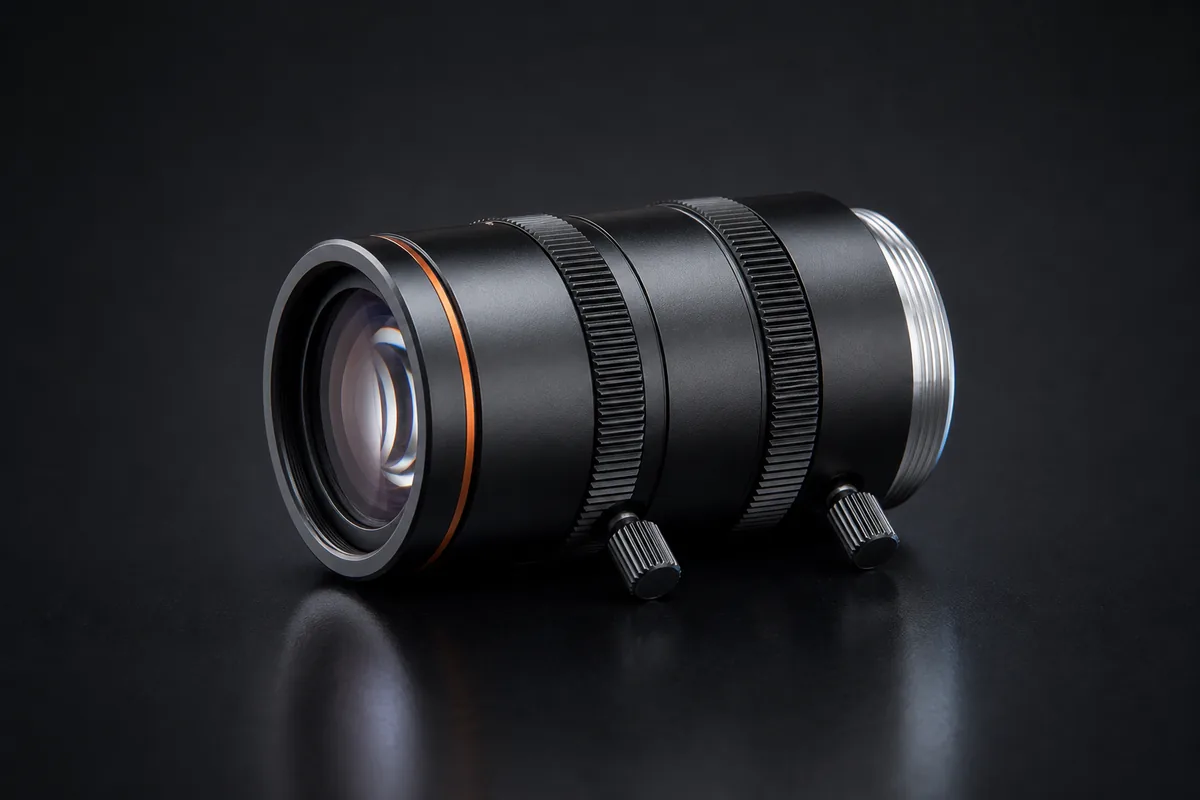
2/3″ is the format of 5–10 MP cameras with larger pixels: at the same resolution the sensor collects more light, so exposure can be shorter and a moving conveyor is captured without blur. Focal lengths from 8 to 75 mm, C-mount. Such a lens also covers smaller formats — 1/1.8″, 1/2″, 1/2.5″ — which is why it is chosen when the camera may still change.
- Warranty
- 36 months
Specifications
| Operating temperature | –10 °C to 50 °C (14 °F to 122 °F); –20 °C to 70 °C (–4 °F to 158 °F) |
| Iris control | Manual; Manuals |
| Focus control | Manual |
| Flange focal length | 17.526 mm |
Part numbers and versions
| Part number | PN | Focal length | Aperture | Format | Mount | MOD | |
|---|---|---|---|---|---|---|---|
| MVL-MF0824M-5MPE | 310100768 | 8 mm | F2.4 to F16 | Ø 11 mm (2/3") | C-mount | 0.1 m | |
| MVL-MF0824M-8MPS | 310103005 | 8 mm | F2.4 to F16 | Ø11.0 mm (2/3’’) | C-mount | 0.1 m | |
| MVL-MF0828M-10MPE | 310102367 | 8 mm | F2.8 to F16 | Φ11.2 mm (2/3") | C-mount | 0.1 m | |
| MVL-MF0828M-8MP | 310100626 | 8 mm | F2.8 to F16 | Ø11 mm (2/3") | C-mount | 0.1 m | |
| MVL-MF1224M-5MPE | 310100769 | 12 mm | F2.4 to F16 | Ø 11 mm (2/3") | C-mount | 0.15 m | |
| MVL-MF1228M-10MPE | 310102368 | 12 mm | F2.8 to F16 | Φ11.2 mm (2/3") | C-mount | 0.1 m | |
| MVL-MF1228M-8MP | 310100627 | 12 mm | F2.8 to F16 | Ø11 mm (2/3") | C-mount | 0.1 m | |
| MVL-MF1228M-8MPS | 310102702 | 12 mm | F2.8 to F16 | Φ11 mm (2/3’’) | C-mount | 0.1 m | |
| MVL-MF1618M-5MPE | 310100770 | 16 mm | F1.8 to F16 | Ø 11 mm (2/3") | C-mount | 0.2 m | |
| MVL-MF1628M-10MPE | 310102369 | 16 mm | F2.8 to F16 | Φ11.2 mm (2/3") | C-mount | 0.1 m | |
| MVL-MF1628M-8MP | 310100628 | 16 mm | F2.8 to F16 | Ø11 mm (2/3") | C-mount | 0.1 m | |
| MVL-MF1628M-8MPS | 310102703 | 16 mm | F2.8 to F16 | Φ11 mm (2/3’’) | C-mount | 0.1 m | |
| MVL-MF2518M-5MPE | 310100771 | 25 mm | F1.8 to F16 | Ø 11 mm (2/3") | C-mount | 0.2 m | |
| MVL-MF2528M-10MPE | 310102370 | 25 mm | F2.8 to F16 | Φ11.2 mm (2/3") | C-mount | 0.15 m | |
| MVL-MF2528M-8MP | 310100629 | 25 mm | F2.8 to F16 | Ø11 mm (2/3") | C-mount | 0.1 m | |
| MVL-MF3518M-5MPE | 310100772 | 35 mm | F1.8 to F16 | Ø 11 mm (2/3") | C-mount | 0.25 m | |
| MVL-MF3528M-10MPE | 310102371 | 35 mm | F2.8 to F16 | Φ11.2 mm (2/3") | C-mount | 0.15 m | |
| MVL-MF3528M-8MP | 310100630 | 35 mm | F2.8 to F16 | Ø11 mm (2/3") | C-mount | 0.15 m | |
| MVL-MF5028M-10MPE | 310102377 | 50 mm | F2.8 to F16 | Φ11.2 mm (2/3") | C-mount | 0.237 m | |
| MVL-MF5028M-5MPE | 310100773 | 50 mm | F2.8 to F16 | Ø 11 mm (2/3") | C-mount | 0.4 m | |
| MVL-MF5028M-8MP | 310100631 | 50 mm | F2.8 to F16 | Ø11 mm (2/3") | C-mount | 0.4 m | |
| MA7520M-5MP | 102200963 | 75 mm | F2.0 to F22 | Ø11 mm (2/3") | C-mount | 0.9 m |
How to choose
These lenses have an 11 mm image circle; a 2/3″ sensor is about 8.5 mm wide (check your camera datasheet for the exact figure). The estimate is the same: f ≈ WD × sensor width / field width, with the exact field taken from the lens FOV table. Watch the minimum object distance: closer than that there is no focus, and an extension ring buys closer focus only at the cost of infinity.
FAQ
How is the first focal-length estimate calculated for this format?
Use f approximately equal to working distance multiplied by sensor width and divided by field width. About 8.5 mm is given as a typical 2/3-inch sensor width, but the camera value and the selected lens FOV table are needed for the final field calculation.
Can these lenses cover camera formats smaller than 2/3 inch?
Yes. The 2/3-inch coverage class also covers 1/1.8-inch, 1/2-inch, and 1/2.5-inch sensors. The listed image circles are around 11 mm, with 10MPE models at 11.2 mm, so sensor format should still be checked against the exact lens entry.
Why are several lenses offered at the same focal length?
Repeated focal lengths carry different 5MPE, 8MP, 8MPS, or 10MPE designations and can differ in maximum aperture, stated image circle, and minimum object distance. At 16 mm, for example, the maximum aperture is F1.8 on MVL-MF1618M-5MPE and F2.8 on the other listed variants.
What minimum object distance must be allowed for focusing?
The value depends on the lens. Many 8–16 mm entries focus from 0.1 m, while listed longer lenses reach 0.15 m, 0.2 m, 0.237 m, 0.25 m, 0.4 m, or 0.9 m. Compare the available working distance with the exact model rather than with focal length alone.
What is the consequence of using an extension ring?
An extension ring allows focus closer than the lens's normal minimum object distance, but infinity focus is lost. Treat it as a change to the focusing range, not as a substitute for checking whether the selected 8–75 mm lens can focus at the planned working distance.