Line scan camera · CL series
Hikrobot MV-CL024-91GC
- Warranty
- 36 months
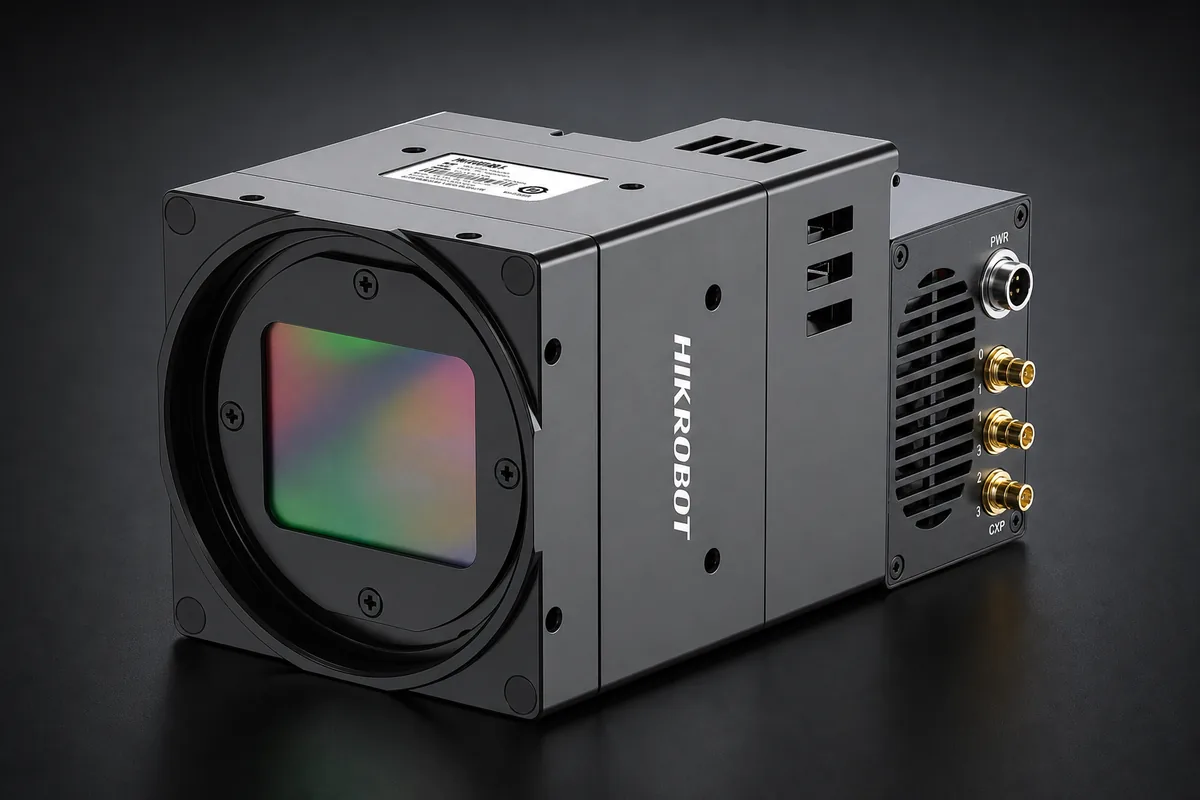
Three-row color capture and positioning
Three-row color acquisition at a 2048-pixel line length is the defining capability of MV-CL024-91GC. The CMOS array uses 7 × 7 µm pixels, provides Mono 8, Bayer RG 8/10/12, RGB 8 and BGR 8 formats, and reaches 58 kHz in standard operation or 70 kHz in high-bandwidth Bayer RG 8/Mono 8. Data runs over Gigabit Ethernet with Fast Ethernet compatibility.
The camera fits moving-material inspection where color channels distinguish print, coating, or component markings and the line rate must follow steady transport. Exposure adjustment from 3 µs to 10 ms supports different illumination and motion conditions. Four configurable I/O lines accept single-ended or differential signals for coordination with the transport, while the 62 × 62 × 40.5 mm IP40 body fits protected machine spaces.
MV-CL022-91GC has the same 2048-pixel color role but uses larger 14 µm pixels, a 2048 × 2 array and a 40 kHz ceiling. MV-CL024-91GM shares the 7 µm pitch and 58 kHz standard rate, but provides mono 1-line or 2-TDI acquisition and rises to 86 kHz in high-bandwidth mode. MV-CL043-A1GC moves to 4096 × 3 color capture over Gigabit Ethernet when more samples are needed across the web.
Specifications
| Sensor type | CMOS |
| Resolution | 2048 × 3 px |
| Pixel size | 7 × 7 μm |
| Mono/color | Color |
| Pixel format | Mono 8, Bayer RG 8/10/12, RGB 8, BGR 8 |
| Dynamic range | 68 dB |
| Exposure time | 3 μs to 10 ms |
| SNR | 44.7 dB |
| Data interface | Gigabit Ethernet (1000 Mbit/s), compatible with Fast Ethernet (100 Mbit/s) |
| Digital I/O | 4 configurable input/output lines; single-ended/differential supported |
| Lens mount | M42*1.0 |
| Power supply | 12 to 24 VDC |
| Power consumption | 5.7 W |
| Ingress protection | IP40 |
| Operating temperature | -20 to 55 °C |
| Storage temperature | -30 to 80 °C |
| Humidity | 5 to 90 % RH |
| Dimensions | 62 × 62 × 40.5 mm |
| Weight | 256 g |
| Flange back length | 12 mm |
| Max line rate (high-bandwidth, bayer rg 8/mono 8) | 70 kHz |
| Max line rate (standard, mono 8/bayer rg 8) | 58 kHz |
Selection and applications
Three-row color web inspection. Fast Bayer line acquisition. Color print and coating checks.
Minimum kit: Install the MV-CL024-91GC camera with an M42*1.0 line-scan lens, a Gigabit Ethernet cable, and a 12 V DC to 24 V DC supply.
Nearby in the range: MV-CL022-91GC — Prefer it for 14 µm color pixels at a 40 kHz ceiling.; MV-CL024-91GM — Prefer it when mono 2-TDI capture replaces color separation.; MV-CL043-A1GC — Prefer it for a 4096 × 3 color line over Gigabit Ethernet..
Cables and accessories for this model
Compatibility per manufacturer data.
- Power
- Power
- Mounting
- Camera mounts
FAQ
Which color output formats are available from MV-CL024-91GC?
The listed formats are Bayer RG 8/10/12, RGB 8 and BGR 8, with Mono 8 also available. At full operation the camera reaches 58 kHz in standard Bayer RG 8/Mono 8 and 70 kHz in the corresponding high-bandwidth mode.
What lens interface and back focus does MV-CL024-91GC require?
The optical interface is M42*1.0 with a 12 mm flange back length. Lens selection should cover the 2048 × 3 color sensor and resolve its 7 × 7 µm pixels across the intended inspected width.
How should MV-CL024-91GC be cabled and powered in a machine?
Use a Gigabit Ethernet connection for image data and a separate 12 V DC to 24 V DC supply. Power consumption is 5.7 W. Four configurable input/output lines are available with single-ended or differential electrical signaling.
What exposure and environment ranges constrain MV-CL024-91GC use?
Exposure is adjustable from 3 µs to 10 ms. The working range is -20 °C to 55 °C at 5% RH to 90% RH, and storage is -30 °C to 80 °C. Its IP40 rating calls for protection from liquid and significant dust exposure.
Why choose MV-CL024-91GC instead of MV-CL022-91GC for color?
MV-CL024-91GC combines a 2048 × 3 array, 7 µm pixels and a 70 kHz high-bandwidth ceiling. MV-CL022-91GC uses 2048 × 2, 14 µm pixels and a 40 kHz ceiling, so the selection turns on the three-row arrangement, pixel pitch and required rate.