Line scan camera · CL Series
Hikrobot MV-CL043-A1GC
- Lead time
- from 5 days
- Warranty
- 36 months
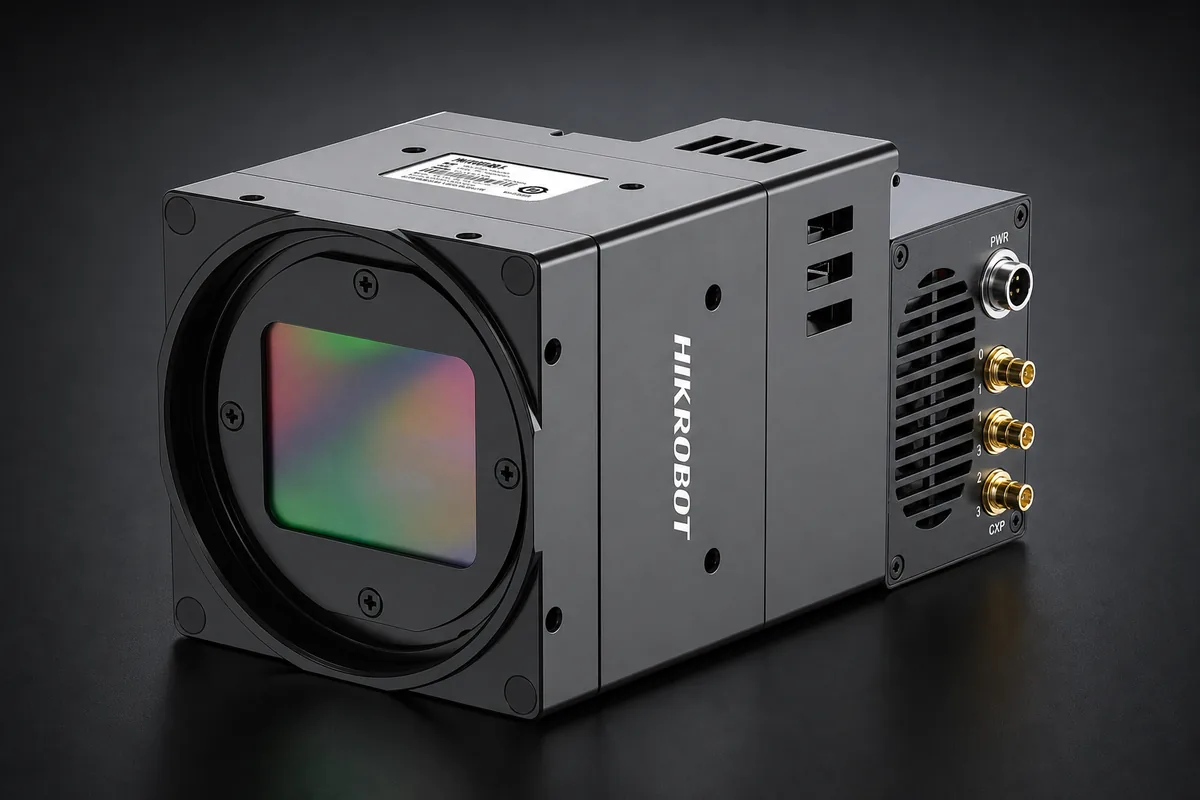
4K three-row color on Gigabit Ethernet
Three-row color capture over a 4096-pixel CMOS line gives MV-CL043-A1GC its specific place in the networked range. The 4096 × 3 array uses 7 × 7 µm pixels and supports a 1-Line scan. Standard operation reaches 28 kHz in Bayer 8 or Mono 8 and 9 kHz in RGB 8/BGR 8; after a reduced region of interest, RGB 8/BGR 8 can reach 40 kHz.
The combination suits continuous print, coating or color-feature inspection where an Ethernet acquisition host is preferred and the output format can be selected around throughput. Exposure spans 3 µs to 10 ms, while gain settings of 1.0×, 2.0× and 4.0× support illumination adjustment. Four configurable I/O lines on the 12-pin P10 connection allow single-ended or differential timing with the moving target.
MV-CL024-91GC offers a shorter 2048 × 3 color line but runs at 70 kHz in high-bandwidth Bayer RG 8/Mono 8. MV-CL044-91NC keeps 4096 × 3 resolution, changes the link to 2.5 Gigabit Ethernet and reaches 75.3 kHz, with PoE support. For an 8192 × 3 color line over the same 2.5 Gigabit Ethernet family, MV-CL084-B1NC provides 37.6 kHz in full-resolution Mono 8/Bayer RG 8.
Specifications
| Sensor resolution | 4096×3 px |
| Maximum line rate | ≤28000 Hz @ Bayer8/Mono8, standard mode; ≤9000 Hz @ RGB8/BGR8, standard mode; ≤40000 Hz @ RGB8/BGR8, in ROI mode |
| Line/TDI image mode | single line |
| Color mode | color |
| Lens mount | M42×1 |
| Data interface | GigE (Fast Ethernet compatible) |
| Sensor technology | CMOS |
| Pixel size | 7×7 µm |
| Dynamic range | 66.2 dB |
| Signal-to-noise ratio | 39 dB |
| Exposure time | 3…10000 µs |
| Auto exposure | Off, Once, Continuous, trigger width |
| Linear gain factor | 1; 2; 4 |
| Pixel format | BayerRG8, RGB8, BGR8, Mono8 |
| Binning | 1x1, 1x2, 1x4, 2x1, 2x2, 2x4, 4x1, 4x2, 4x4 |
| Trigger mode | external, internal; line @ external trigger; frame @ external trigger; line, frame @ external trigger |
| Flange focal distance | 12 ±0.15 mm |
| Protocol compatibility | GigE Vision, GenICam |
| Communication protocol versions | GigE Vision 2.0 |
| Third party software protocol | GigE Vision |
| Client software | MVS |
| Operating systems | Windows 7 (32/64-bit), Windows 10 (32/64-bit), Windows 11 (64-bit), Linux (32/64-bit) |
| Digital I/O lines | 4 bidirectional lines, single-ended, differential, lines 0, 1, 3, 4 |
| Digital I/O connector | P10 12-pin |
| Power supply | 12…24 V |
| Power consumption | 4.2 W (typical) @ DC, supply voltage 12 V |
| Ingress protection | IP40 @ with lens and cables properly installed |
| Working temperature | -20…50 °C |
| Storage temperature | -30…80 °C |
| Humidity | 5…90 % @ non-condensing |
| Dimensions | 62×62×41 mm |
| Weight | 280 g (approx.) |
| Certification | CE, RoHS, KC |
| Mounts via adapter | F-mount (via adapter); C-mount (via adapter) |
| Reverse image | horizontal |
Documents
Engineering data for this model
Calculated by the MVisionPro engineering tools from the passport data of this model for typical tasks. The figures are estimates for preliminary selection.
Engineering conclusion: At 500 mm/s and 0.1 mm longitudinal sampling, the working rate is 6000 Hz; the confirmed mode allows 28000 Hz (460 % reserve against the un-margined requirement).
Note: This comparison uses explicit two-axis sampling and the listed passport line-rate mode; it does not claim encoder or CIS sizing.
Line rate by web speed
| Task | Required line width | Required line rate | Working line rate (with margin) | Confirmed mode | Reserve |
|---|---|---|---|---|---|
| 200 mm web at 30 m/min | 2000 px | 5000 Hz | 6000 Hz | 28000 Hz | 460 % |
| 500 mm web at 60 m/min | 2500 px | 5000 Hz | 6000 Hz | 28000 Hz | 460 % |
| 1000 mm web at 120 m/min | 2000 px | 4000 Hz | 4800 Hz | 28000 Hz | 600 % |
Sampling step and exposure
| Task | Sampling step (cross / along) | Exposure limit |
|---|---|---|
| 200 mm web at 30 m/min | 0.1 mm / 0.1 mm | 133.33 µs |
| 500 mm web at 60 m/min | 0.2 mm / 0.2 mm | 133.33 µs |
| 1000 mm web at 120 m/min | 0.5 mm / 0.5 mm | 166.67 µs |
Compatible cables
| Type | Model | What was checked |
|---|---|---|
| Cable | MV-ACC-01-1101-5m | Data role, interface family, connector path and 5 m length |
| Cable | MV-ACG-RJ45s(up)-RJ45-HF-5m | Data role, interface family, connector path and 5 m length |
| Cable | MV-ACG-RJ45s(up)-RJ45-ST-5m | Data role, interface family, connector path and 5 m length |
| Cable | MV-ACG-RJ45s-RJ45-HF-5m | Data role, interface family, connector path and 5 m length |
How these figures were calculated
- Assumption: Cross-web and along-motion sampling steps are distinct.
- Assumption: The working line rate includes the explicitly selected engineering margin.
- Assumption: Motion speed is constant along the selected motion axis.
- Warning: Spatial sampling is an engineering estimate; measurement performance must be confirmed by calibration.
- Assumption: A selected camera is checked only against its passport interface profile.
Engineering tools
Selection and applications
4K three-row color inspection. GigE Bayer web scanning. Reduced-width RGB capture.
Minimum kit: Use the MV-CL043-A1GC camera, an M42*1.0 line-scan lens or adapted C-mount/F-mount optic, a Gigabit Ethernet cable, and a 12 V DC to 24 V DC supply through the 12-pin P10 connector.
Nearby in the range: MV-CL024-91GC — Prefer it for a shorter 2048 × 3 line at up to 70 kHz; MV-CL044-91NC — Prefer it for 4096 × 3 capture over 2.5 Gigabit Ethernet with PoE; MV-CL084-B1NC — Prefer it when the color line must extend to 8192 pixels.
Cables and accessories for this model
Compatibility per manufacturer data.
- Data cables
- GigE
- I/O & power cables
- 12-pin IO
- Power
- Power
- Mounting
- Camera mounts
FAQ
How does output format change MV-CL043-A1GC line rate?
In standard operation Bayer 8 and Mono 8 reach 28 kHz, while RGB 8 and BGR 8 reach 9 kHz. RGB 8/BGR 8 can reach 40 kHz after reducing the region of interest, so full-line output and reduced-width output must be distinguished.
What lens connection and back focus apply to MV-CL043-A1GC?
The native optical interface is M42*1.0 with a 12 mm flange back length. F-mount, C-mount and other lens types may be attached through an adapter, with coverage selected for the 4096 × 3 array and 7 µm pixels.
How much electrical power does MV-CL043-A1GC require?
The camera accepts 12 V DC to 24 V DC and has typical consumption of 4.2 W at 12 V DC. Power and four configurable I/O lines share the 12-pin P10 connector, while image data uses the separate Gigabit Ethernet link.
Which operating limits matter for an MV-CL043-A1GC enclosure?
Operation is specified from -20 °C to 50 °C and 5% RH to 90% RH without condensation; storage is -30 °C to 80 °C. IP40 applies with proper lens installation and wiring, requiring external control of liquid and heavy dust exposure.
When should MV-CL044-91NC replace MV-CL043-A1GC in a design?
Both provide a 4096 × 3 CMOS array with 7 µm pixels. MV-CL043-A1GC uses Gigabit Ethernet and reaches 28 kHz at standard Bayer 8/Mono 8, while MV-CL044-91NC uses 2.5 Gigabit Ethernet and reaches 75.3 kHz.