Frame grabber · 10 GigE
Hikrobot MV-GQ1001
- Warranty
- 36 months
Single-camera 50 Gbit/s acquisition
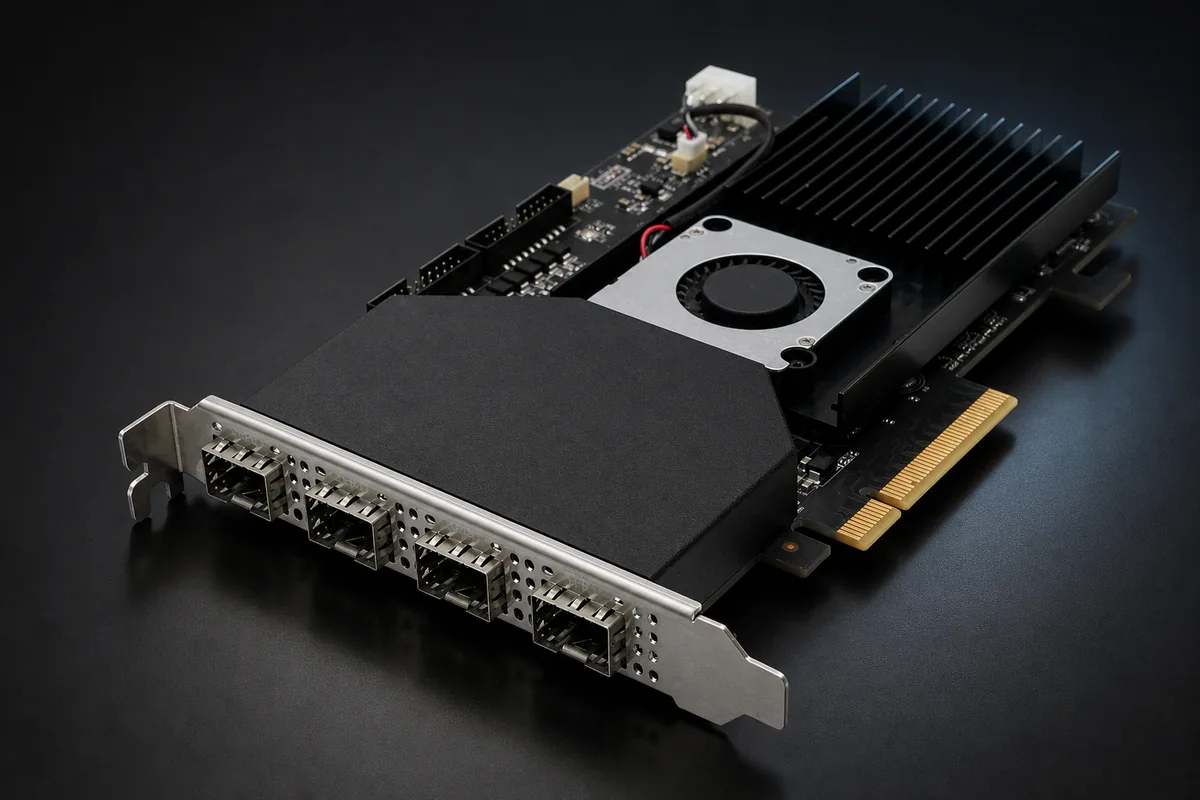
A single 50 Gbit/s XoFLink camera stream is the defining workload for MV-GQ1001. The board receives data through one QSFP28 optical-module interface and an MPO fiber port, buffers it in 8 GB of DDR4 memory, and transfers it to the host over PCI-E gen3 × 8. Maximum host transmission bandwidth is 7800 MB/s, with 6700 MB/s sustained.
This architecture fits one high-data-rate camera used for continuous line-scan acquisition, high-throughput inspection or synchronized image capture. Eight configurable I/O connectors accept single-ended or differential signals; the listed line groups support inputs from 3.3 V to 12 V or 24 V and outputs from 3.3 V to 24 V. Typical board consumption is 18.5 W, and operation is specified from 0 to 60 °C.
MV-GS1104F spreads 40 Gbit/s across four 10 Gbit/s SFP+ ports and sustains the same 6700 MB/s through PCI-E gen3 × 8, but carries 4 GB memory. MV-GS1004F V3.0 offers four SFP+ ports with 27 Gbit/s total and 3200 MB/s sustained over PCI-E gen3 × 4. Choose MV-GQ1001 when one QSFP28/MPO XoFLink connection at 50 Gbit/s and 8 GB buffering are the governing requirements.
Specifications
| Camera ports | 1×QSFP28 |
| Cameras supported | 1 per frame grabber |
| Camera connection speed | 50 Gbps |
| Interconnect | PCI-E gen3 × 8 |
| Delivery bandwidth | 7800 MB/s (max. transmission bandwidth), 6700 MB/s (sustained transmission bandwidth) |
| On-board memory | 8 GB DDR4-RAM |
| Trigger I/O | Provides 8 configurable I/O connectors, compatible with single-ended/differential signals. Line 0/1/4/5/6/7 supports input (3.3 V to 12 V) and output (3.3 V to 24 V) Line 2/3 supports input and output (3.3 V to 24 V) |
| Data interface | MPO fiber port |
| Power consumption | 18.5 W typ. |
| Operating temperature | 0 to 60 °C |
| Storage temperature | -20 to 70 °C |
| Humidity | 10 to 95 % RH |
| Dimensions | 181 × 126.3 × 21.6 mm |
| Certification | CE-EMC,KC |
| Camera interface protocol | XoFLink |
| Optical module interface | QSFP28 × 1 |
| Supported OS | Windows 7/10/11, Ubuntu 16.04 to 20.04 on Linux |
| Client software | MVS |
| SDK | SDK for secondary development |
Selection and applications
Single-camera 50 Gbit/s acquisition. High-throughput line-scan capture. Triggered optical-link inspection.
Minimum kit: Install MV-GQ1001 in a PCI-E gen3 × 8 host slot, connect one XoFLink camera through QSFP28 and MPO fiber, and provide host power for 18.5 W typical consumption.
Nearby in the range: MV-GS1104F — Prefer it when four 10 Gbit/s SFP+ links and 40 Gbit/s aggregate camera speed are required.; MV-GS1004F V3.0 — Prefer it for four SFP+ ports, 27 Gbit/s total camera speed and PCI-E gen3 × 4..
FAQ
What camera link and optical connection does MV-GQ1001 accept?
The camera protocol is XoFLink, presented through one QSFP28 optical-module interface and an MPO fiber port. The board supports one camera connection at 50 Gbit/s, so the optical link must match that interface.
How much image data can the board sustain toward the host?
Host transfer is listed at 7800 MB/s maximum and 6700 MB/s sustained through PCI-E gen3 × 8. The board also carries 8 GB DDR4 memory to buffer the single incoming camera stream during acquisition.
Which trigger voltages are handled by the configurable I/O?
There are 8 configurable I/O connectors for single-ended or differential signals. Lines 0, 1, 4, 5, 6 and 7 accept 3.3 V to 12 V inputs and provide 3.3 V to 24 V outputs; lines 2 and 3 accept and output 3.3 V to 24 V.
What host slot and power provision are needed for this grabber?
MV-GQ1001 uses a PCI-E gen3 × 8 interconnect and consumes 18.5 W typically. The host must provide that slot width and thermal handling within the board's 0 to 60 °C working range.
Which operating systems and acquisition tools are listed?
Operating-system support covers Windows 7, Windows 10, Windows 11 and Ubuntu 16.04 through 20.04 on Linux. MVS client software and an SDK for secondary development are listed for acquisition and integration.