Frame grabber · 10 GigE
Hikrobot MV-GS1002F V3.0
- Warranty
- 36 months
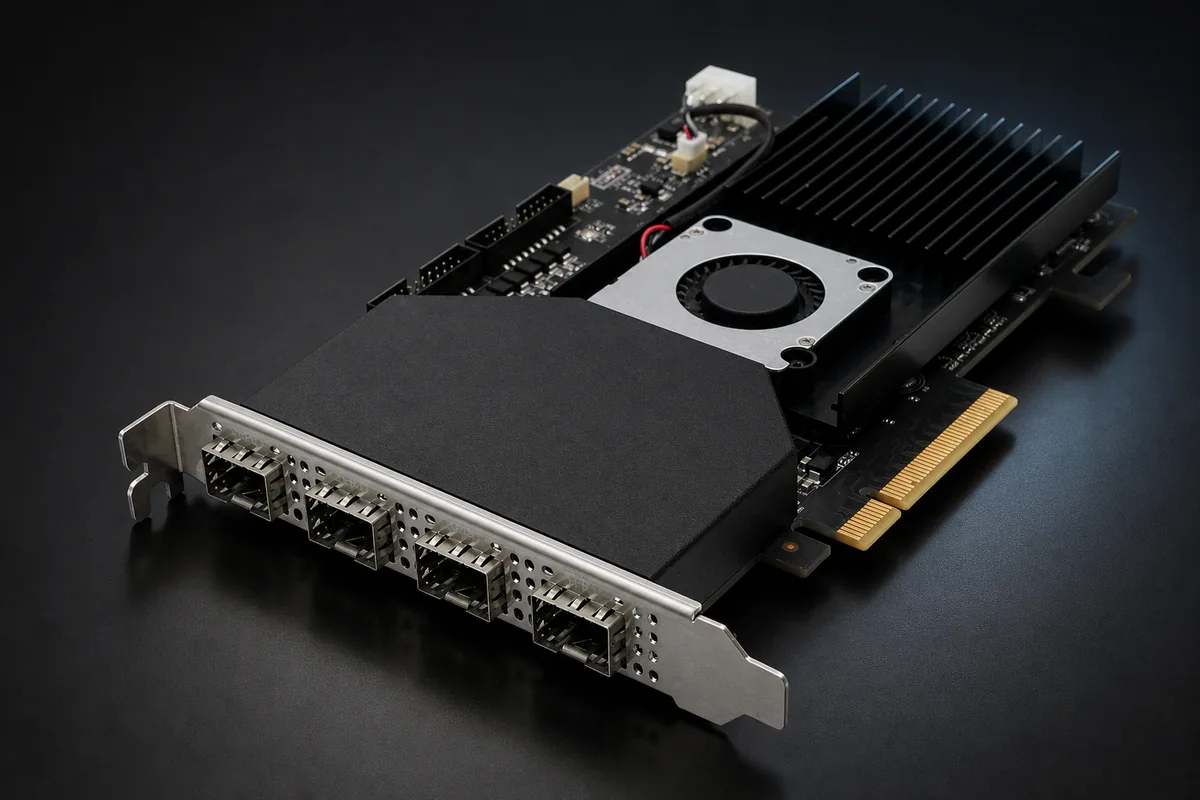
Dual-port XoFLink acquisition placement
Two SFP+ camera interfaces give MV-GS1002F V3.0 a focused role in XoFLink acquisition. Each port runs at 10 Gbit/s, with 20 Gbit/s total camera bandwidth, while 2 GB DDR4 memory buffers one or two streams. The PCI-E gen3 × 4 host path is rated for 4000 MB/s maximum and 3200 MB/s sustained transmission.
The board suits dual-camera inspection, paired line-scan stations and synchronized acquisition where fiber links separate cameras from the processing host. Eleven configurable I/O connections support single-ended or differential signaling and cascading of multiple frame grabbers. Bracket lines accept 3.3 V to 24 V inputs, while the card consumes 9.8 W and works from 0 to 60 °C.
MV-GS1004F V3.0 doubles the SFP+ count to four and raises total camera bandwidth to 27 Gbit/s, retaining 3200 MB/s sustained host transfer. MV-GS1104F also has four ports but moves to PCI-E gen3 × 8, 4 GB memory and 6700 MB/s sustained transfer. Select MV-GS1002F V3.0 for one or two XoFLink cameras when two SFP+ ports and the lower 9.8 W board consumption fit.
Specifications
| Camera ports | SFP+ ×2 |
| Cameras supported | 1/2 |
| Camera connection speed | 10 Gbps for single port, 20 Gbps in total |
| Interconnect | PCI-E gen3 × 4 |
| Delivery bandwidth | 4000 MB/s (max. transmission bandwidth), 3200 MB/s (sustained transmission bandwidth) |
| Sustained transmission bandwidth | 3200 MB/s |
| On-board memory | 2 GB DDR4 |
| Protocol | XoFLink |
| Trigger I/O | Provides 11 configurable I/O connectors, compatible with single- ended/differential signals, and supports cascading of multiple frame grabbers. I/O on bracket: Line 0 to Line 7 supports input (3.3 V to 24 V) and output (max. 24 V) I/O on PCB: Line 8 to Line 10 supports input (3.3 V to 12 V) and output (3.3 V) |
| Power consumption | 9.8 W |
| Operating temperature | 0 °C to 60 °C |
| Storage temperature | –20 °C to 70 °C |
| Humidity | 10% RH to 95% RH (no condensation) |
| Dimensions | 181 mm × 126.3 mm × 21.6 mm |
| Certification | CE-EMC,KC |
| SFP+ modules | 2 |
| Supported OS | Windows 7/10/11, Ubuntu 16.04 to 22.04 on Linux |
| Client software | MVS |
| SDK | SDK for secondary development |
Selection and applications
Dual-camera fiber acquisition. Synchronized XoFLink inspection. Cascaded frame-grabber triggering.
Minimum kit: Fit the board in a PCI-E gen3 × 4 slot, connect one or two XoFLink cameras through its SFP+ ports, and provide host power for 9.8 W consumption.
Nearby in the range: MV-GS1004F V3.0 — Prefer it when as many as four SFP+ cameras and 27 Gbit/s aggregate link speed are needed.; MV-GS1104F — Prefer it for 40 Gbit/s total camera speed and 6700 MB/s sustained host transfer..
FAQ
How many XoFLink cameras can MV-GS1002F V3.0 connect?
The board supports one or two cameras through 2 SFP+ interfaces. Each link runs at 10 Gbit/s and the combined camera connection speed is 20 Gbit/s, with 2 GB DDR4 memory available on the board.
What sustained host bandwidth is available over PCI Express?
The PCI-E gen3 × 4 interface provides 4000 MB/s maximum transmission bandwidth and 3200 MB/s sustained transmission bandwidth. Host storage and processing should be arranged around the sustained figure for continuous acquisition.
How is trigger and synchronization wiring accommodated?
Eleven configurable I/O connectors accept single-ended or differential signals and allow multiple grabbers to be cascaded. Bracket lines 0 through 7 support input from 3.3 V to 24 V and output up to 24 V.
What are the operating limits and board power consumption?
Power consumption is 9.8 W. Working temperature spans 0 to 60 °C, storage temperature spans -20 to 70 °C, and allowable humidity is 10% RH to 95% RH without condensation.
Which software platforms can host this two-port board?
The listed platforms are Windows 7, Windows 10, Windows 11 and Ubuntu 16.04 through 22.04 on Linux. MVS client software and an SDK for secondary development are included in the integration information.