Frame grabber · GigE frame grabber
Hikrobot MV-GT2102
- Warranty
- 36 months
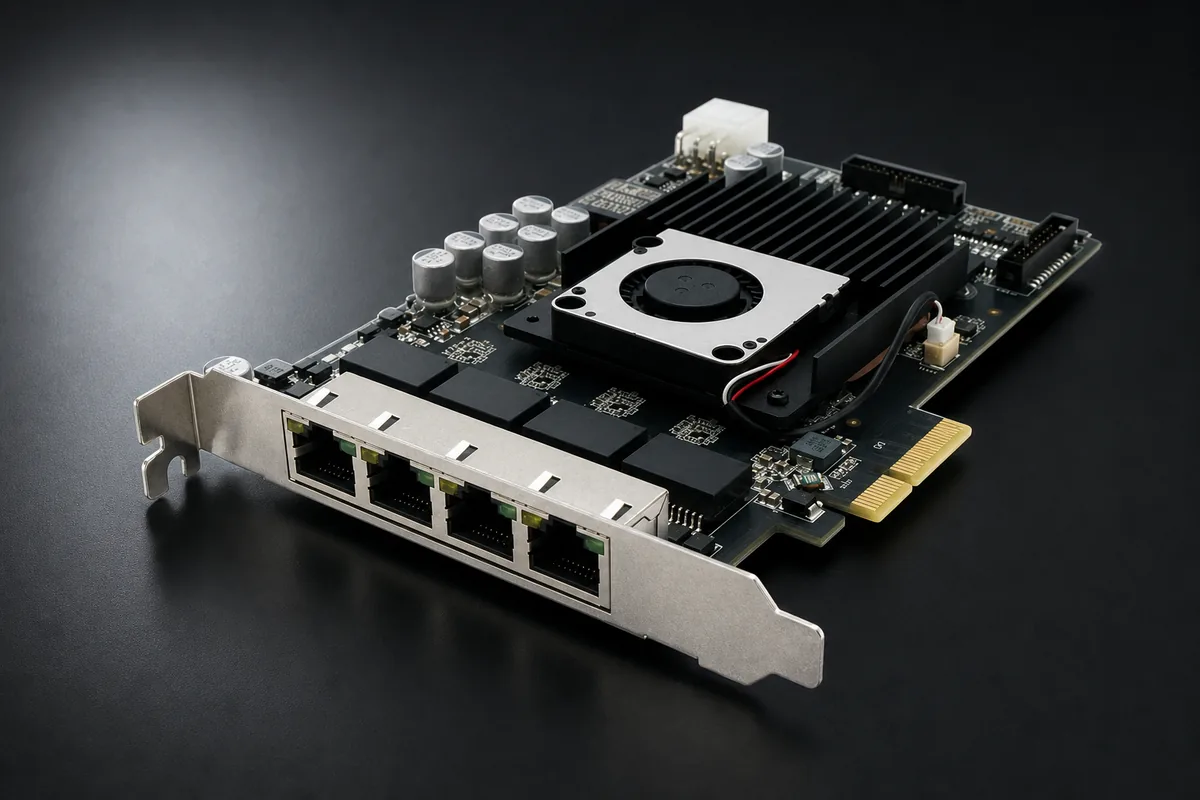
Dual-RJ45 host bandwidth role
Two RJ45 camera interfaces feeding a PCI-E gen3 × 4 host connection define the MV-GT2102 acquisition architecture. The card provides a maximum transfer bandwidth of 4000 MB/s and a continuous figure of 3200 MB/s. This combination positions it for a dual-link imaging host sized around the documented maximum and continuous board-to-computer rates.
The two physical camera connections suit an inspection computer that must receive a pair of RJ45 image links through one PCI-E slot. A 3200 MB/s continuous path allows system sizing around sustained transfer rather than the 4000 MB/s maximum alone. Integration should therefore begin by reserving a PCI-E gen3 × 4 connection, mapping one camera cable to each RJ45 port, and checking the connected equipment's own link and power requirements.
MV-GT2102P is the direct powered-interface neighbour: it retains two RJ45 ports, PCI-E gen3 × 4, 4000 MB/s maximum and 3200 MB/s continuous transfer, while explicitly adding PoE support. Choose MV-GT2102 when the acquisition design only depends on the documented dual-port host path. Choose MV-GT2102P when the camera connections must also support PoE. MV-GU2104 is the alternative when four USB3.0 type-A ports at 5 Gbit/s are required instead of two RJ45 ports.
Overview
A two-port RJ45 network frame grabber for GigE cameras. It goes into a PCI Express gen3 ×4 slot and takes the stream from two cameras without frame loss: acquisition bypasses the system network stack, so CPU load stays low even at full rate.
Choose it when the onboard ports are too few, or when their throughput is not enough for stable acquisition.
Specifications
| Camera ports | RJ45 × 2 |
| Interconnect | PCI-E gen3 × 4 |
| Delivery bandwidth | 4000 MB/s(max. transmission bandwidth); 3200 MB/s(continuous transmission bandwidth) |
Selection and applications
Dual-RJ45 image acquisition. Continuous high-bandwidth host transfer. Two-link inspection data intake.
Minimum kit: Use MV-GT2102 in a host with a PCI-E gen3 × 4 connection, attach the required cameras through two matching RJ45 cables, and provide the power arrangement specified for those cameras.
Nearby in the range: MV-GT2102P — Prefer it when the same dual-RJ45 host path must also support PoE.; MV-GU2104 — Prefer it for four USB3.0 type-A camera ports at 5 Gbit/s..
FAQ
How many camera connectors are provided on MV-GT2102?
MV-GT2102 presents two RJ45 camera interfaces. Both enter the host through the board's PCI-E gen3 × 4 interconnect, creating a two-connection acquisition layout on one card.
What continuous transfer bandwidth is stated for MV-GT2102?
The continuous transmission figure is 3200 MB/s. Maximum transmission bandwidth is 4000 MB/s, so sustained host-path planning should use the separately stated continuous value.
Which PCI-E slot connection does the MV-GT2102 card use?
The required interconnect is PCI-E gen3 × 4. That host path carries traffic from both RJ45 camera interfaces and is associated with 4000 MB/s maximum and 3200 MB/s continuous transfer.
How does MV-GT2102 differ from the MV-GT2102P variant?
Both cards have two RJ45 camera interfaces, PCI-E gen3 × 4 and the same 4000 MB/s maximum and 3200 MB/s continuous figures. MV-GT2102P additionally lists PoE support.
What should be checked when sizing an MV-GT2102 host path?
Reserve the documented PCI-E gen3 × 4 connection and size sustained movement around 3200 MB/s rather than only the 4000 MB/s maximum. The two incoming physical connections are RJ45.
When is a four-port USB board preferable to MV-GT2102?
MV-GU2104 is preferable when the camera side requires four USB3.0 type-A ports at 5 Gbit/s. MV-GT2102 instead provides two RJ45 camera interfaces and a 3200 MB/s continuous PCI-E gen3 × 4 host path.