Frame grabber · USB
Hikrobot MV-GU2204
- Warranty
- 36 months
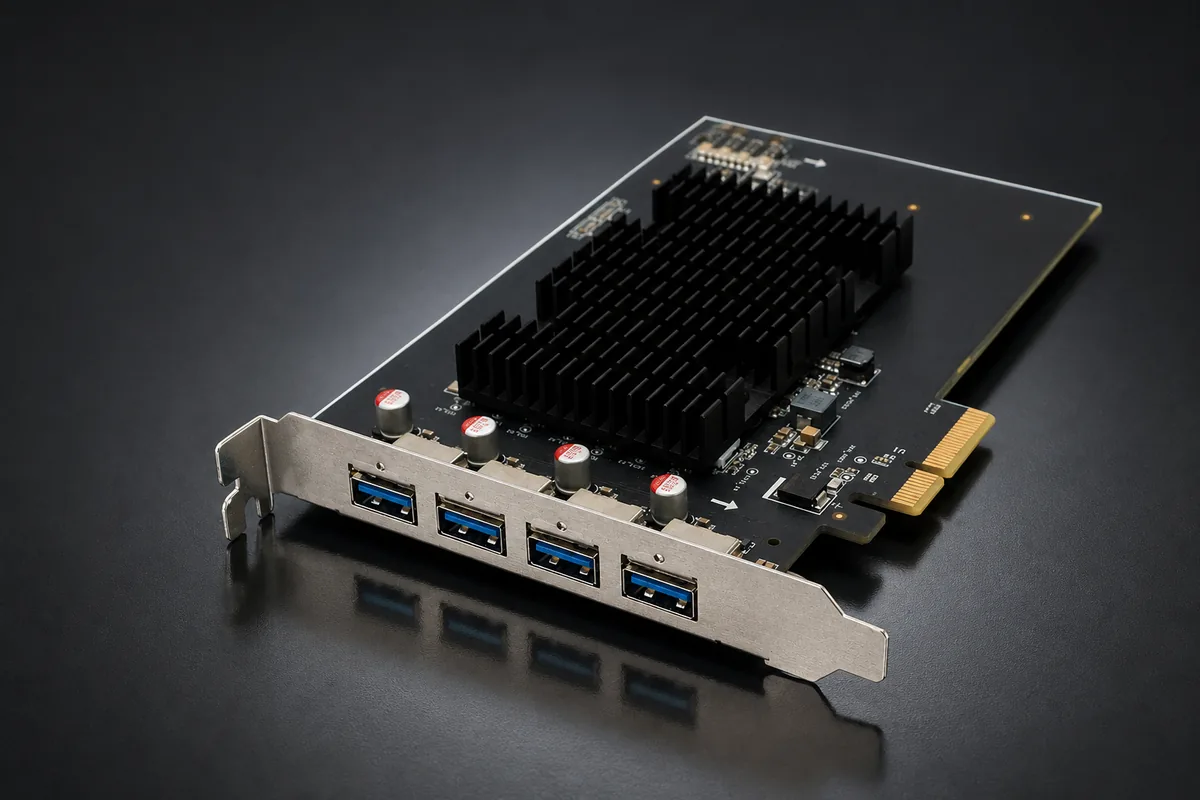
Reduced-size four-port USB path
Four 5 Gbit/s USB3.0 type-A camera links in a 165.5 × 120 × 22 mm board define MV-GU2204 as the shorter full-height USB acquisition option. PCI-E gen2 × 4 carries a maximum of 1720 MB/s and sustains 1600 MB/s to the host. Each port can supply 4.5 W at 5 V DC, while board consumption is 5.5 W without USB power or 23.5 W with that power included.
The card supports a four-camera inspection computer where several USB image sources need separate ports and a common host-transfer path. At approximately 143.6 g, it reduces mechanical load compared with MV-GU2104. The board operates from 0 to 60 °C and at 10 to 95% RH. Its stated Windows 7/10/11 support is specifically on Intel platforms, a host-selection detail to resolve before the acquisition computer is fixed.
MV-GU2204 and MV-GU2204L share port count, link speed, power output, transfer bandwidth and 5.5/23.5 W consumption. The L variant changes the dimensions to 165.9 × 80.1 × 22 mm and weighs about 140 g, making it the lower-profile choice. MV-GU2104 is larger at 181.1 × 126.3 × 21.6 mm and 160 g, consumes 6/24 W, and adds Linux to the operating-system list. Select the board that matches host height and platform constraints.
Specifications
| Camera ports | USB3.0 type-A |
| Cameras supported | 4 |
| Camera connection speed | 5 Gbps |
| Interconnect | PCI-E gen2 × 4 |
| Delivery bandwidth | 1720 MB/s (max. transmission bandwidth), 1600 MB/s (sustained transmission bandwidth) |
| Power output per channel | 4.5 W @ 5 VDC |
| Power consumption | 5.5 W without USB power supply; 23.5 W with USB power supply |
| Operating temperature | 0 to 60 °C |
| Storage temperature | -20 to 70 °C |
| Humidity | 10 to 95 % RH |
| Dimensions | 165.5 × 120 × 22 mm |
| Weight | Approx. 143.6 g |
| Certification | CE-EMC,KC |
| Supported OS | Windows 7/10/11 on Intel® platforms |
Selection and applications
Four-link USB camera intake. Powered Windows image acquisition. Compact full-height USB capture.
Minimum kit: Pair MV-GU2204 with an Intel-platform Windows host offering PCI-E gen2 × 4, up to four USB cameras and USB3.0 type-A cables, observing 4.5 W at 5 V DC per powered channel.
Nearby in the range: MV-GU2204L — Prefer it for the reduced 80.1 mm board height and approximately 140 g weight.; MV-GU2104 — Prefer it when the host operating system is Linux.; MV-GT2102P — Prefer it for two PoE-enabled RJ45 inputs and 3200 MB/s continuous transfer..
Cameras that connect to this board
USB3.0 type-A · up to 4 cameras · 1720 MB/s:
Matched by interface and port count.
FAQ
What camera connection count is available on MV-GU2204?
The board supports four cameras and exposes USB3.0 type-A interfaces for those connections. Each link is rated at 5 Gbit/s, and the four channels share the PCI-E gen2 × 4 host connection.
How much output power is specified per MV-GU2204 port?
Each channel provides 4.5 W at 5 V DC. Total board consumption is 5.5 W when USB power is excluded and 23.5 W when USB power is included. Four powered camera channels are supported.
Which host transfer bandwidth figures apply to MV-GU2204?
The PCI-E gen2 × 4 board is rated for 1720 MB/s maximum transfer and 1600 MB/s sustained transfer. This shared path carries traffic from the four 5 Gbit/s USB camera links.
What host platform limitation is stated for MV-GU2204?
Operating-system support is Windows 7, Windows 10 and Windows 11 on Intel platforms. MV-GU2104 is the alternative when a Linux host is required; both boards use PCI-E gen2 × 4 and sustain 1600 MB/s.
What size and weight should be allowed for MV-GU2204?
The board measures 165.5 × 120 × 22 mm and weighs approximately 143.6 g. It operates from 0 to 60 °C with 10 to 95% RH and can be stored from -20 to 70 °C.
When is the MV-GU2204L format preferable to MV-GU2204?
MV-GU2204L reduces board height from 120 mm to 80.1 mm and weight from approximately 143.6 g to approximately 140 g. The four-port speed, power and host-bandwidth figures remain unchanged.