Area camera · CH120 series
Hikrobot MV-CH120-10UC
- Lead time
- from 5 days
- Warranty
- 36 months
Inspection role and model choice
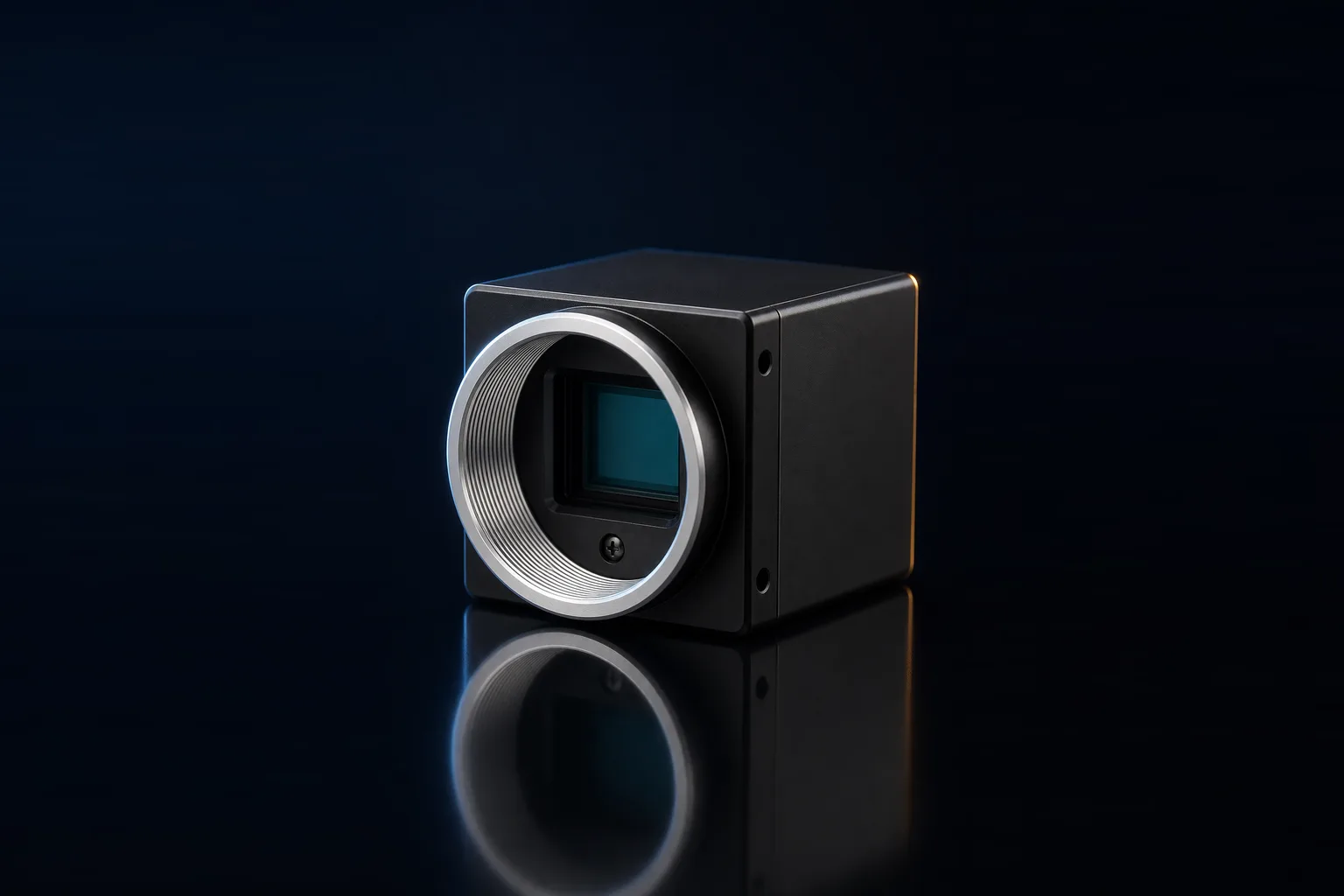
The Sony IMX304 gives MV-CH120-10UC a 4096 × 3000 color frame, delivered at up to 30.5 fps in the V4.0 version and 23.1 fps in the base version. The CMOS sensor uses a global shutter; its 3.45 × 3.45 µm pixels cover a 1.1 inch sensor; the image path is USB 3.0; the optical interface is C-mount. Color output retains chromatic differences for inspection criteria based on markings, print or part appearance.
Use this combination for color inspection of labels, printed features and indexed assemblies. The global shutter keeps the 4096 × 3000 frame temporally aligned on moving or indexed objects, while the frame rate (up to 30.5 fps for V4.0, 23.1 fps for the base version) sets the available acquisition cadence. USB power is supported; the external input is 9 V DC to 24 V DC on V4.0 and 12 V DC on the base version. The 6-pin connector provides the listed control lines for coordinating acquisition with the machine.
Range placement becomes clear beside MV-CH120-10GM and MV-CH100-60UM. MV-CH120-10GM changes the frame path to Gigabit Ethernet and records mono with 9.9 fps. Prefer it when Gigabit Ethernet is the required image interface. MV-CH100-60UM provides 4096 × 2460 mono capture with 36 fps through USB 3.0. Prefer it when mono output with 36 fps is required.
Available versions
One device, different revisions. We ship the current one by default; if a specific revision is already installed on your line, name it in the request and we will match it.
| Part number | PN | Version | |
|---|---|---|---|
| MV-CH120-10UC | 306300486 / 306300487 | — | |
| MV-CH120-10UC V4.0 | 306301979 | V4.0 |
Specifications
| Shutter | global |
| Sensor model | Sony® IMX304 |
| Nominal optical sensor format | 1.1″ |
| Sensor resolution | 4096×3000 px |
| Color mode | color |
| Lens mount | C-mount |
| Data interface | USB 3.0 |
| Sensor technology | CMOS |
| Pixel size | 3.45×3.45 µm |
| Dynamic range | 72.2 dB |
| Signal-to-noise ratio | 40.2 dB |
| Exposure time | 2…14 µs @ ultra-short exposure mode; 15…10000000 µs @ standard exposure mode |
| Auto exposure | Off, Once, Continuous |
| Binning | 1x1, 2x2, 4x4 |
| Decimation | 1x1, 2x2, 4x4 |
| Image buffer | 128 MB1 |
| USB 2.0 compatibility | yes |
| Protocol compatibility | USB3 Vision, GenICam |
| Third party software protocol | USB3 Vision |
| Client software | MVS |
| Operating systems | Windows 7 (32/64-bit), Windows 10 (32/64-bit), Windows 11 (64-bit), Linux (32/64-bit) |
| Digital I/O lines | 1 input, opto-isolated, line 0; 1 output, opto-isolated, line 1; 1 bidirectional line, non-isolated, line 2 |
| Power delivery | external power supply, USB |
| Storage temperature | -30…70 °C |
| Certification | CE, RoHS, KC |
| Port inventory | USB 3.0 (data) |
| Reverse image | horizontal, vertical |
| Part number | Maximum frame rate | Gain | Working temperature | Dimensions | Digital I/O connector |
|---|---|---|---|---|---|
MV-CH120-10UC V4.0All specifications
| 30.5 fps @ BayerRG8, resolution 4096×3000 px | 0…24 dB | -10…50 °C | 29×29×30 mm | P7 6-pin |
MV-CH120-10UCAll specifications
| 23.1 fps @ resolution 4096×3000 px | 0…20 dB | 0…50 °C | 44×29×59 mm | Hirose 6-pin |
1 not stated for all variants
Documents
Selection and applications
Color inspection at 4096 × 3000. Geometric capture of moving or indexed parts. Acquisition at up to 30.5 fps (V4.0) or 23.1 fps (base version) over USB 3.0.
Minimum kit: Start with MV-CH120-10UC, a lens with the C-mount interface covering the 1.1 inch sensor, a cable for USB 3.0, and USB power or an external supply: 9 V DC to 24 V DC for V4.0, 12 V DC for the base version.
Nearby in the range: MV-CH120-10GM — Prefer it when Gigabit Ethernet is the required image interface; MV-CH100-60UM — Prefer it when mono output with 36 fps is required.
Cables and accessories for this model
Compatibility per manufacturer data.
- Data cables
- USB 3.0
- I/O & power cables
- Hirose 6-pin IO
- Power
- Power
- Mounting
- Camera mounts
FAQ
How do resolution and cadence position MV-CH120-10UC for motion?
MV-CH120-10UC uses a global shutter that exposes the 4096 × 3000 frame on one timing basis, supporting geometric capture of moving and indexed parts. It reaches 30.5 fps in the V4.0 version and 23.1 fps in the base version. Exposure is 2 to 14 µs in ultrashort mode and 15 µs to 10 s in standard mode.
What interface and power options are stated for MV-CH120-10UC?
MV-CH120-10UC transfers images through USB3.0, compatible with USB2.0. USB power is supported; the external input is 9 V DC to 24 V DC on V4.0 and 12 V DC on the base version. Typical power consumption at 5 V DC is 3.2 W for V4.0 and 3.5 W for the base version.
Which optics match the image format of MV-CH120-10UC?
MV-CH120-10UC uses the C-mount lens interface. The lens image circle must cover the stated 1.1 inch sensor format. Optical resolution should be evaluated against the 3.45 × 3.45 µm pixel pitch; the camera frame is 4096 × 3000. Focal length and working distance then follow from the required scene width and mechanical layout.
How should MV-CH120-10UC be housed within its operating limits?
The V4.0 version of MV-CH120-10UC has an IP40 enclosure, a 29 × 29 × 30 mm body, a working range of -10 to 50 °C, a humidity range of 20 to 95 % RH and a mass of about 80 g. The base version has an IP30 enclosure, a 44 × 29 × 59 mm body, a working range of 0 to 50 °C, a humidity range of 20 to 80 % RH and a mass of about 100 g. Include the mass of the ordered version in the bracket and motion-load calculation.
Which points separate MV-CH120-10UC from MV-CH120-10GM?
MV-CH120-10UC records color images through USB 3.0 at up to 30.5 fps (V4.0) or 23.1 fps (base version); its lens connection is C-mount. MV-CH120-10GM records mono images with 9.9 fps through Gigabit Ethernet and uses C-mount optics. Prefer it when Gigabit Ethernet is the required image interface.
Which control and image-output details matter for MV-CH120-10UC?
MV-CH120-10UC uses a 6-pin control connector with opto-isolated input x1, opto-isolated output x1 and bi-directional non-isolated I/O x1. Exposure is 2 to 14 µs in ultrashort mode and 15 µs to 10 s in standard mode; gain spans 0 to 24 dB on V4.0 and 0 to 20 dB on the base version.