Area camera · CH Series
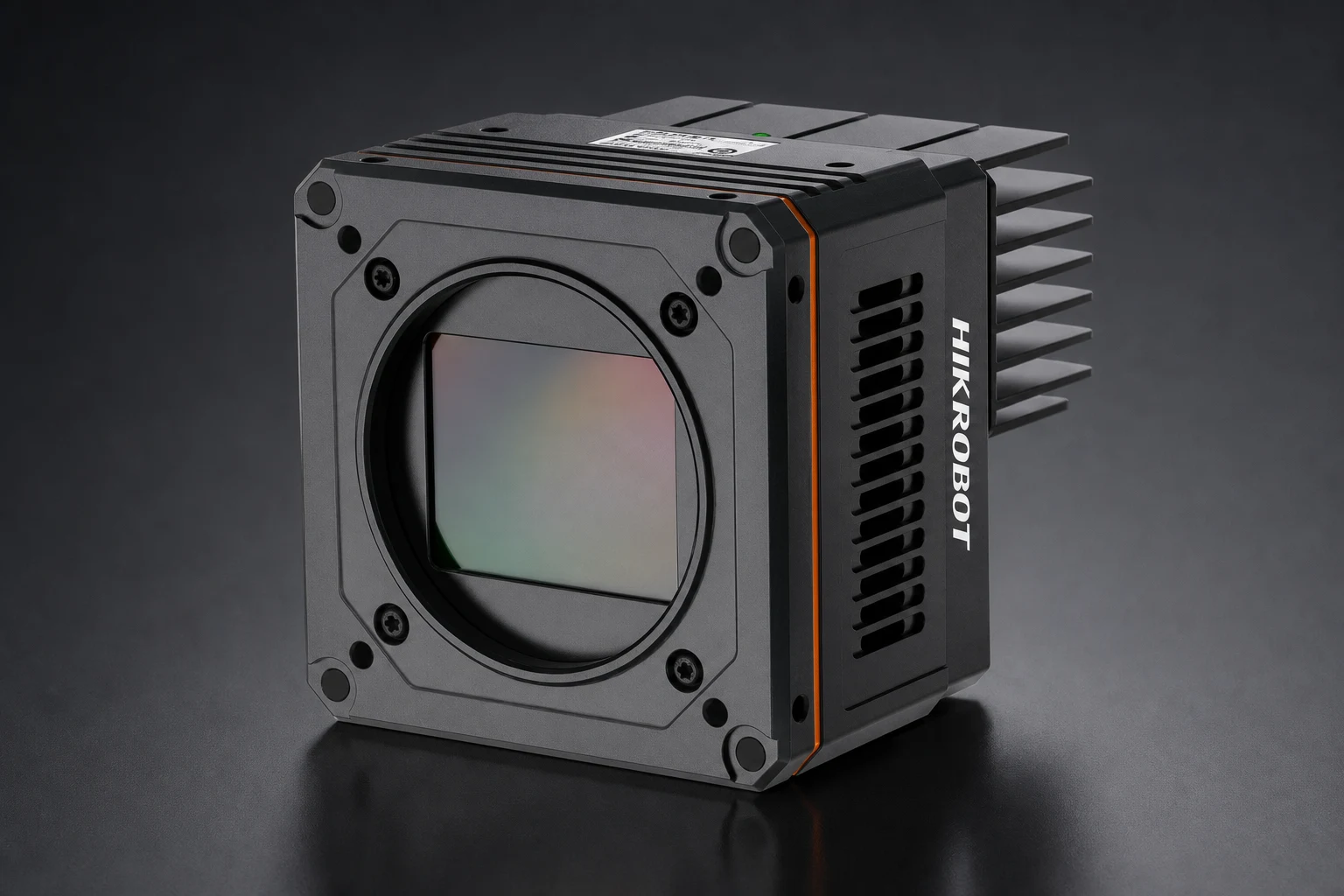
Hikrobot MV-CH320-60TC-M58S-NN
- Lead time
- from 5 days
- Warranty
- 36 months
Where this model fits
Built around the Stacked BSI, MV-CH320-60TC-M58S-NN combines 7744 × 4336 color capture with 30 fps @ 7744 × 4336 Bayer BG 8. The CMOS sensor uses a rolling shutter; its 2.9 µm × 2.9 µm pixels cover a 22.6 mm × 12.7 mm sensor; the image path is 10 Gigabit Ethernet; the optical interface is M58 × 0.75. Color output retains chromatic differences for inspection criteria based on markings, print or part appearance.
Practical targets include stationary color inspection of wide panels, printed features and assembled parts. The rolling shutter favours stationary targets, stopped indexing or strobe-controlled exposure; 30 fps @ 7744 × 4336 Bayer BG 8 is the stated readout point and must be considered with exposure timing. The stated supply range is 9 V DC to 24 V DC. The 12-pin P10 connector provides the listed control lines for coordinating acquisition with the machine.
Two same-category references are MV-CH310-10TM-M58S-NN and MV-CH650-60TC-M58S-NN. The first combines 6464 × 4852, 17.2 fps @ 6464 × 4852 Mono 8 and 10 Gigabit Ethernet; prefer it when mono output with 17.2 fps @ 6464 × 4852 mono 8 is required. The second uses M58 × 0.75 optics with color output at 17.5 fps @ 9344 × 7008 Bayer BG 8. Prefer it when 17.5 fps @ 9344 × 7008 Bayer BG 8 acquisition matches the line cadence.
Specifications
| Shutter | rolling |
| Sensor model | Stacked BSI1 |
| Sensor resolution | 7744×4336 px1 |
| Maximum frame rate | 30 fps1 |
| Color mode | color |
| Lens mount | M581 |
| Data interface | 10GigE (GigE compatible)1 |
| Sensor technology | CMOS, stacked BSI |
| Pixel size | 2.9×2.9 µm1 |
| Dynamic range | 70.6 dB1 |
| Signal-to-noise ratio | 41 dB1 |
| Exposure time | 12…10000000 µs1 |
| Auto exposure | Off, Once, Continuous, rolling shutter1 |
| Gain | 0…24 dB1 |
| Pixel format | Mono8, Mono10, Mono12, BayerBG8, BayerBG10, BayerBG10Packed, BayerBG12, BayerBG12Packed, YUV422Packed, YUV422_YUYV_Packed, RGB8, BGR81 |
| Binning | 1x1, 1x2, 1x4, 2x1, 2x2, 2x4, 4x1, 4x2, 4x41 |
| Decimation | 1x1, 1x2, 1x4, 2x1, 2x2, 2x4, 4x1, 4x2, 4x41 |
| Protocol compatibility | GigE Vision, GenICam1 |
| Communication protocol versions | GigE Vision 2.01 |
| Third party software protocol | GigE Vision1 |
| Client software | MVS1 |
| Operating systems | Windows 7 (32/64-bit), Windows 10 (32/64-bit), Windows 11 (64-bit), Linux (32/64-bit)1 |
| Digital I/O lines | 1 input, opto-isolated, line 0; 1 output, opto-isolated, line 1; 1 bidirectional line, non-isolated, line 21 |
| Digital I/O connector | P10 12-pin1 |
| Power supply | 9…24 V @ DC1 |
| Power delivery | external power supply1 |
| Power consumption | 11.2 W1 |
| Ingress protection | IP401 |
| Working temperature | 0…50 °C1 |
| Storage temperature | -30…80 °C1 |
| Humidity | 20…95 % @ non-condensing1 |
| Dimensions | 84×84×92.5 mm1 |
| Certification | CE, RoHS, KC1 |
| Physical sensor dimensions | 22.6×12.7 mm1 |
| Port inventory | RS-232 (serial)1 |
| Reverse image | horizontal, vertical1 |
1 unofficial data
Documents
Selection and applications
Color inspection at 7744 × 4336. Detailed capture of stationary or indexed targets. Acquisition at 30 fps @ 7744 × 4336 Bayer BG 8 over 10 Gigabit Ethernet.
Minimum kit: Start with MV-CH320-60TC-M58S-NN, a lens with the M58 × 0.75 interface covering the 22.6 mm × 12.7 mm sensor, a cable for 10 Gigabit Ethernet, and a 9 V DC to 24 V DC supply.
Nearby in the range: MV-CH310-10TM-M58S-NN — Prefer it when mono output with 17.2 fps @ 6464 × 4852 Mono 8 is required; MV-CH650-60TC-M58S-NN — Prefer it when 17.5 fps @ 9344 × 7008 Bayer BG 8 acquisition matches the line cadence.
Cables and accessories for this model
Compatibility per manufacturer data.
- I/O & power cables
- 12-pin IO
- Power
- Power
- Mounting
- Camera mounts
FAQ
What does the shutter architecture mean for MV-CH320-60TC-M58S-NN on moving parts?
MV-CH320-60TC-M58S-NN uses a rolling shutter that reads the 7744 × 4336 image sequentially, so stationary targets, stopped indexing or strobe-controlled exposure are the appropriate starting point. The stated rate is 30 fps @ 7744 × 4336 Bayer BG 8, and exposure can be set within 12 µs to 10 s.
How is MV-CH320-60TC-M58S-NN connected for image transfer and power?
MV-CH320-60TC-M58S-NN transfers images through 10 Gigabit Ethernet (10000 Mbit/s), compatible with Gigabit Ethernet (1000 Mbit/s). The stated supply range is 9 V DC to 24 V DC. Power consumption is Typ. 11.2 W @ 12 V DC.
Which lens interface and sensor coverage does MV-CH320-60TC-M58S-NN need?
Lens selection for MV-CH320-60TC-M58S-NN starts with its M58 × 0.75 interface. Use an image circle that covers the 22.6 mm × 12.7 mm sensor. Resolving power must be assessed for the 2.9 µm × 2.9 µm pixel pitch across the 7744 × 4336 frame. Set focal length from scene width and distance after confirming image-circle coverage.
What should the enclosure plan account for with MV-CH320-60TC-M58S-NN?
MV-CH320-60TC-M58S-NN has an IP40 (under proper lens installation and wiring) enclosure and a 84 mm × 84 mm × 92.5 mm (3.3" × 3.3" × 3.6") body. The working range is 0 °C to 50 °C (32 °F to 122 °F). The humidity range is 20% RH to 95% RH (no condensation). Listed camera mass is Approx. 600 g (1.3 lb.); include it in the bracket and motion-load calculation.
Which technical differences separate MV-CH320-60TC-M58S-NN and MV-CH310-10TM-M58S-NN?
MV-CH320-60TC-M58S-NN records color images with 30 fps @ 7744 × 4336 Bayer BG 8 through 10 Gigabit Ethernet; its lens connection is M58 × 0.75. MV-CH310-10TM-M58S-NN records mono images with 17.2 fps @ 6464 × 4852 Mono 8 through 10 Gigabit Ethernet and uses M58 × 0.75 optics. Prefer it when mono output with 17.2 fps @ 6464 × 4852 Mono 8 is required.
Which I/O, exposure or format controls does MV-CH320-60TC-M58S-NN provide?
MV-CH320-60TC-M58S-NN uses the following control connection: 12-pin P10 connector provides power and I/O, including opto -isolated input × 1 (Line 0), opto-isolated output × 1 (Line 1), bi-directional non-isolated I/O × 1 (Line 2), and RS-232 × 1. Exposure spans 12 µs to 10 s, and gain spans 0 dB to 24 dB.