Area camera · CH Series
Hikrobot MV-CH610-10TC-F-TF V2.0
- Lead time
- from 5 days
- Warranty
- 36 months
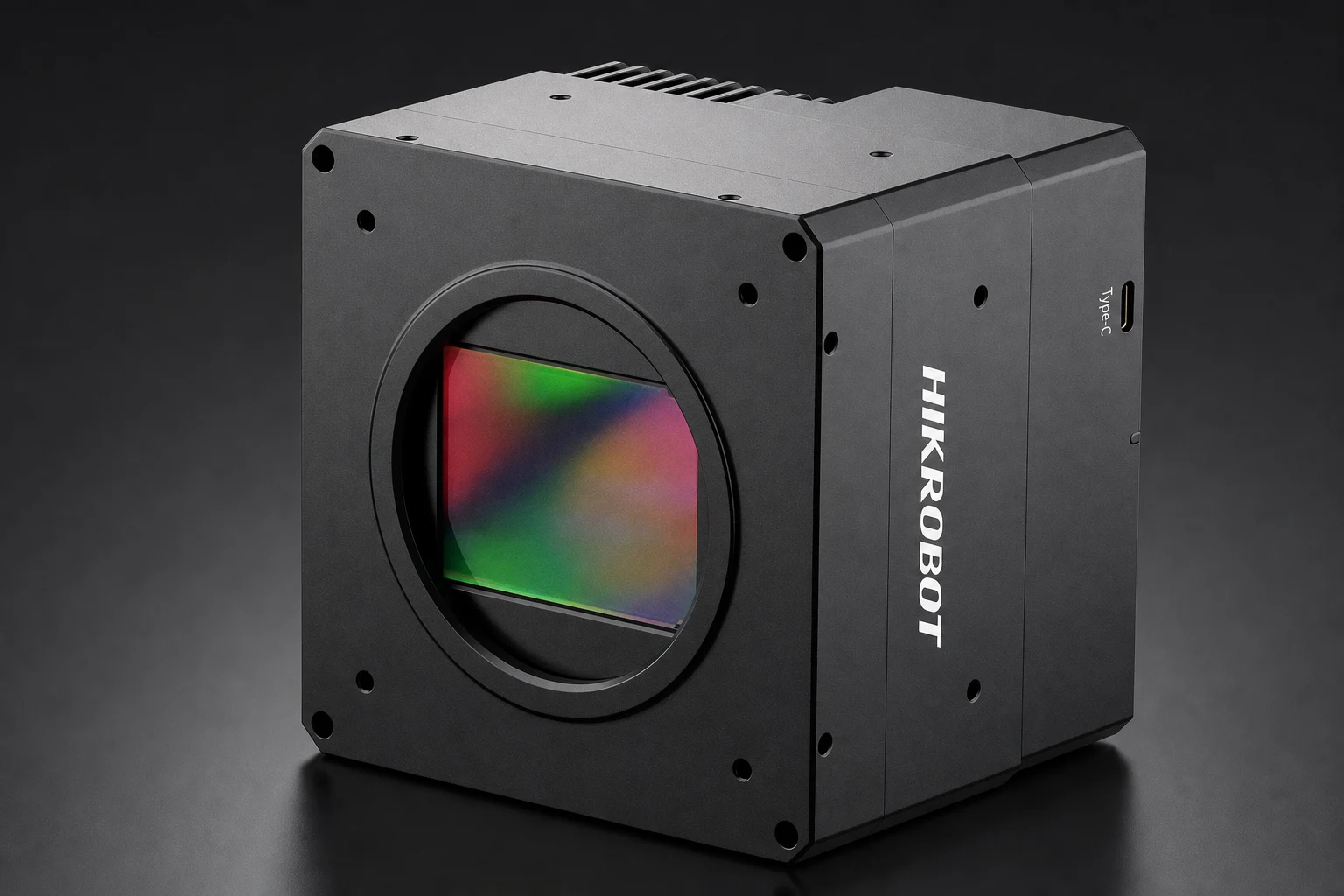
Inspection role and model choice
The Sony® IMX455 gives MV-CH610-10TC-F-TF V2.0 a 9568 × 6380 color frame delivered at 17.9 fps @9568 × 6380 Bayer BG 8. The CMOS sensor uses a rolling shutter; its 3.76 μm × 3.76 μm pixels cover a 36 mm × 24 mm sensor; the image path is 10 Gigabit Ethernet; the optical interface is F-mount. Color output retains chromatic differences for inspection criteria based on markings, print or part appearance.
Use this combination for stationary color inspection of large panels, prints and multi-feature assemblies. The rolling shutter favours stationary targets, stopped indexing or strobe-controlled exposure; 17.9 fps @9568 × 6380 Bayer BG 8 is the stated readout point and must be considered with exposure timing. The stated supply range is 24 V DC. The 12-pin P10 connector provides the listed control lines for coordinating acquisition with the machine.
Against neighbouring area cameras, MV-CH650-60TC-M58S-NN offers 9344 × 7008 with 17.5 fps @ 9344 × 7008 Bayer BG 8 over 10 Gigabit Ethernet, whereas MV-CH610-10TC-F-TF V2.0 retains its 9568 × 6380 and 10 Gigabit Ethernet profile. Prefer it when the optical assembly uses M58 × 0.75. MV-CH6040-10XC-M72-TF shifts the choice to color imaging through CoaXPress with DIN interface with 1.38 fps @ 14208 × 10640 RGB 8. Prefer it when CoaXPress with DIN interface is the required image interface.
Specifications
| Shutter | rolling |
| Sensor model | Sony® IMX4551 |
| Sensor resolution | 9568×6380 px1 |
| Maximum frame rate | 17.9 fps1 |
| Color mode | color |
| Lens mount | F-mount1 |
| Data interface | 10GigE (GigE compatible)1 |
| Sensor technology | CMOS |
| Pixel size | 3.76×3.76 µm1 |
| Dynamic range | 75.3 dB |
| Signal-to-noise ratio | 46.8 dB |
| Exposure time | 9…10000000 µs |
| Auto exposure | Auto, Off, Once, global reset |
| Gain | 0…36 dB |
| Pixel format | Mono8, Mono10, Mono12, Mono16, BayerRG8, BayerRG10, BayerRG10Packed, BayerRG12, BayerRG12Packed, BayerRG16, YUV422_8, YUV422_8_YUYV, RGB8, BGR8 |
| Binning | 1x1, 1x2, 1x4, 2x1, 2x2, 2x4, 4x1, 4x2, 4x4 |
| Decimation | 1x1, 1x2, 1x4, 2x1, 2x2, 2x4, 4x1, 4x2, 4x4 |
| Flange focal distance | 46.5 mm |
| Protocol compatibility | GigE Vision, GenICam |
| Communication protocol versions | GigE Vision 2.0 |
| Third party software protocol | GigE Vision |
| Client software | MVS |
| Operating systems | Windows 7 (32/64-bit), Windows 10 (32/64-bit), Windows 11 (64-bit), Linux (32/64-bit) |
| Digital I/O lines | 1 input, opto-isolated, line 0; 1 output, opto-isolated, line 1; 1 bidirectional line, non-isolated, line 2 |
| Digital I/O connector | P10 12-pin |
| Power supply | 24 V @ DC, external power supply |
| Power consumption | 14.4 W1 |
| Cooling | thermoelectric, fan |
| Ingress protection | IP401 |
| Working temperature | 0…50 °C |
| Storage temperature | -30…80 °C |
| Humidity | 20…95 % @ non-condensing |
| Dimensions | 100×100×82 mm |
| Weight | 1090 g (approx.) |
| Certification | CE, RoHS, KC |
| Physical sensor dimensions | 36×24 mm |
| Port inventory | RS-232 (serial) |
| Reverse image | horizontal |
1 unofficial data
Documents
Selection and applications
Color inspection at 9568 × 6380. Detailed capture of stationary or indexed targets. Acquisition at 17.9 fps @9568 × 6380 Bayer BG 8 over 10 Gigabit Ethernet.
Minimum kit: Start with MV-CH610-10TC-F-TF V2.0, a lens with the F-mount interface covering the 36 mm × 24 mm sensor, a cable for 10 Gigabit Ethernet, and a 24 V DC supply.
Nearby in the range: MV-CH650-60TC-M58S-NN — Prefer it when the optical assembly uses M58 × 0.75; MV-CH6040-10XC-M72-TF — Prefer it when CoaXPress with DIN interface is the required image interface.
Cables and accessories for this model
Compatibility per manufacturer data.
- I/O & power cables
- 12-pin IO
- Power
- Power
- Mounting
- Camera mounts
FAQ
What does the shutter architecture mean for MV-CH610-10TC-F-TF V2.0 on moving parts?
MV-CH610-10TC-F-TF V2.0 uses a rolling shutter that reads the 9568 × 6380 image sequentially, so stationary targets, stopped indexing or strobe-controlled exposure are the appropriate starting point. The stated rate is 17.9 fps @9568 × 6380 Bayer BG 8, and exposure can be set within 9 µs to 10 s.
How is MV-CH610-10TC-F-TF V2.0 connected for image transfer and power?
MV-CH610-10TC-F-TF V2.0 transfers images through 10 Gigabit Ethernet (10000 Mbit/s), compatible with Gigabit Ethernet (1000 Mbit/s). The stated supply range is 24 V DC. Power consumption is Typ. 14.4 W @ 24 V DC (non-TEC mode) Typ. 27.6 W @ 24 V DC (TEC mode).
Which lens interface and sensor coverage does MV-CH610-10TC-F-TF V2.0 need?
MV-CH610-10TC-F-TF V2.0 uses the F-mount lens interface. The lens image circle must cover the stated 36 mm × 24 mm sensor format. Optical resolution should be evaluated against the 3.76 μm × 3.76 μm pixel pitch; the camera frame is 9568 × 6380. Focal length and working distance then follow from the required scene width and mechanical layout.
What should the enclosure plan account for with MV-CH610-10TC-F-TF V2.0?
MV-CH610-10TC-F-TF V2.0 has an IP40 (under proper lens installation and wiring) enclosure and a 100 mm × 100 mm × 82 mm (3.9" × 3.9" × 3.2") body. The working range is 0 °C to 50 °C (32 °F to 122 °F). The humidity range is 20% RH to 95% RH (no condensation). Listed camera mass is Approx. 1090 g (2.4 lb.); include it in the bracket and motion-load calculation.
Which technical differences separate MV-CH610-10TC-F-TF V2.0 and MV-CH650-60TC-M58S-NN?
MV-CH610-10TC-F-TF V2.0 records color images with 17.9 fps @9568 × 6380 Bayer BG 8 through 10 Gigabit Ethernet; its lens connection is F-mount. MV-CH650-60TC-M58S-NN records color images with 17.5 fps @ 9344 × 7008 Bayer BG 8 through 10 Gigabit Ethernet and uses M58 × 0.75 optics. Prefer it when the optical assembly uses M58 × 0.75.
Which I/O, exposure or format controls does MV-CH610-10TC-F-TF V2.0 provide?
MV-CH610-10TC-F-TF V2.0 uses the following control connection: 12-pin P10 connector provides power and I/O, including opto-isolated input × 1 (Line 0), opto-isolated output × 1 (Line 1), bi-directional non-isolated I/O × 1 (Line 2), and RS-232 × 1. Exposure spans 9 µs to 10 s, and gain spans 0 dB to 36 dB.