Area camera · CH Series
Hikrobot MV-CH650-90YM-M58S-NN
- Warranty
- 36 months
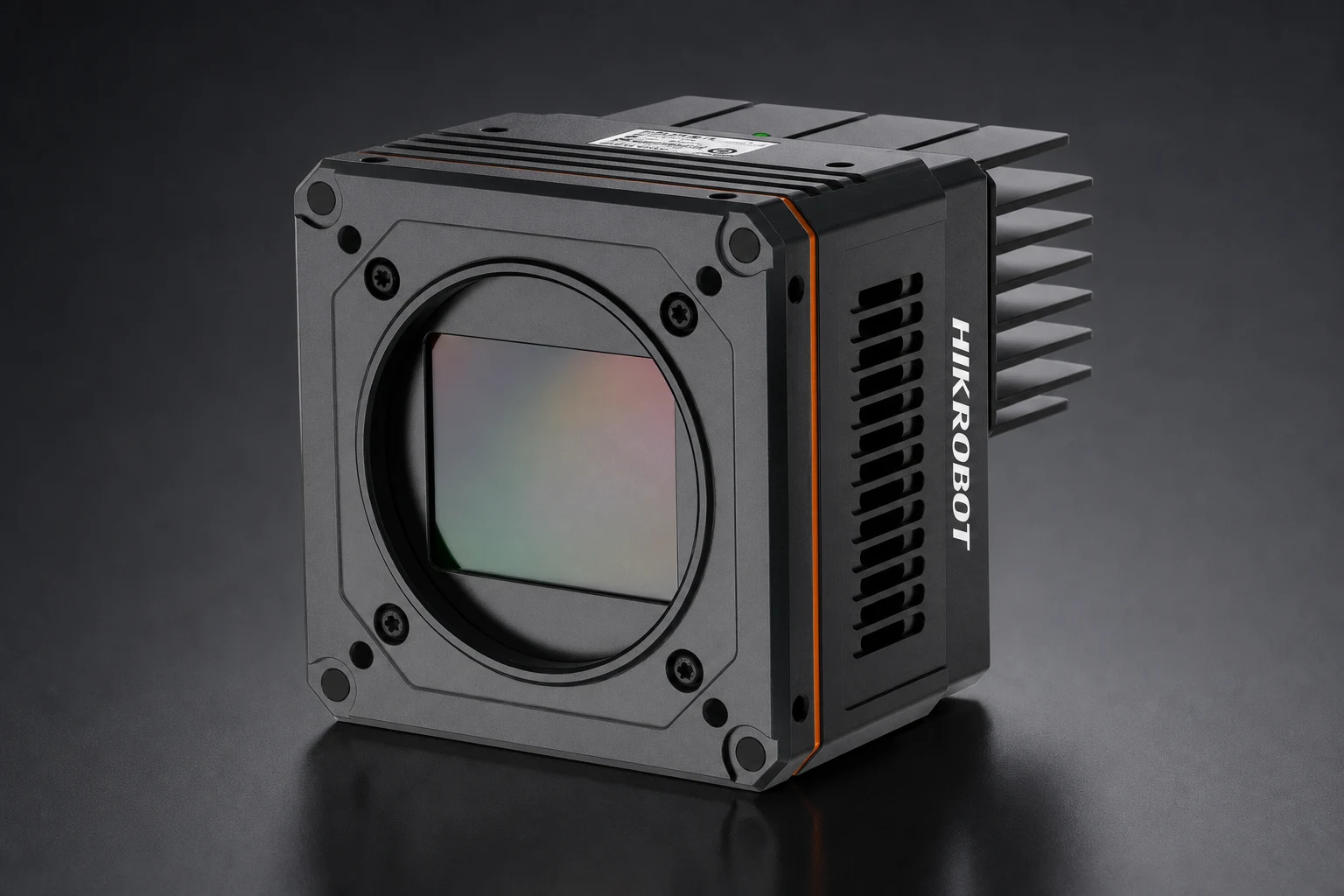
Where to use this camera
Large-frame mono inspection is the central use of MV-CH650-90YM-M58S-NN, with 9344 × 7000 capture at 71 fps @ 9344 × 7000. The CMOS sensor uses a global shutter; its 3.2 µm × 3.2 µm pixels cover a 29.9 mm × 22.4 mm sensor; the image path is CoaXPress with Micro-BNC interface; the optical interface is M58 × 0.75. The monochrome output suits measurements and contrast-based inspection where color separation is not the measured feature.
This capture profile maps to fast monochrome measurement, contour tracking and moving-surface inspection. The global shutter keeps the 9344 × 7000 frame temporally aligned on moving or indexed objects, while 71 fps @ 9344 × 7000 sets the available acquisition cadence. Power can enter through PoCXP on the CXP-0 and CXP-1 connectors or from 24 V DC. The 12-pin P10 connector provides the listed control lines for coordinating acquisition with the machine.
Range placement becomes clear beside MV-CH650-90YC-M58S-NN and MV-CH650-90XM-M58S-NF. MV-CH650-90YC-M58S-NN also uses CoaXPress with Micro-BNC interface and records color with 71 fps @ 9344 × 7000. Prefer it when color output with 71 fps @ 9344 × 7000 is required. MV-CH650-90XM-M58S-NF provides 9344 × 7000 mono capture with 31.5 fps @ 9216 × 7000 through CoaXPress with DIN interface. Prefer it when CoaXPress with DIN interface is the required image interface.
Available versions
One device, different revisions. We ship the current one by default; if a specific revision is already installed on your line, name it in the request and we will match it.
| Part number | PN | Note | Version | |
|---|---|---|---|---|
| MV-CH650-90YM-M58S-NN | 306301673 | 24 VDC power, 13 W consumption | — | |
| MV-CH650-90YM-M58S-NN V2.0 | 306302244 | 12–24 VDC power, 14.4 W consumption | V2.0 |
Specifications
| Product type | 65.4 MP CoaXPress Area Scan Camera |
| Sensor type | CMOS, global shutter |
| Sensor model | Gpixel GMAX3265 |
| Sensor format | 29.9 mm × 22.4 mm |
| Resolution | 9344 × 7000 |
| Pixel size | 3.2 µm × 3.2 µm |
| Maximum frame rate | 71 fps @ 9344 × 7000 |
| Mono color | Mono |
| Dynamic range | 66 dB |
| Exposure time | 12 μs to 10 sec |
| Gain | 1.25x |
| Data interface | CoaXPress with Micro-BNC interface |
| Digital I/O | 12-pin P10 connector provides power and I/O, including opto-isolated input × 1 (Line 0), opto-isolated output × 1 (Line 1), bi-directional non-isolated I/O × 1 (Line 2), and RS-232 × 1. |
| Lens mount | M58 × 0.75 |
| Power supply | 24 VDC, CXP-0 and CXP-1 connectors support PoCXP |
| Power consumption | Typ. 13.0 W @ 24 VDC |
| Ingress protection | IP40 (under proper lens installation and wiring) |
| Operating temperature | 0 °C to 50 °C (32 °F to 122 °F) |
| Storage temperature | –30 °C to 80 °C (–22 °F to 176 °F) |
| Humidity | 20% RH to 95% RH (no condensation) |
| Dimensions | 84 mm × 84 mm × 62.5 mm (3.3″ × 3.3″ × 2.5″) |
| Weight | Approx. 650 g (1.4 lb.) |
| Certification | CE-EMC, KC, UL |
| Compatibility | CoaXPress, GenICam |
| Cooling | Without fan or heat sink |
Selection and applications
Mono inspection at 9344 × 7000. Geometric capture of moving or indexed parts. Acquisition at 71 fps @ 9344 × 7000 over CoaXPress with Micro-BNC interface.
Minimum kit: Start with MV-CH650-90YM-M58S-NN, a lens with the M58 × 0.75 interface covering the 29.9 mm × 22.4 mm sensor, a cable for CoaXPress with Micro-BNC interface, and PoCXP or a 24 V DC supply.
Nearby in the range: MV-CH650-90YC-M58S-NN — Prefer it when color output with 71 fps @ 9344 × 7000 is required.; MV-CH650-90XM-M58S-NF — Prefer it when CoaXPress with DIN interface is the required image interface..
Cables and accessories for this model
Compatibility per manufacturer data.
- Data cables
- CoaXPress
- I/O & power cables
- 12-pin IO
- Power
- Power
- Mounting
- Camera mounts
FAQ
What does the shutter architecture mean for MV-CH650-90YM-M58S-NN on moving parts?
MV-CH650-90YM-M58S-NN uses a global shutter that exposes the 9344 × 7000 frame on one timing basis, supporting geometric capture of moving and indexed parts. It reaches 71 fps @ 9344 × 7000, and exposure can be set within 12 µs to 10 s.
How is MV-CH650-90YM-M58S-NN connected for image transfer and power?
MV-CH650-90YM-M58S-NN transfers images through CoaXPress with Micro-BNC interface. Power can enter through PoCXP on the CXP-0 and CXP-1 connectors or from 24 V DC. Power consumption is Typ. 13.0 W @ 24 V DC.
Which lens interface and sensor coverage does MV-CH650-90YM-M58S-NN need?
Lens selection for MV-CH650-90YM-M58S-NN starts with its M58 × 0.75 interface. Use an image circle that covers the 29.9 mm × 22.4 mm sensor. Resolving power must be assessed for the 3.2 µm × 3.2 µm pixel pitch across the 9344 × 7000 frame. Set focal length from scene width and distance after confirming image-circle coverage.
What should the enclosure plan account for with MV-CH650-90YM-M58S-NN?
MV-CH650-90YM-M58S-NN has an IP40 (under proper lens installation and wiring) enclosure and a 84 mm × 84 mm × 62.5 mm (3.3" × 3.3" × 2.5") body. The working range is 0 °C to 50 °C (32 °F to 122 °F). The humidity range is 20% RH to 95% RH (no condensation). Listed camera mass is Approx. 650 g (1.4 lb.); include it in the bracket and motion-load calculation.
Which technical differences separate MV-CH650-90YM-M58S-NN and MV-CH650-90YC-M58S-NN?
MV-CH650-90YM-M58S-NN records mono images with 71 fps @ 9344 × 7000 through CoaXPress with Micro-BNC interface; its lens connection is M58 × 0.75. MV-CH650-90YC-M58S-NN records color images with 71 fps @ 9344 × 7000 through CoaXPress with Micro-BNC interface and uses M58 × 0.75 optics. Prefer it when color output with 71 fps @ 9344 × 7000 is required.
Which I/O, exposure or format controls does MV-CH650-90YM-M58S-NN provide?
MV-CH650-90YM-M58S-NN uses the following control connection: 12-pin P10 connector provides power and I/O, including opto-isolated input × 1 (Line 0), opto-isolated output × 1 (Line 1), bi-directional non-isolated I/O × 1 (Line 2), and RS-232 × 1. Exposure spans 12 µs to 10 s, and gain is listed as 1.25x.