Line scan camera · CL Series
Hikrobot MV-CL042-91CM
- Warranty
- 36 months
Mono 4K capture across Camera Link modes
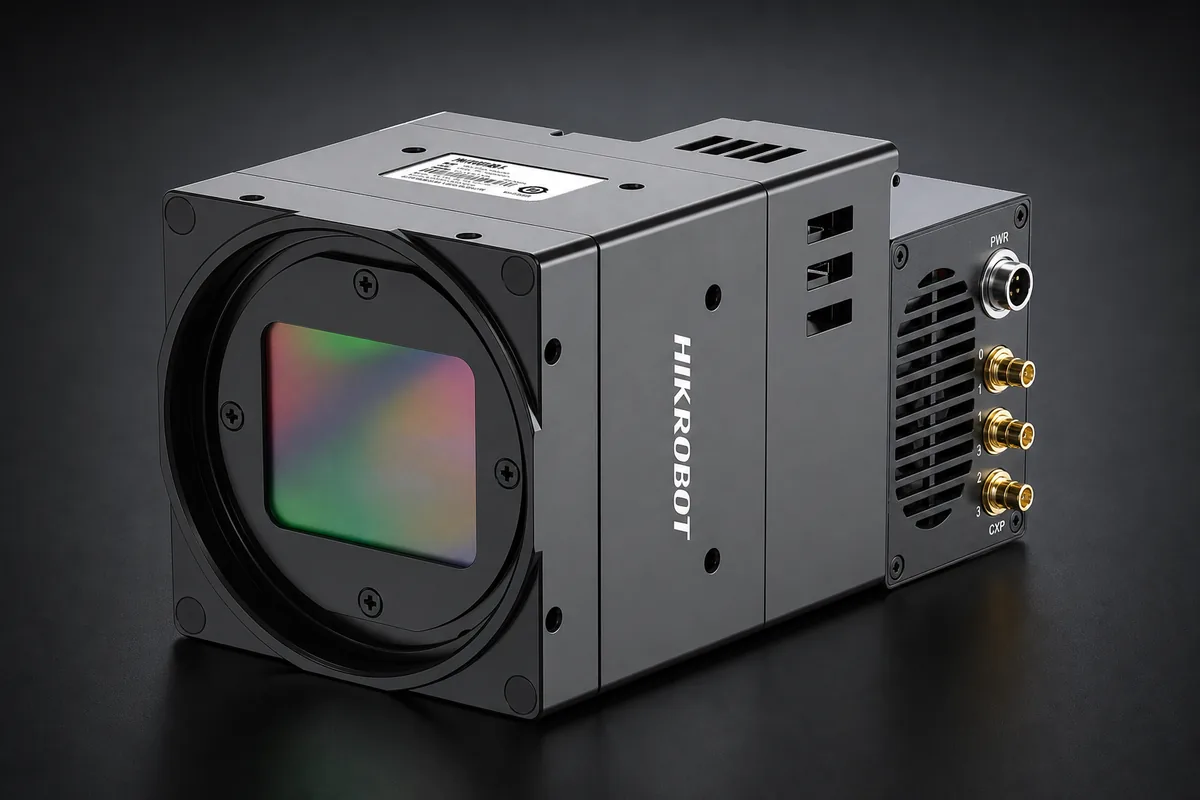
A 4096 × 2 mono CMOS line and stepped Camera Link bandwidth modes shape MV-CL042-91CM. Its 7 µm pixels run at 40.5 kHz in Base, 81 kHz in Medium and 100 kHz in Full configuration. Image data leaves through an SDR Camera Link connector, while a separate USB interface supports firmware updating. The body is a compact 62 mm × 62 mm × 36.9 mm.
The camera is suited to mono surface or edge inspection where a Camera Link frame grabber forms part of the machine architecture. The 4096-sample line supports wider or more finely sampled objects than the 2048-pixel members, and the three link configurations let the receiver bandwidth follow line speed. Its M42*1 mount has a 12 mm optical back focal length and can accept C-mount, F-mount or other optics through an adapter.
MV-CL042-91CC keeps the same 4096 × 2 array size, 7 µm pitch and housing but provides color capture, reaching as much as 100 kHz according to Camera Link configuration. MV-CL042-91CM-V2 is the higher-rate mono relative: its Full mode reaches 162 kHz and its 80-bit mode 195 kHz. MV-CL042-91GM instead provides comparable 4096 × 2 imaging over Gigabit Ethernet at up to 80 kHz for network-based acquisition.
Specifications
| Product type | 4096 px Camera Link Line Scan Camera |
| Sensor type | CMOS |
| Resolution | 4096 × 2 |
| Pixel size | 7 μm |
| Mono color | Mono |
| Data interface | Camera Link (SDR connector); USB interface for updating firmware |
| Lens mount | M42*1, optical back focal length: 12 mm (0.5″), applicable to F-mount, C-mount and lens of other types via lens adapter |
| Dimensions | 62 mm × 62 mm × 36.9 mm (2.4″ × 2.4″ × 1.5″) |
| Certification | CE-EMC, KC, UL |
| Max line rate | 40.5 kHz (Base), 81 kHz (Medium), 100 kHz (Full) |
Selection and applications
4K mono Camera Link inspection. Mono line capture at 100 kHz. Compact frame-grabber installations.
Minimum kit: Pair the MV-CL042-91CM camera with an M42*1 line-scan lens or adapted lens, the Camera Link cable and frame grabber required by its SDR connection, and a suitable camera power source.
Nearby in the range: MV-CL042-91CC — Prefer it when the 4096 × 2 Camera Link task needs color.; MV-CL042-91CM-V2 — Prefer it when Full mode must extend from 100 kHz to 162 kHz.; MV-CL042-91GM — Prefer it for 4096 × 2 capture over Gigabit Ethernet..
Cables and accessories for this model
Compatibility per manufacturer data.
- Data cables
- Camera Link
- Power
- Power
- Mounting
- Camera mounts
FAQ
What line rates correspond to the MV-CL042-91CM Camera Link modes?
Base configuration reaches 40.5 kHz, Medium reaches 81 kHz and Full reaches 100 kHz. These are mode-specific limits, so the frame grabber, cable arrangement and camera configuration should be planned around the selected Camera Link bandwidth.
Which optical adapters can be used with the MV-CL042-91CM mount?
The camera provides an M42*1 thread and a 12 mm optical back focal length. Its mount can take F-mount, C-mount and other lens types via a lens adapter; optical coverage must still match the 4096 × 2 sensor and 7 µm pitch.
Is the USB connector the image interface on MV-CL042-91CM?
No. Production image transfer uses Camera Link through the SDR connector. The USB interface is identified for firmware updating, so normal acquisition requires a Camera Link cable and a receiver supporting the chosen Base, Medium or Full configuration.
What mechanical envelope does MV-CL042-91CM occupy?
The specified body size is 62 mm × 62 mm × 36.9 mm. Space is also needed for the M42*1 lens or its adapter and for the rear data and power connections, which are outside the stated camera-body dimensions.
When does MV-CL042-91CM-V2 offer an advantage over MV-CL042-91CM?
Both variants use a 4096 × 2 mono CMOS line with 7 µm pixels. MV-CL042-91CM reaches 100 kHz in Full mode, while MV-CL042-91CM-V2 reaches 162 kHz in Full and 195 kHz in its 80-bit mode.