Area camera · CU Series
Hikrobot MV-CU060-10UM
- Warranty
- 36 months
Inspection use and neighbours
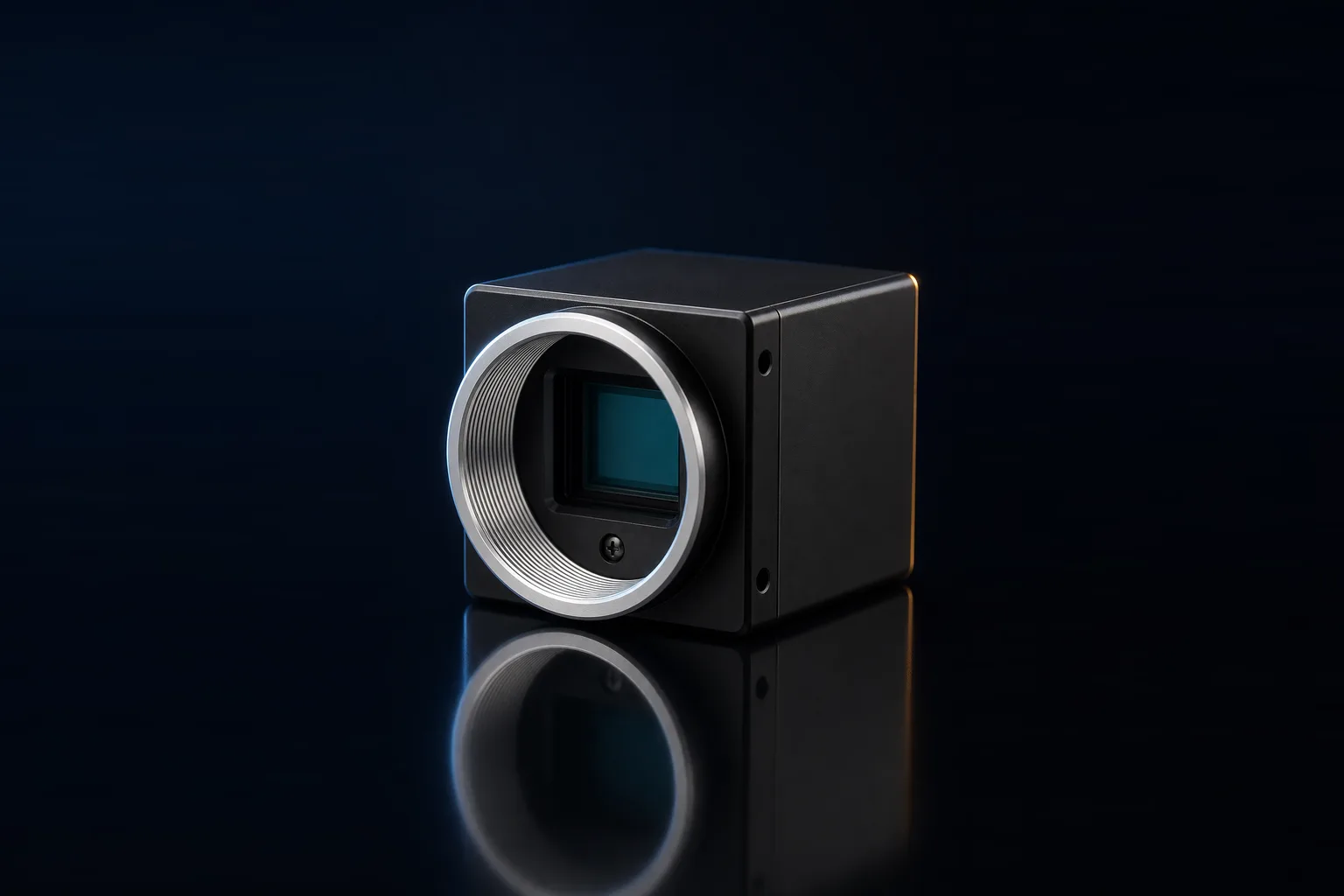
Mono 8 capture at 3072 × 2048 and 59.6 fps makes MV-CU060-10UM the intensity-imaging member of the USB Sony IMX178 pair. Its 1/1.8-inch CMOS sensor has 2.4 µm pixels and a rolling shutter, with exposure adjustable from 8 µs to 1 sec. The short 29 mm × 29 mm × 30 mm body places six-megapixel-class acquisition close to a USB-connected processing host.
The camera is suited to indexed edge measurement, mark and code imaging, presence checks, and surface-contrast inspection where colour is unnecessary. USB 3.0 can supply the typical 1.9 W at 5 V DC, while a 9 V DC to 24 V DC input supports separately powered machinery. One isolated input, one isolated output, and one bidirectional non-isolated line provide the connections needed for part sensing and illumination timing.
MV-CU060-10UC adds Bayer RG 8 colour at the same resolution and 59.6 fps when hue carries inspection information. MV-CU060-10GM uses Gigabit Ethernet at 19.1 fps for a longer network-oriented topology. MV-CU013-80UM drops to 1280 × 1024 but combines a global shutter with 240.4 fps, making it the stronger choice when motion timing outweighs spatial sampling.
Specifications
| Product type | 6.3 MP USB 3.0 Area Scan Camera |
| Sensor type | CMOS, rolling shutter |
| Sensor model | Sony® IMX178 |
| Sensor format | 1/1.8″ |
| Resolution | 3072 × 2048 |
| Pixel size | 2.4 μm × 2.4 μm |
| Maximum frame rate | 59.6 fps @3072 × 2048 Mono 8 |
| Mono color | Mono |
| Dynamic range | 66.4 dB |
| Exposure time | 8 μs to 1 sec |
| Gain | 0 dB to 24 dB |
| Data interface | USB3.0, compatible with USB2.0 |
| Digital I/O | 6-pin P7 connector provides power and I/O, including opto-isolated input × 1 (Line 0), opto- isolated output × 1 (Line 1), bi-directional non-isolated I/O × 1 (Line 2). |
| Lens mount | C-mount |
| Power supply | 9 VDC to 24 VDC, supports USB3.0 power supply |
| Power consumption | Typ. 1.9 W @ 5 VDC (USB3.0 provides power supply) |
| Ingress protection | IP40 (under proper lens installation and wiring) |
| Operating temperature | 0 °C to 50 °C (32 °F to 122 °F) |
| Storage temperature | -30 °C to 70 °C (-22 °F to 158 °F) |
| Humidity | 20% to 80% RH, non-condensing |
| Dimensions | 29 mm × 29 mm × 30 mm (1.1″ × 1.1″ × 1.2″) |
| Weight | Approx. 76 g (0.2 lb.) |
| Certification | CE-EMC, KC, UL |
| Compatibility | USB3 Vision, GenICam |
Selection and applications
Fast monochrome edge inspection. Indexed mark and code capture. Host-powered compact vision stations.
Minimum kit: The minimum setup is MV-CU060-10UM, a 1/1.8-inch-compatible C-mount lens, and a USB 3.0 cable to a powered host port, or a 9 V DC to 24 V DC supply for separate power.
Nearby in the range: MV-CU060-10UC — Prefer it when Bayer RG 8 colour is needed at 59.6 fps.; MV-CU060-10GM — Prefer it when the link must be Gigabit Ethernet rather than USB 3.0.; MV-CU013-80UM — Prefer it for a global shutter and 240.4 fps at 1280 × 1024..
Cables and accessories for this model
Compatibility per manufacturer data.
- Data cables
- USB 3.0
- I/O & power cables
- Hirose 6-pin IO
- Power
- Power
- Mounting
- Camera mounts
FAQ
Why choose the Mono 8 member of the Sony IMX178 USB pair?
MV-CU060-10UM outputs Mono 8 at 3072 × 2048 and 59.6 fps. Use it when algorithms depend on intensity, edges, or texture rather than colour. MV-CU060-10UC retains the same basic timing and sensor geometry but provides Bayer RG 8 colour data.
Does MV-CU060-10UM need a separate camera power lead?
Not necessarily. The USB 3.0 connection can provide power, with typical consumption of 1.9 W at 5 V DC. A 9 V DC to 24 V DC supply is also supported, so separate power can be used where the host port or cable arrangement is not selected for camera power.
What must the lens resolve on this monochrome USB camera?
The optical interface is C-mount, in front of a 1/1.8-inch sensor sampled at 2.4 µm. Select coverage for that sensor format and resolution for a 3072 × 2048 raster. Field of view and working distance then determine the appropriate focal length.
Can a short exposure remove all rolling-shutter distortion?
Exposure can be reduced to 8 µs, which can limit motion blur, but the sensor remains rolling shutter. For measurement of a moving object, arrange a stop-and-capture sequence or controlled lighting. MV-CU013-80UM provides a global shutter when row timing is unacceptable.
How can this camera exchange timing signals with a machine?
Its 6-pin P7 connector includes one opto-isolated input, one opto-isolated output, and one bidirectional non-isolated I/O. These can connect an acquisition trigger, an illumination command, and a status or control signal according to the machine timing design.