Area camera · CU Series
Hikrobot MV-CU120-10UM
- Warranty
- 36 months
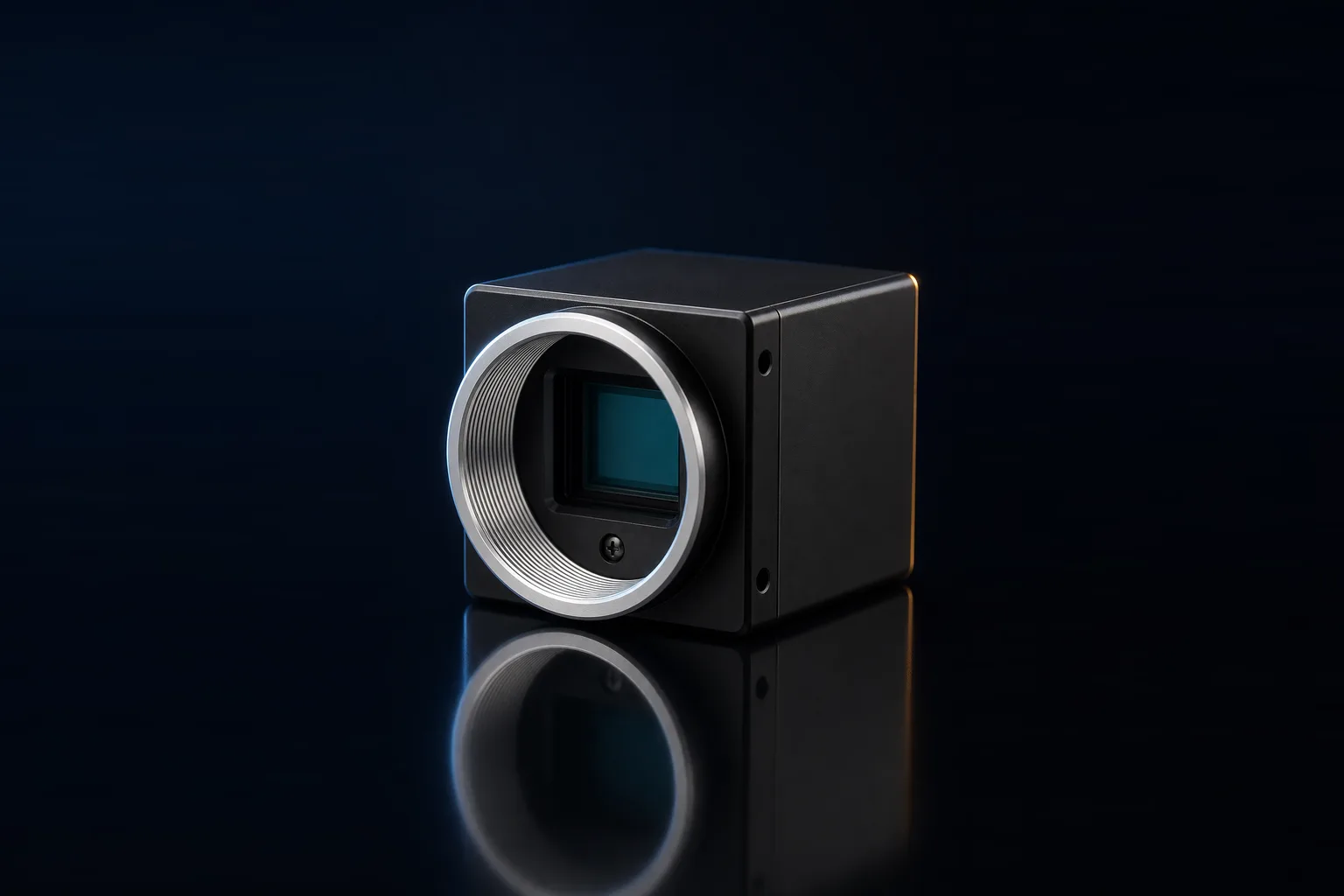
Detailed monochrome capture in the CU range
Mono 8 images at 4024 × 3036 and 29.2 fps make MV-CU120-10UM a high-detail USB camera for intensity-driven inspection. The Sony IMX226 is a 1/1.7-inch rolling-shutter CMOS sensor with 1.85 µm pixels, 69.4 dB dynamic range, and exposure from 20 µs to 0.5 sec. Its 29 mm × 29 mm × 30 mm housing concentrates this sampling into a short C-mount body.
The camera is suited to indexed dimensional inspection, small-mark detection, alignment, and texture assessment where colour data is unnecessary. A USB 3.0 port can deliver data and the typical 1.9 W at 5 V DC, reducing the connections near a local host. Alternatively, a 9 V DC to 24 V DC feed can power the camera, and the P7 lines can synchronize acquisition with sensing and illumination.
MV-CU120-10UC retains the same resolution and 29.2 fps cadence but adds Bayer RG 8 colour. MV-CU120-10GM changes the connection to Gigabit Ethernet and lowers the rate to 9.7 fps for distributed layouts. MV-CU200-20UM records 5120 × 3840 Mono 8 at 18 fps when almost twenty-megapixel sampling is worth the lower throughput.
Specifications
| Product type | 12.2 MP USB 3.0 Area Scan Camera |
| Sensor type | CMOS, rolling shutter |
| Sensor model | Sony® IMX226 |
| Sensor format | 1/1.7″ |
| Resolution | 4024 × 3036 |
| Pixel size | 1.85 μm × 1.85 μm |
| Maximum frame rate | 29.2 fps @4024 × 3036 Mono 8 |
| Mono color | Mono |
| Dynamic range | 69.4 dB |
| Exposure time | 20 μs to 0.5 sec |
| Gain | 0 dB to 24 dB |
| Data interface | USB3.0, compatible with USB2.0 |
| Digital I/O | 6-pin P7 connector provides power and I/O, including opto-isolated input × 1 (Line 0), opto- isolated output × 1 (Line 1), bi-directional non-isolated I/O × 1 (Line 2). |
| Lens mount | C-mount |
| Power supply | 9 VDC to 24 VDC, supports USB3.0 power supply |
| Power consumption | Typ. 1.9 W @ 5 VDC (USB3.0 provides power supply) |
| Ingress protection | IP40 (under proper lens installation and wiring) |
| Operating temperature | 0 °C to 50 °C (32 °F to 122 °F) |
| Storage temperature | -30 °C to 70 °C (-22 °F to 158 °F) |
| Humidity | 20% to 80% RH, non-condensing |
| Dimensions | 29 mm × 29 mm × 30 mm (1.1″ × 1.1″ × 1.2″) |
| Weight | Approx. 76 g (0.2 lb.) |
| Certification | CE-EMC, KC, UL |
| Compatibility | USB3 Vision, GenICam |
Selection and applications
Indexed dimensional inspection. Small monochrome mark detection. Detailed USB alignment imaging.
Minimum kit: The minimum setup is MV-CU120-10UM, a 1/1.7-inch-compatible C-mount lens, and a USB 3.0 cable to a powered host, or a 9 V DC to 24 V DC supply for separate power.
Nearby in the range: MV-CU120-10UC — Prefer it when Bayer RG 8 colour is needed at 4024 × 3036 and 29.2 fps.; MV-CU120-10GM — Prefer it for a Gigabit Ethernet link at the same resolution and 9.7 fps.; MV-CU200-20UM — Prefer it when 5120 × 3840 Mono 8 sampling is required at 18 fps..
Cables and accessories for this model
Compatibility per manufacturer data.
- Data cables
- USB 3.0
- I/O & power cables
- Hirose 6-pin IO
- Power
- Power
- Mounting
- Camera mounts
FAQ
What kind of analysis benefits from MV-CU120-10UM?
The camera supplies Mono 8 at 4024 × 3036 and 29.2 fps. That format suits algorithms based on edges, texture, position, and brightness without carrying colour samples. MV-CU120-10UC is the corresponding choice when Bayer RG 8 colour is required.
How is power delivered in a compact USB installation?
USB 3.0 can power MV-CU120-10UM at a typical 1.9 W from 5 V DC. The camera also accepts 9 V DC to 24 V DC for separate power. This allows the supply topology to follow host-port capacity and machine wiring constraints.
What C-mount lens coverage is required at 4024 × 3036?
A C-mount lens must cover the 1/1.7-inch Sony IMX226 and resolve detail consistent with its 1.85 µm pixels. Select focal length only after defining object size, field of view, and working distance, then verify resolution across the full image circle.
Does the short exposure change the shutter architecture?
No. Exposure can be set down to 20 µs, which helps reduce motion blur, but the sensor remains rolling shutter. Accurate geometry is most straightforward with stationary or indexed targets; global-shutter cameras address continuously moving measurement scenes.
What ambient operating range applies around MV-CU120-10UM?
The camera operates from 0 °C to 50 °C and from 20% to 80% RH without condensation. Its enclosure is IP40 with correct lens installation and wiring. Prevent direct liquid exposure and maintain a non-condensing environment around the camera.