3D laser profile sensor · DP2000 series Laser Profiler
Hikrobot MV-DP2050
- Warranty
- 36 months
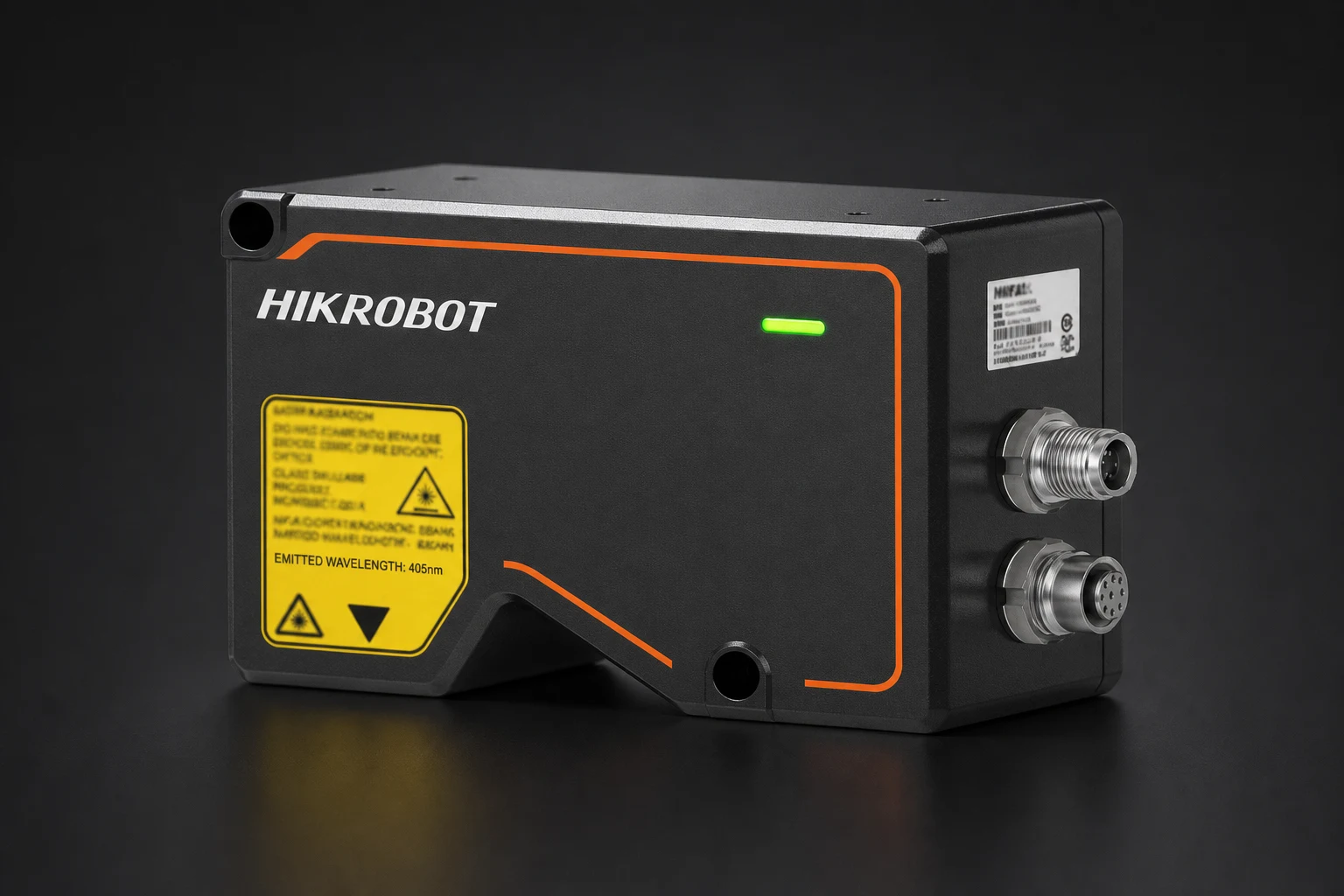
Narrow-range profiling with more standoff
A 47 mm working distance and 31.5 mm reference field give MV-DP2050 more lateral coverage than the shortest-range profilers while retaining a 6 mm Z range. Each profile contains 3200 points, with 1.58 to 1.74 µm Z resolution and 0.41 µm repeatability. The high-frame-rate mode spans 3.3 to 23.9 kHz over Gigabit Ethernet.
This geometry fits shallow parts whose height, edge position or surface contour must be followed across roughly a 30 mm width. The field varies from 30.5 mm near to 32.5 mm far, so the usable width can be matched to the expected height envelope. IP67 protection and a 0 to 45 °C working range support installation near production motion, while the M12 I/O supplies timing channels.
Choose MV-DP2050 over MV-DP2020 when the 47 mm standoff and 31.5 mm field matter more than MV-DP2020's 0.22 µm repeatability. MV-DP2061 works near 60.2 mm and widens the reference field to 46.6 mm with a 10.4 mm Z range. MV-DP2050 stays focused on shallow 6 mm relief with 0.41 µm repeatability and the same 23.9 kHz upper rate.
Overview
A DP2000 series laser profiler — the base class: the sensor projects a laser line across the part and measures height at every point of the section, up to 3200 points per profile.
Working distance 47 mm, measurement range 6 mm.
Used where a profile is needed rather than a picture: weld bead control, adhesive bead height, gap and flush, warpage, parcel volume. Data goes to VM3D or 3DMVS, and to third-party software over a standard protocol.
Specifications
| Resolution | 3200 |
| Scan frame rate | 3.3 kHz to 23.9 kHz (high frame rate mode) |
| Data interface | Gigabit Ethernet (1000 Mbit/s), compatible with Fast Ethernet (100 Mbit/s) |
| Digital I/O | 12-pin M12 interface provides power and I/O, including opto-isolated input × 2 (Line 0/9), differential input × 2 (Line 3/6), and differential output × 1 (Line 1) |
| Working distance | 47 mm |
| Resolution z-axis | 1.58 μm to 1.74 μm |
| Repeatability z-axis | 0.41 μm @ data that sensor tests gauge block on optical platform |
| Measurement range z-axis | 6 mm |
| Power supply | 24 VDC |
| Power consumption | Typ. 15.2 W @ 24 VDC |
| Ingress protection | IP67 |
| Operating temperature | 0 °C to 45 °C (32 °F to 113 °F) |
| Storage temperature | –30 °C to 80 °C (–22 °F to 176 °F) |
| Humidity | 20% RH to 85% RH (no condensation) |
| Dimensions | 155.5 mm × 101 mm × 53.5 mm (6.1″ × 4.0″ × 2.1″) |
| Weight | Approx. 992 g (2.2 lb.) |
| Field of view | 30.5 mm @ near field of view; 31.5 mm @ reference distance; 32.5 mm @ far field of view |
| Accuracy | 0.01 |
| Resolution x-axis | 9.9 µm to 10.4 µm |
| Laser class | Class 3R |
| Laser wavelength | 405 nm |
| Software | 3DMVS, VM3D, or third-party software |
Selection and applications
Shallow height inspection across a 31.5 mm reference field. Edge and contour tracking within a 6 mm Z range. Moving-line profile capture from 3.3 to 23.9 kHz.
Minimum kit: MV-DP2050, a Gigabit Ethernet cable, a 12-pin M12 power and I/O cable, a 24 VDC supply, and a 3DMVS, VM3D or third-party software host form the minimum acquisition kit.
Nearby in the range: MV-DP2020 — Prefer it for a 21.4 mm working distance and 0.22 µm repeatability over a 14.3 mm reference field.; MV-DP2061 — Prefer it when the task needs a 46.6 mm reference field and a 10.4 mm Z range..
Cables and accessories for this model
Compatibility per manufacturer data.
- Other
- 3D accessories
FAQ
How wide a part can MV-DP2050 profile through its measurement range?
The X field is 30.5 mm near, 31.5 mm at the reference distance and 32.5 mm far. The corresponding Z range is 6 mm at a 47 mm working distance. These dimensions define the envelope for shallow height and contour measurements across the part.
What vertical detail and repeatability does MV-DP2050 provide?
Z resolution changes from 1.58 to 1.74 µm through the measurement range, and the stated repeatability is 0.41 µm from gauge-block testing on an optical platform. Each transverse profile contains 3200 measurement points.
Can MV-DP2050 follow a moving surface at high profile rates?
Its high-frame-rate mode covers 3.3 to 23.9 kHz. The chosen rate can be paired with the line motion to set longitudinal profile spacing, while the 3200 points in each profile define sampling across the X field.
What cabling and supply are needed for the MV-DP2050 installation?
Profile data uses Gigabit Ethernet at 1000 Mbit/s, with 100 Mbit/s Fast Ethernet compatibility. A 12-pin M12 connection carries 24 VDC power and I/O, and typical consumption is 15.2 W. The I/O provides isolated and differential channels.
What enclosure and temperature conditions are specified for MV-DP2050?
The enclosure is IP67 and operates from 0 to 45 °C. Storage is specified from -30 to 80 °C, with 20 to 85% RH when condensation is absent. The 155.5 × 101 × 53.5 mm housing weighs approximately 992 g.
Which software routes are stated for processing MV-DP2050 data?
The supported software choices are 3DMVS, VM3D or third-party software. Communication is through the Gigabit Ethernet interface, which is also compatible with Fast Ethernet when 100 Mbit/s operation fits the selected output rate.