3D Cameras and Laser Profilers
3D laser profilers and stereo cameras for geometry control: height, gap, flatness and volume — from micron-level Z resolution to robot guidance.
| Model | Z resolution | Z range | Scan rate | Interface |
|---|---|---|---|---|
| MV-DP4090-01P3D laser profile sensor | 1.87 to 3.98 µm | 42 mm | 2.5 kHz / 49 kHz ROI mode | Gigabit Ethernet… |
| MV-DP4060-01P3D laser profile sensor | 1.06 to 1.98 μm | 21 mm | 2.5 kHz | Gigabit Ethernet… |
| MV-DP3020-01P V2.03D laser profile sensor | 0.65 to 0.72 / 0.71 to 0.78 µm | 6 / 6.8 mm | 1.3 / 3.4 to 46.7 kHz | Gigabit Ethernet… |
| MV-DB700S-C V3.03D stereo camera | — | — | 30 fps | Gigabit Ethernet |
| MV-DP4020-01P3D laser profile sensor | — | — | 2.5 kHz | Gigabit Ethernet… |
| MV-DP4430-03P3D laser profile sensor | — | — | 2.5 kHz within max. measurement range; 49 kHz max in ROI mode | Gigabit Ethernet… |
| MV-DB1300A3D stereo camera | — | 2100 mm | — | Gigabit Ethernet |
| MV-DB500S3D stereo camera | — | 1500 mm / 1500 mm | 30 fps @ singulation mode / 6 fps @ volume measurement mode | Gigabit Ethernet / Gigabit Ethernet |
| MV-DL2125Line laser 3D camera | — | 1000 mm / 1000 mm | 600 fps @ 1 m3 measurement range | Gigabit Ethernet / Gigabit Ethernet 1000 Mbit/s 1000 Mbit/s |
| MV-DP20203D laser profile sensor | 0.71 μm to 0.78 µm | 6.8 mm | 1.7 kHz to 23.9 kHz | Gigabit Ethernet… |
| MV-DP20503D laser profile sensor | 1.58 μm to 1.74 μm | 6 mm | 3.3 kHz to 23.9 kHz | Gigabit Ethernet… |
| MV-DP20603D laser profile sensor | 1.50 μm to 2.71 μm | 26 mm | 660 Hz… | Gigabit Ethernet… |
| MV-DP20613D laser profile sensor | 2.71 μm to 3.26 μm | 10.4 mm | 3.3 kHz to 23.9 kHz | Gigabit Ethernet… |
| MV-DP20623D laser profile sensor | 0.94 μm to 1.22 µm | 11 mm | 1.7 kHz to 23.9 kHz | Gigabit Ethernet… |
| MV-DP20803D laser profile sensor | 3.77 μm to 4.54 μm | 15.2 mm | 3.3 kHz to 23.9 kHz | Gigabit Ethernet… |
| MV-DP21203D laser profile sensor | 3.83 μm to 7.74 μm | 80 mm | 660 Hz within max. measurement range; max. 10 kHz in ROI mode Hz / 1.7 to 23.9 kHz | Gigabit Ethernet… |
| MV-DP21403D laser profile sensor | 6.38 μm to 7.09 μm | 26 mm | 3.3 kHz to 23.9 kHz | Gigabit Ethernet… |
| MV-DP22403D laser profile sensor | 5.65 μm to 11.20 µm / 6.47 to 26.11 µm | 200 mm | 700 Hz , max. 10 KHz | Gigabit Ethernet… |
| MV-DP24703D laser profile sensor | 10.39 µm to 169.79 µm | 670 mm | 1.7 kHz to 23.9 kHz | Gigabit Ethernet… |
| MV-DP29003D laser profile sensor | 16.86 μm to 180.24 μm | 910 mm | 1.7 kHz to 23.9 kHz | Gigabit Ethernet… |
| MV-DP30603D laser profile sensor | 1.45 μm to 2.17 μm / 1.74 μm to 3.07 μm / 1.74 to 3.07 μm | 20.5 mm / 27 mm | 1.3 kHz… | Gigabit Ethernet… |
| MV-DP30623D laser profile sensor | 0.94 μm to 1.22 µm | 11 mm | 3.4 kHz to 46.7 kHz | Gigabit Ethernet… |
| MV-DP31203D laser profile sensor | 4.23 μm to 7.47 μm / 4.38 μm to 8.33 µm | 80 mm / 86 mm | 1.3 kHz… | Gigabit Ethernet… |
| MV-DP33003D laser profile sensor | 9.36 μm to 26.27 µm | 210 mm | 3.4 kHz to 46.7 kHz | Gigabit Ethernet… |
| MV-DP35803D laser profile sensor | 14.45 μm to 98.78 µm | 580 mm | 3.4 kHz to 46.7 kHz | Gigabit Ethernet… |
| MV-DP39003D laser profile sensor | 23.04 μm to 185.06 µm | 905 mm | 3.4 kHz to 46.7 kHz | Gigabit Ethernet… |
| MV-DP41803D laser profile sensor | 3.72 μm to 8.40 μm | 100 mm | 2.5 kHz , max. 49 kHz | Gigabit Ethernet… |
| MV-DP49403D laser profile sensor | 14.8 μm to 98.7 μm | 900 mm | 2.5 kHz , max. 49 kHz | Gigabit Ethernet… |
| MV-RS-Base-LGalvanometer laser 3D camera | — | 1000 mm | — | Gigabit Ethernet |
| MV-RS-Base-MGalvanometer laser 3D camera | — | 400 mm | — | Gigabit Ethernet |
| MV-RS-Base-SGalvanometer laser 3D camera | — | 400 mm | — | Gigabit Ethernet |
| MV-RS-Pro-XLGalvanometer laser 3D camera | — | 2000 mm | — | Gigabit Ethernet |
| MV-RS-Ultra-LGalvanometer laser 3D camera | — | 800 mm | — | Gigabit Ethernet |
| MV-RS-Ultra-MGalvanometer laser 3D camera | — | 700 mm | — | Gigabit Ethernet |
| MV-RS-Ultra-SGalvanometer laser 3D camera | — | 300 mm | — | Gigabit Ethernet |
| MV-RS-Ultra-XLGalvanometer laser 3D camera | — | 2000 mm | — | Gigabit Ethernet |
| iMVS-VM3D-63003D measurement software licence | — | — | — | — |
| iMVS-VM3D-6300/Licence Key3D measurement software licence | — | — | — | — |
| iMVS-VM3D-73003D measurement software licence | — | — | — | — |
| iMVS-VM3D-7300/Licence Key3D measurement software licence | — | — | — | — |
| iMVS-VM3D-Pro-63003D measurement software licence | — | — | — | — |
| iMVS-VM3D-Pro-73003D measurement software licence | — | — | — | — |
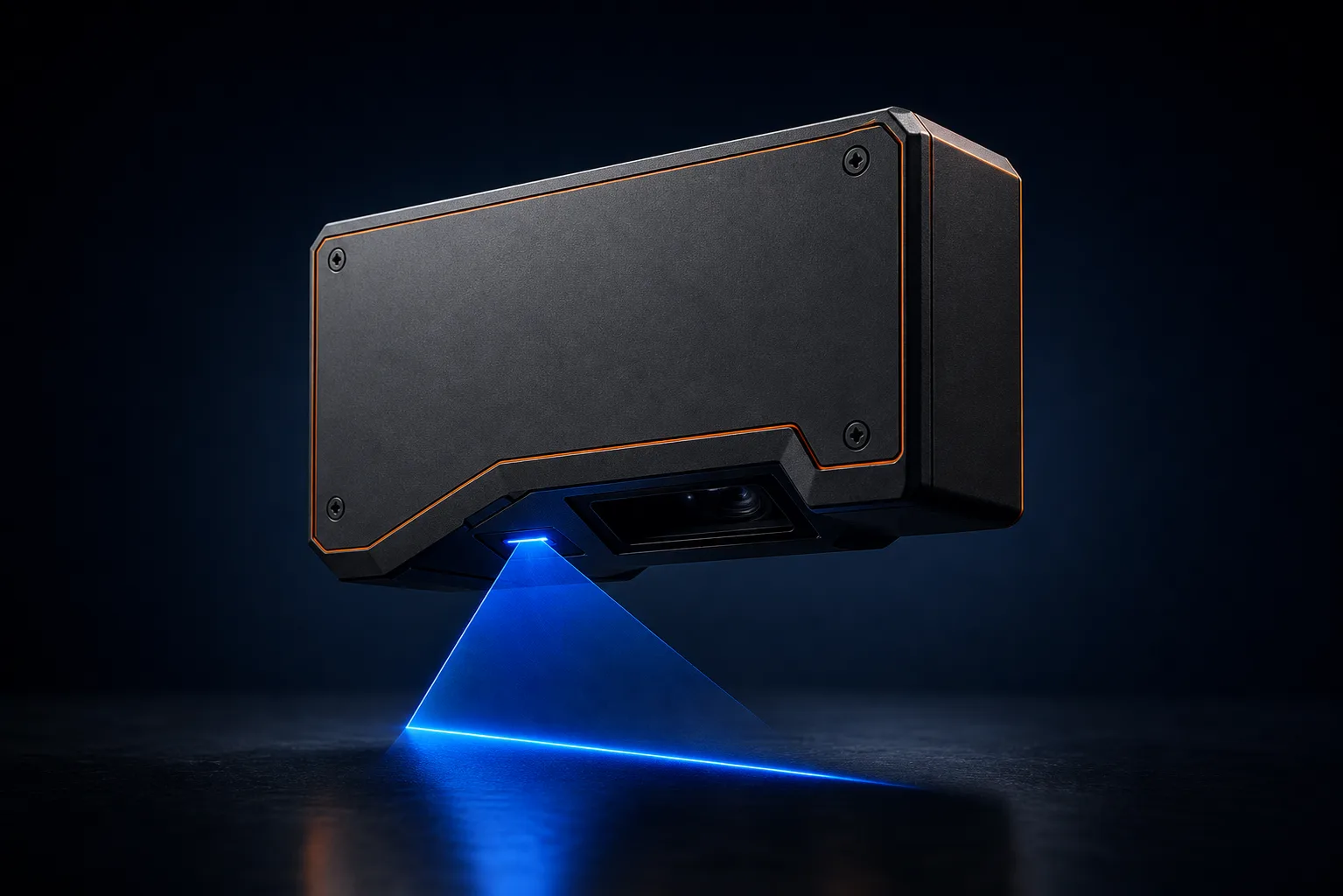
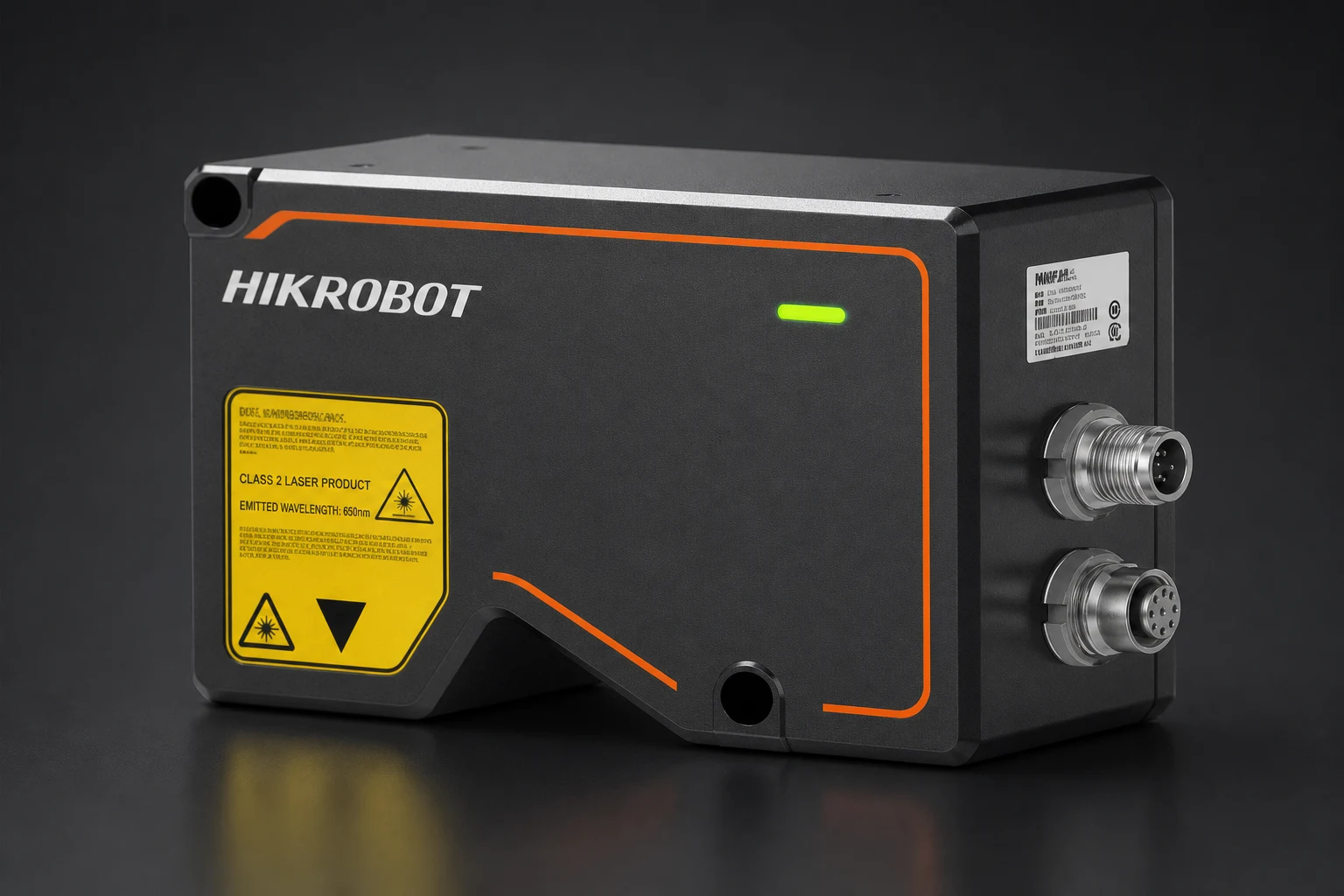
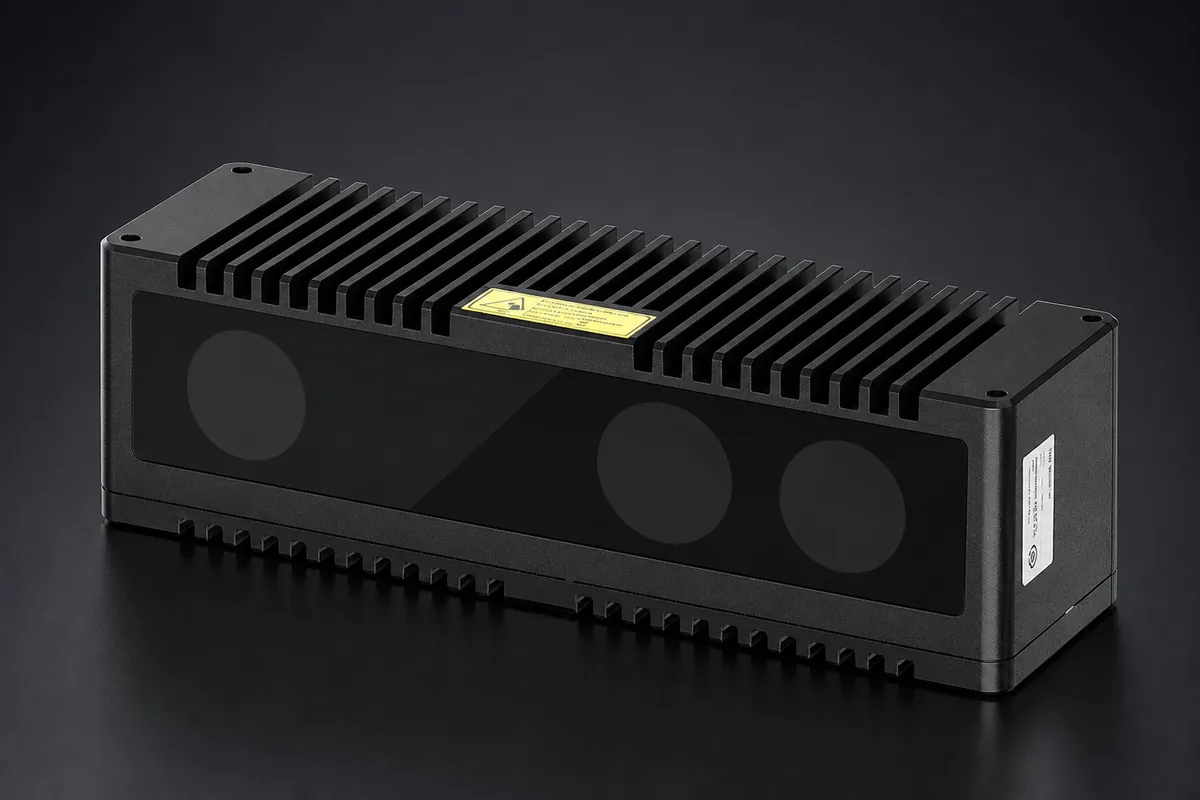
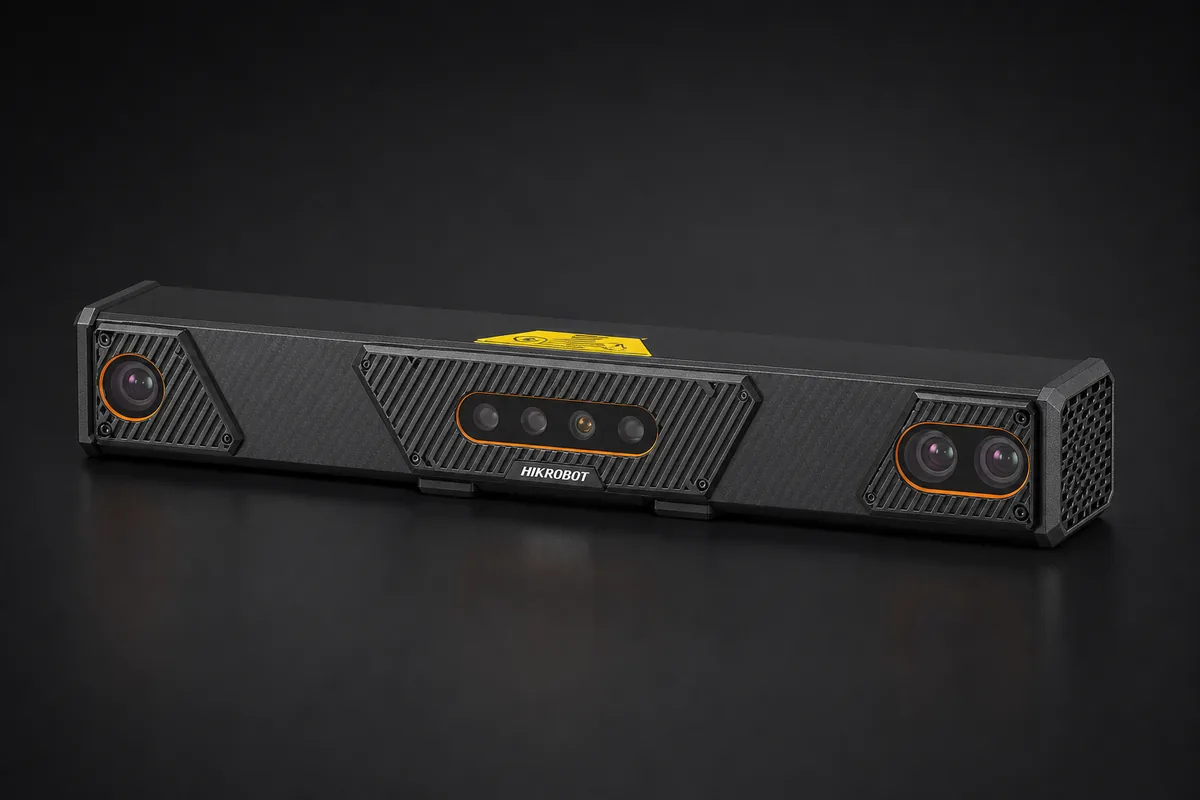
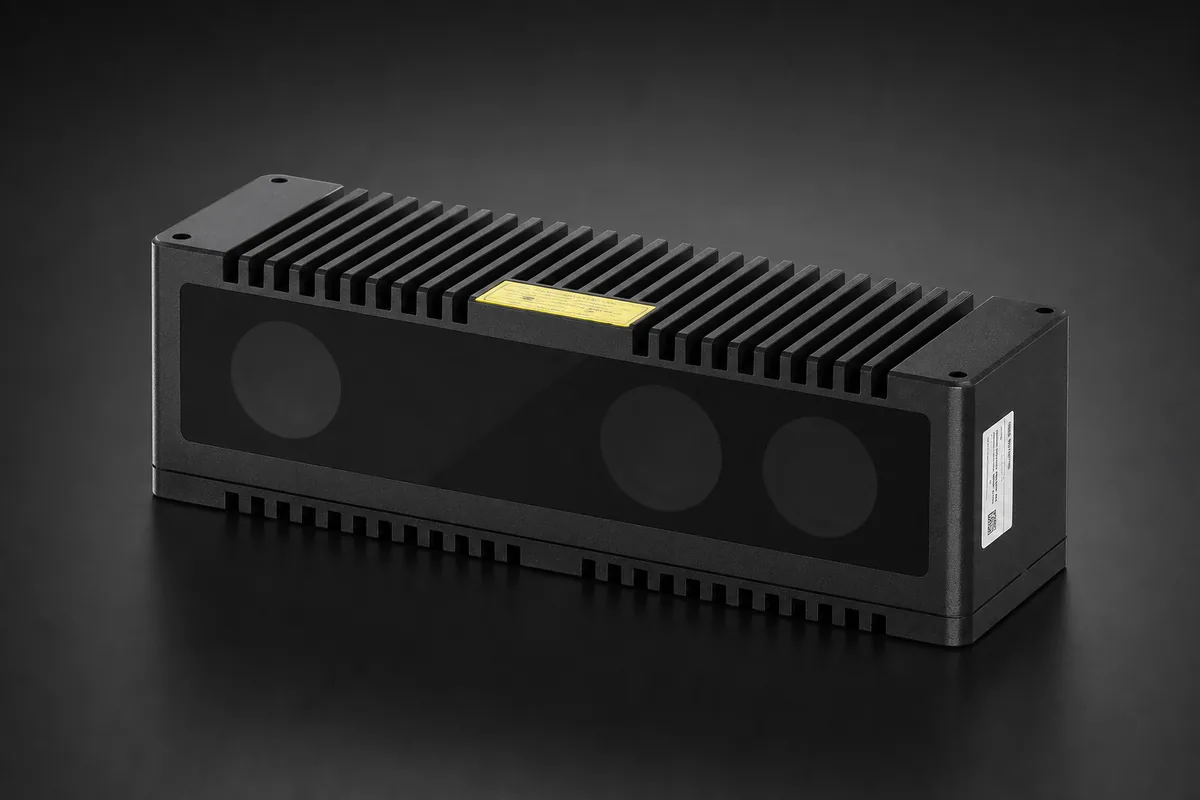
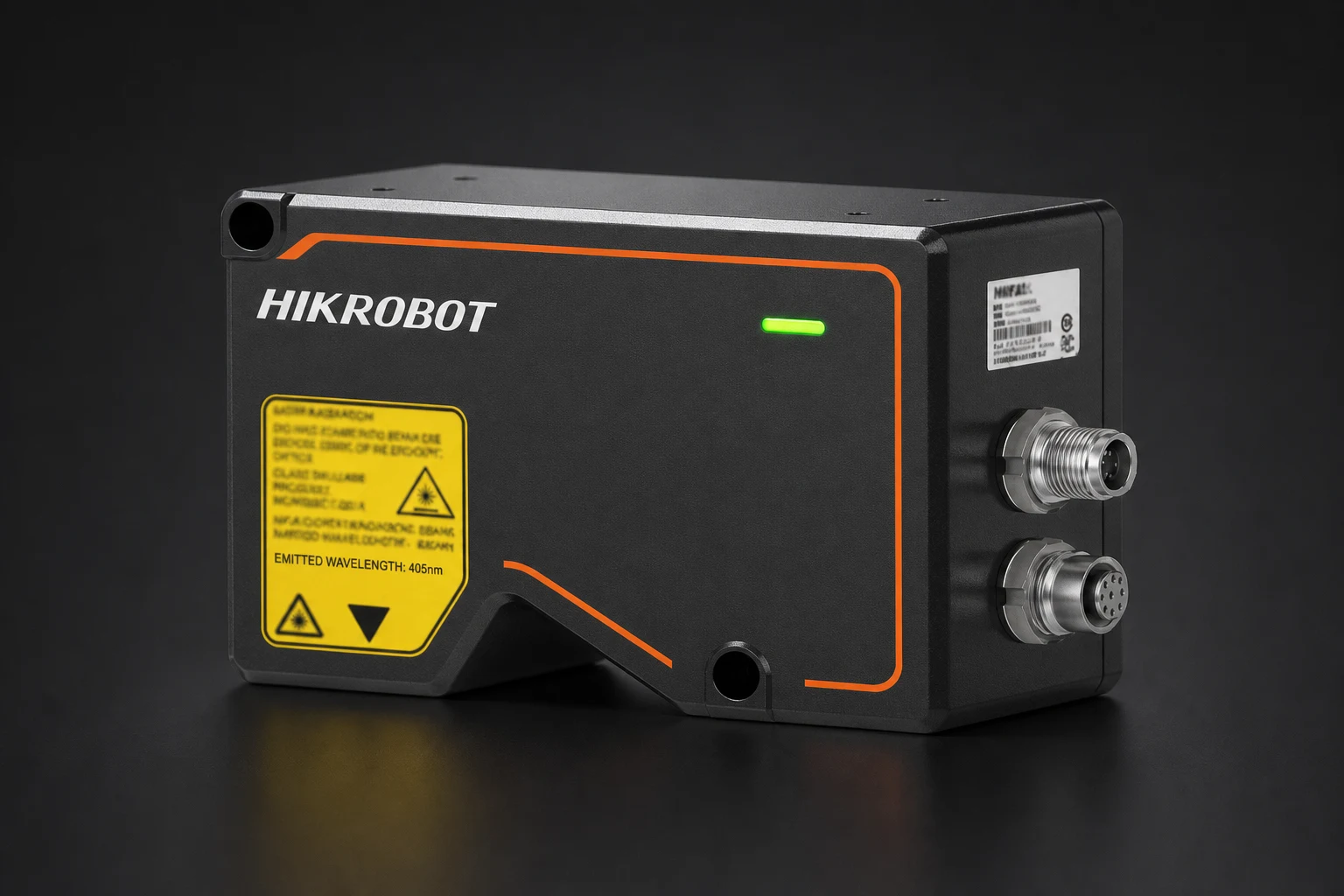
Choose the acquisition geometry first
The 3D range covers laser profile sensors, stereo cameras, galvanometer laser cameras, a line laser camera, and 3D measurement software licences. These acquisition types support geometry checks such as height, gap, flatness, and volume, with stereo depth also represented for robot guidance. They are distinct measurement arrangements rather than interchangeable versions of one camera class.
A laser profiler projects a line and triangulates height at many points across that line. One acquisition is a 2D height profile; relative motion between the sensor and part stacks successive profiles into a 3D surface. Stereo cameras acquire a depth scene, while galvanometer and line-laser products use their own scanning geometry. Decide which representation the task needs before comparing speed values.
For a profiler, selection is governed by working distance, measurement range, field of view across the laser line, points per profile, profile rate, and X and Z resolution. MV-DP2020-01P V2.0 illustrates the relationship: 21.4 mm working distance, 6.8 mm measurement range, fields of view from 14.0 to 14.6 mm, 3200 points/profile, and a 1.7–23.9 kHz profile rate.
Resolution, repeatability, enclosure, laser, power, and network connection complete the check. The same profiler lists 0.71-0.78 um Z resolution, 4.38-4.67 um X resolution, and 0.22 um repeatability on a gauge block and optical platform. It uses a 405 nm Class 3R laser, Gigabit Ethernet, 24 VDC, IP67, and 3DMVS software. Speeds expressed in fps, Hz, and kHz should only be compared within the same acquisition class.
FAQ
Which 3D acquisition class matches the required measurement output?
Choose among a laser line profile, a stereo depth scene, galvanometer scanning, and the listed line laser arrangement. Laser profilers suit successive cross-section acquisition, while stereo products are represented for depth scenes and robot guidance. The geometries should not be treated as direct substitutes.
How does motion turn a laser profile into a full 3D surface?
The profiler projects a laser line and triangulates height at many positions across it, producing one 2D profile. Motion of the object or sensor supplies the second scan direction, so successive profiles can be stacked into the 3D representation.
What geometry defines the measurable window of a compact profiler?
Check working distance, measurement range, and the near, reference, and far fields of view together. For MV-DP2020-01P V2.0 these are 21.4 mm working distance, 6.8 mm range, and 14.0, 14.3, and 14.6 mm fields of view.
Which sampling and repeatability figures require separate review?
MV-DP2020-01P V2.0 records 3200 points/profile and lists 0.71-0.78 um Z resolution, 4.38-4.67 um X resolution, and 0.22 um repeatability on a gauge block and optical platform. Keep these quantities distinct when assessing the measurement task.
Why should fps, Hz, and kHz values not form one speed ranking?
The range uses different speed units because its devices acquire different kinds of information. A profiler rate in kHz describes profiles, while other geometries use fps or Hz. Compare rate only after choosing the device class and defining what one acquisition represents.
The 3D category contains distinct acquisition geometries: laser profilers, stereo cameras, galvanometric scanning cameras, and a laser line camera. They should not be treated as interchangeable. The English core currently includes one documented 3D laser profiler, MV-DP2020-01P V2.0, PN 306400482. This guide therefore focuses on laser-line triangulation and that model's evidenced measurement envelope.
How a laser profiler builds 3D data
A 3D laser profiler projects a laser line and uses triangulation to collect height at many points across the line. Laser line profiler, laser profile sensor, and laser triangulation sensor are documented names for this class. The query variant 2D profile sensor refers to one profile; motion of the part or sensor stacks profiles into the 3D representation produced by a 3D profile scanner.
MV-DP2020 measurement geometry
MV-DP2020-01P V2.0 has a 21.4 mm working distance and 6.8 mm measurement range. Its near, reference, and far fields of view are 14.0, 14.3, and 14.6 mm. It records 3200 points/profile at 1.7–23.9 kHz.
Resolution and repeatability fields
The documented Z resolution is 0.71-0.78 um and X resolution is 4.38-4.67 um. Listed repeatability is 0.22 um on a gauge block and optical platform. A publication-ready accuracy or linearity specification with units is not available here; rely on the official datasheet for metrology decisions.
Interface, enclosure, and laser class
The model uses a 405 nm Class 3R laser, Gigabit Ethernet, and 24 VDC power. It has an IP67 rating and is documented with 3DMVS software.
Compare speed only within one device class
The broader category records speed in fps, Hz, and kHz depending on acquisition geometry. These fields should not be combined into one ranking without normalization.
FAQ
Do you need a laser line profile, a full 3D surface, or a stereo depth scene for robot guidance?
A laser line profiler collects a 2D height profile across a projected line; motion of the part or sensor stacks profiles into a 3D representation. The local 3D category treats stereo cameras and the other documented acquisition geometries as distinct classes that should not be described as interchangeable.