Frame grabber · GE Series
Hikrobot MV-GE2002P V2.0
- Lead time
- from 5 days
- Warranty
- 36 months
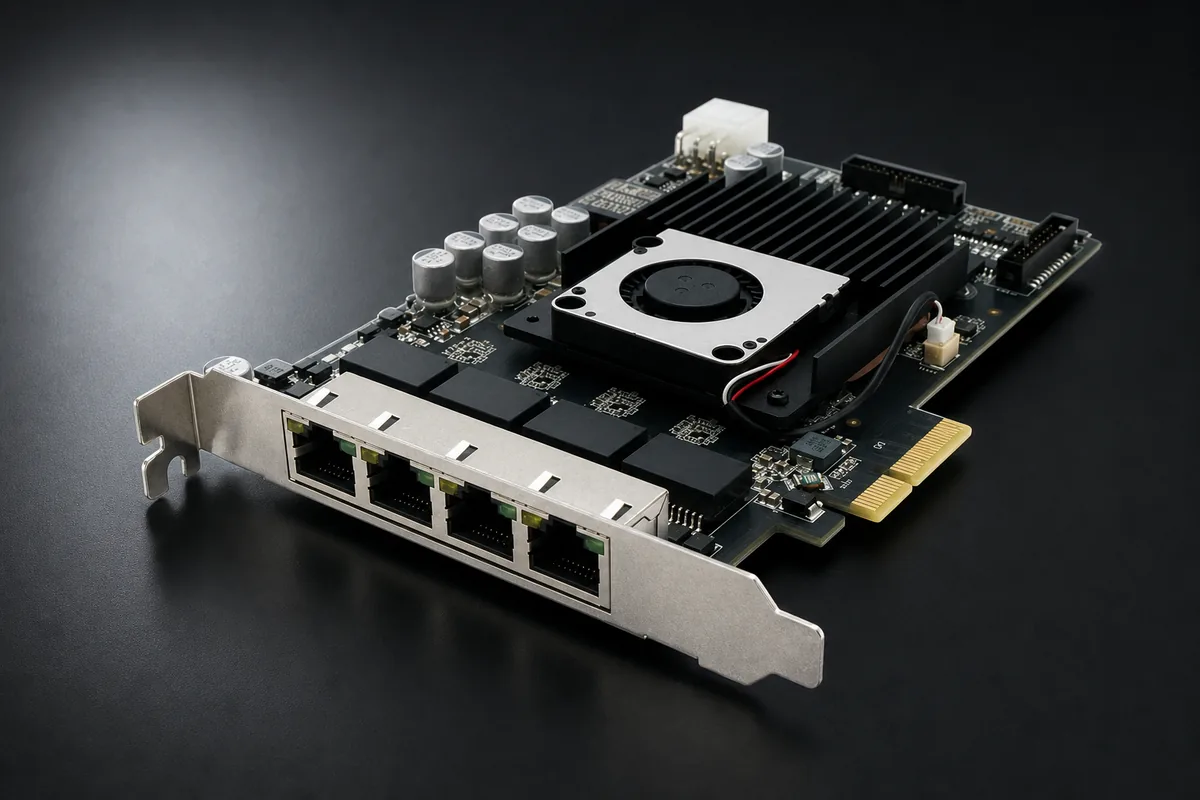
PoE-equipped dual-port selection
PoE support sets MV-GE2002P V2.0 apart as the powered member of the dual-port GE2000 NIC group. Two RJ45 interfaces accept 10/100/1000 Mbit/s GigE industrial cameras, and the shared host route sustains 800 MB/s with an 860 MB/s maximum. The board uses a PCI-E gen2 × 4 interconnect with a gen2 × 2 link and consumes 7.5 W, before considering the power needs of attached equipment.
The paired-port design is suited to two-view inspection where camera traffic and power are carried through the PoE-enabled network connections. Natural cooling fins operate without a board fan, and the stated working range is 0 to 60 °C at 10 to 95% RH. Its 181 × 126.3 × 21.6 mm dimensions and 190 g weight should be allowed for in the host, whose operating system may be Windows 7/10/11 or Linux.
MV-GE2002 V2.0 is the lighter two-port choice at 125 g and 4.3 W, with a 161 × 120 × 21.6 mm board, but the P variant is the one that explicitly supports PoE. MV-GE2002L V2.0 also draws 4.3 W and reduces height to 79.2 mm while listing 9 KB jumbo frames. For four powered camera ports, MV-GE2004P V2.0 retains the 800 MB/s host path but increases consumption to 9 W and weight to 201 g.
Specifications
| Data interface | GigE |
| Board bandwidth | 6880 Mbit/s (max.); 6400 Mbit/s (sustained) |
| Camera connectors | RJ45 ×2 |
| Host interface | PCIe 2.0 x4 |
| Maximum cameras | ≤2 |
| Protocol compatibility | IEEE 802.3 |
| Operating systems | Windows 7, Windows 10, Windows 11, Linux |
| Power consumption | 7.5 W (typical) @ excluding PoE output |
| Cooling | natural cooling, heat sink |
| Working temperature | 0…60 °C |
| Storage temperature | -20…70 °C |
| Humidity | 10…95 % @ non-condensing |
| Dimensions | 181×126.3×21.6 mm |
| Weight | 190 g |
| Certification | CE, RoHS, KC |
| Channel bandwidth | 10 Mbit/s; 100 Mbit/s; 1000 Mbit/s |
| Streams | 2 |
| Cooling fan present | no |
| Jumbo frame support | 9000 bytes |
Documents
Selection and applications
Powered dual-GigE acquisition. Two-view Ethernet inspection. Fanless PoE camera networking.
Minimum kit: Mount MV-GE2002P V2.0 in a PCI-E gen2 host and connect up to two PoE-capable GigE industrial cameras with RJ45 network cables, using the card's listed PoE support for camera power.
Nearby in the range: MV-GE2002 V2.0 — Prefer it for a 125 g, 4.3 W dual-port card with 800 MB/s sustained transfer; MV-GE2002L V2.0 — Prefer it for the 79.2 mm board height and 9 KB jumbo-frame support; MV-GE2004P V2.0 — Prefer it when four PoE-enabled GigE ports are needed.
FAQ
Does MV-GE2002P V2.0 provide PoE on its RJ45 interfaces?
PoE support is explicitly listed for this two-port model. Both RJ45 connections are intended for GigE industrial cameras at 10/100/1000 Mbit/s, allowing the powered variant to carry network traffic and camera power through those links.
What PCI-E host link is required for MV-GE2002P V2.0?
The card uses a PCI-E gen2 × 4 interconnect and negotiates a PCI-E gen2 × 2 link. It provides 860 MB/s maximum transfer bandwidth and 800 MB/s sustained bandwidth to the host.
What thermal arrangement is used on MV-GE2002P V2.0?
The board is naturally cooled with fins and has no fan. Consumption is 7.5 W, operation is specified from 0 to 60 °C, and the storage interval is -20 to 70 °C.
How large and heavy is the MV-GE2002P V2.0 acquisition card?
MV-GE2002P V2.0 measures 181 × 126.3 × 21.6 mm and weighs 190 g. These mechanical figures differ from the smaller 161 × 120 × 21.6 mm, 125 g MV-GE2002 V2.0.
Which operating systems can host the MV-GE2002P V2.0 board?
The supported host list includes Windows 7, Windows 10, Windows 11 and Linux. Camera-side support is stated for as many as two GigE industrial cameras on the RJ45 ports.
When should MV-GE2004P V2.0 replace a two-port layout?
Use MV-GE2004P V2.0 when the system needs four powered GigE camera ports rather than two. It keeps 800 MB/s sustained transfer and PoE support, but board consumption rises from 7.5 W to 9 W.