Frame grabber · GE Series
Hikrobot MV-GE2004P V2.0
- Warranty
- 36 months
Powered four-port NIC context
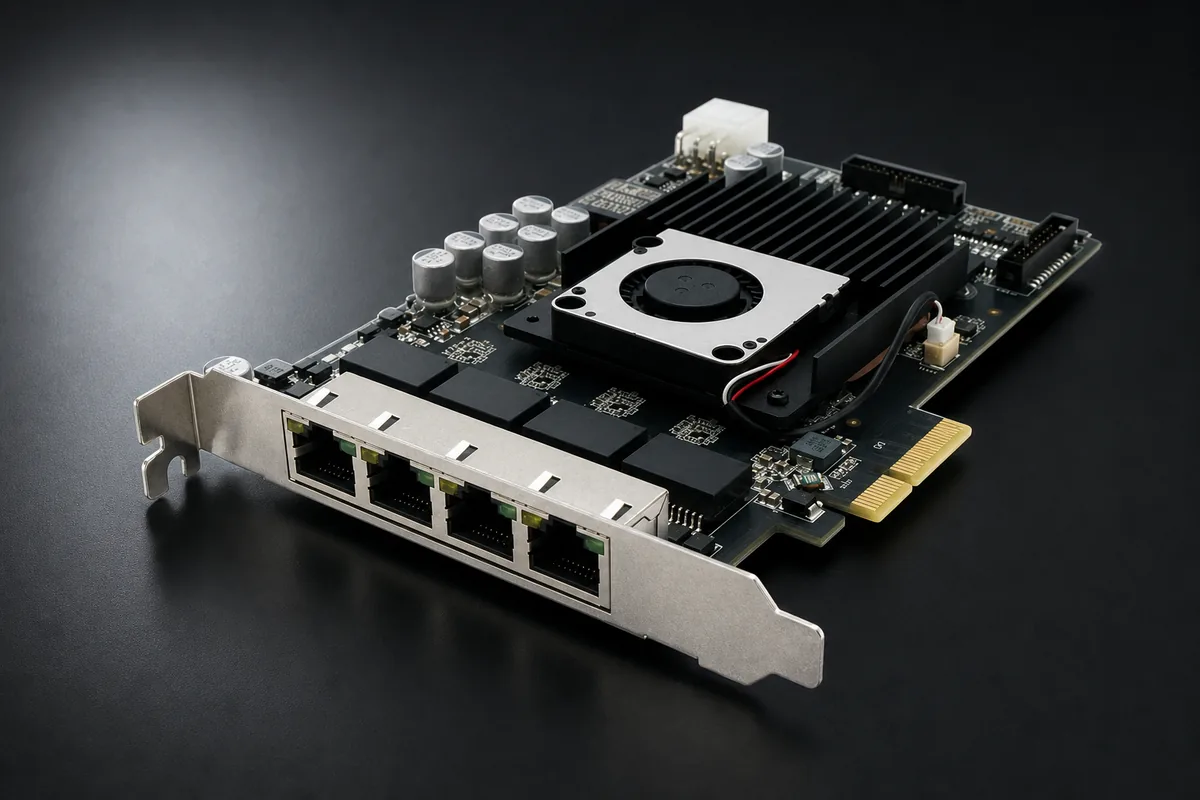
Four PoE-enabled RJ45 interfaces define MV-GE2004P V2.0 as the powered four-camera NIC in the GE2000 group. Each link supports 10/100/1000 Mbit/s GigE industrial cameras. The card uses PCI-E gen2 × 4 with a gen2 × 2 link, delivering 860 MB/s maximum and 800 MB/s sustained bandwidth. Natural cooling fins handle the board's 9 W consumption without an on-board fan.
The arrangement suits a four-view inspection computer where the camera network should also provide power through the RJ45 connections. Its 181 × 126.3 × 21.6 mm outline and 201 g weight need to be included in host mechanical planning. During acquisition the enclosure must maintain 0 to 60 °C and 10 to 95% RH; supported host environments include Windows 7/10/11 and Linux.
MV-GE2004 V2.0 carries four camera connections in a smaller 161 × 120 × 21.6 mm, 130 g card and draws 5.5 W, while retaining the same 800 MB/s sustained path. MV-GE2002P V2.0 keeps PoE but reduces the camera count to two, consumption to 7.5 W and weight to 190 g. MV-GE2204P also provides four PoE ports and 800 MB/s sustained transfer, adding a WX1860 chip and 9.5 KB jumbo frames at 3 W board consumption.
Specifications
| Camera ports | RJ45 × 4 |
| Cameras supported | 4 max |
| Camera connection speed | 10/100/1000 Mbps |
| Camera type supported | GigE industrial camera |
| Interconnect | PCI-E gen2 × 4, PCI-E gen2 × 2 link |
| Delivery bandwidth | 860 MB/s (max. transmission bandwidth), 800 MB/s (sustained transmission bandwidth) |
| Sustained transmission bandwidth | 800 MB/s |
| PoE support | PoE supported |
| Power consumption | 9 W |
| Operating temperature | 0 to 60 °C |
| Storage temperature | -20 to 70 °C |
| Humidity | 10 to 95 % RH |
| Dimensions | 181 × 126.3 × 21.6 mm |
| Weight | 201 g |
| Certification | CE-EMC,KC |
| Camera interface standard | IEEE 802.3 |
| Cooling mode | Natural cooling, cooling fins without fans |
| Supported OS | Windows 7/10/11, Linux |
Selection and applications
Four-port PoE camera intake. Powered multi-view GigE inspection. Passively cooled Ethernet capture.
Minimum kit: Install MV-GE2004P V2.0 in a PCI-E gen2 host and attach up to four PoE-capable GigE industrial cameras with RJ45 network cables, using the board's PoE-enabled interfaces for power.
Nearby in the range: MV-GE2004 V2.0 — Prefer it for four camera ports in a 130 g, 5.5 W card.; MV-GE2002P V2.0 — Prefer it when only two PoE-enabled camera ports are needed.; MV-GE2204P — Prefer it for 9.5 KB jumbo frames and 3 W board consumption..
Cameras that connect to this board
RJ45 × 4 · up to 4 cameras · 860 MB/s:
Matched by interface and port count.
FAQ
How many powered camera links are on MV-GE2004P V2.0?
The board supports a maximum of four GigE industrial cameras through four RJ45 interfaces, and PoE support is listed. Each network connection can negotiate 10, 100 or 1000 Mbit/s.
What host transfer bandwidth does MV-GE2004P V2.0 provide?
The shared host path reaches 860 MB/s maximum and sustains 800 MB/s. It uses a PCI-E gen2 × 4 interconnect with a PCI-E gen2 × 2 link for transfers from the four RJ45 ports.
How is heat removed from the MV-GE2004P V2.0 board?
Cooling is natural, with fins and no fans on the board. Power consumption is 9 W, operation is specified from 0 to 60 °C, and storage is allowed from -20 to 70 °C.
What space and load should be allowed for MV-GE2004P V2.0?
The NIC measures 181 × 126.3 × 21.6 mm and weighs 201 g. Operating humidity is 10 to 95% RH, and the host should accommodate the card while maintaining its stated environmental range.
Which model reduces MV-GE2004P V2.0 to two PoE ports?
MV-GE2002P V2.0 is the two-camera PoE version. It retains 10/100/1000 Mbit/s links and 800 MB/s sustained transfer, while consumption changes from 9 W to 7.5 W and weight from 201 g to 190 g.
How does MV-GE2204P differ from the MV-GE2004P V2.0 board?
MV-GE2204P lists a WX1860 chip, four streams, 9.5 KB jumbo frames and 3 W consumption. Both boards have four RJ45 ports, PoE support and 800 MB/s sustained bandwidth.