Frame grabber · GE Series
Hikrobot MV-GE2202P
- Warranty
- 36 months
Dual-camera PoE and bandwidth
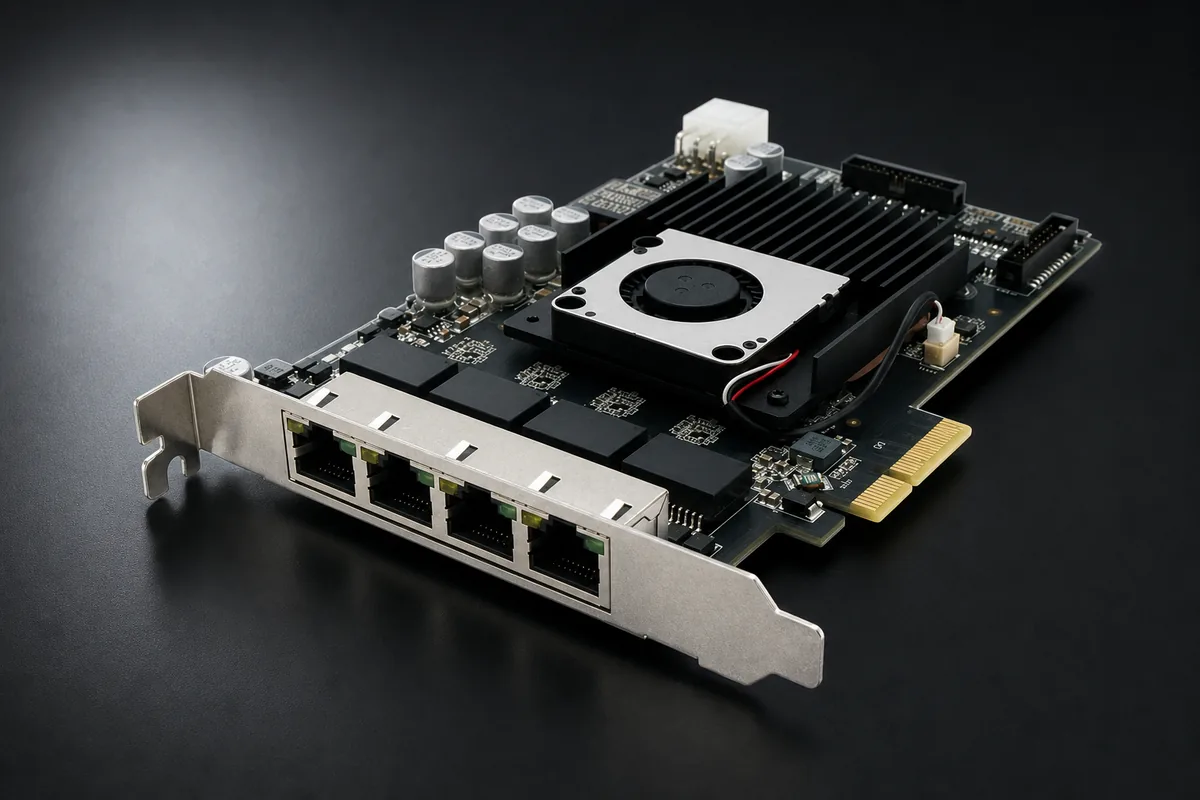
PoE at 15.4 W per channel combines with two WX1860-controlled GigE ports in MV-GE2202P. The dual RJ45 links accept 10/100/1000 Mbit/s industrial cameras and carry two streams with 9.5 KB jumbo frames. PCI-E gen2 × 4, with a gen2 × 2 link option, delivers 860 MB/s maximum and 800 MB/s sustained bandwidth. The board itself is specified at 2 W.
This configuration supports paired-camera inspection in which each Ethernet run carries both acquisition data and power. Natural cooling avoids a board fan, while the 181 × 126.3 × 21.6 mm, 190 g card operates from 0 to 60 °C. Host choices include 64-bit Windows 7, 10 and 11 or Linux. The per-channel 15.4 W ceiling must be checked for each connected camera before using the powered link.
MV-GE2202 shares the WX1860, two-port, 2 W and 800 MB/s profile; MV-GE2202P additionally documents 15.4 W PoE output on both channels. MV-GE2202L is the compact two-port alternative with a 161.4 × 79.3 × 23.23 mm outline. MV-GE2204P extends the powered architecture to four ports and four streams, while increasing consumption to 3 W and weight to 201 g.
Specifications
| Camera ports | RJ45 × 2 |
| Cameras supported | 2 max |
| Camera connection speed | 10/100/1000 Mbps |
| Camera type supported | GigE industrial camera |
| Interconnect | PCI-E gen2 × 4, PCI-E gen2 × 2 link |
| Delivery bandwidth | 860 MB/s (max. transmission bandwidth), 800 MB/s (sustained transmission bandwidth) |
| Sustained transmission bandwidth | 800 MB/s |
| PoE support | PoE, each channel provides 15.4 W |
| Power consumption | 2 W |
| Operating temperature | 0 to 60 °C |
| Storage temperature | -30 to 70 °C |
| Humidity | 10% to 95% RH |
| Dimensions | 181 × 126.3 × 21.6 mm |
| Weight | 190 g |
| Certification | CE-EMC,KC |
| Main chip | WX1860 chip |
| Camera interface standard | IEEE 802.3 |
| Stream | 2 |
| Jumbo frame | 9.5 KB |
| Cooling mode | Natural cooling |
| Supported OS | 64-bit Windows 7/10/11, Linux |
Selection and applications
Two-camera PoE acquisition. Powered jumbo-frame networking. Low-draw paired-view capture.
Minimum kit: Fit MV-GE2202P in a PCI-E gen2 host and connect one or two PoE-capable GigE industrial cameras with RJ45 network cables, observing the 15.4 W allowance on each channel.
Nearby in the range: MV-GE2202 — Prefer it for a two-stream WX1860 path with 2 W board consumption.; MV-GE2202L — Prefer it when the host needs the 79.3 mm compact board dimension.; MV-GE2204P — Prefer it when four PoE ports and four camera streams are required..
Cameras that connect to this board
RJ45 × 2 · up to 2 cameras · 860 MB/s:
Matched by interface and port count.
FAQ
What PoE level is available from each MV-GE2202P channel?
Each of the two channels can provide 15.4 W through PoE. The connected GigE industrial camera must remain within that per-port figure; board power consumption is separately stated as 2 W.
Which controller and jumbo-frame size does MV-GE2202P use?
The main controller is a WX1860 chip, and the Ethernet path supports 9.5 KB jumbo frames. Two RJ45 interfaces carry two camera streams at 10/100/1000 Mbit/s.
What transfer bandwidth reaches the MV-GE2202P host?
The board reaches 860 MB/s maximum and 800 MB/s sustained transfer. Its interconnect is PCI-E gen2 × 4 and also lists PCI-E gen2 × 2 link operation. Two camera streams share this host path.
How should MV-GE2202P operating conditions be managed?
Natural cooling is used, with an operating interval from 0 to 60 °C and humidity from 10% to 95% RH. Storage is specified from -30 to 70 °C, so the host enclosure must maintain those limits.
Does MV-GE2202P support current 64-bit Windows hosts?
The listed environments are 64-bit Windows 7, Windows 10 and Windows 11, together with Linux. The PCI-E gen2 interface supplies the host connection for both camera streams.
What expands when moving from MV-GE2202P to MV-GE2204P?
MV-GE2204P doubles the RJ45 ports and streams from two to four while retaining 15.4 W PoE per channel, 9.5 KB jumbo frames and 800 MB/s sustained transfer. Its board consumption is 3 W rather than 2 W.