Vision controller · VC5000 series
Hikrobot MV-VC572x
- Warranty
- 36 months
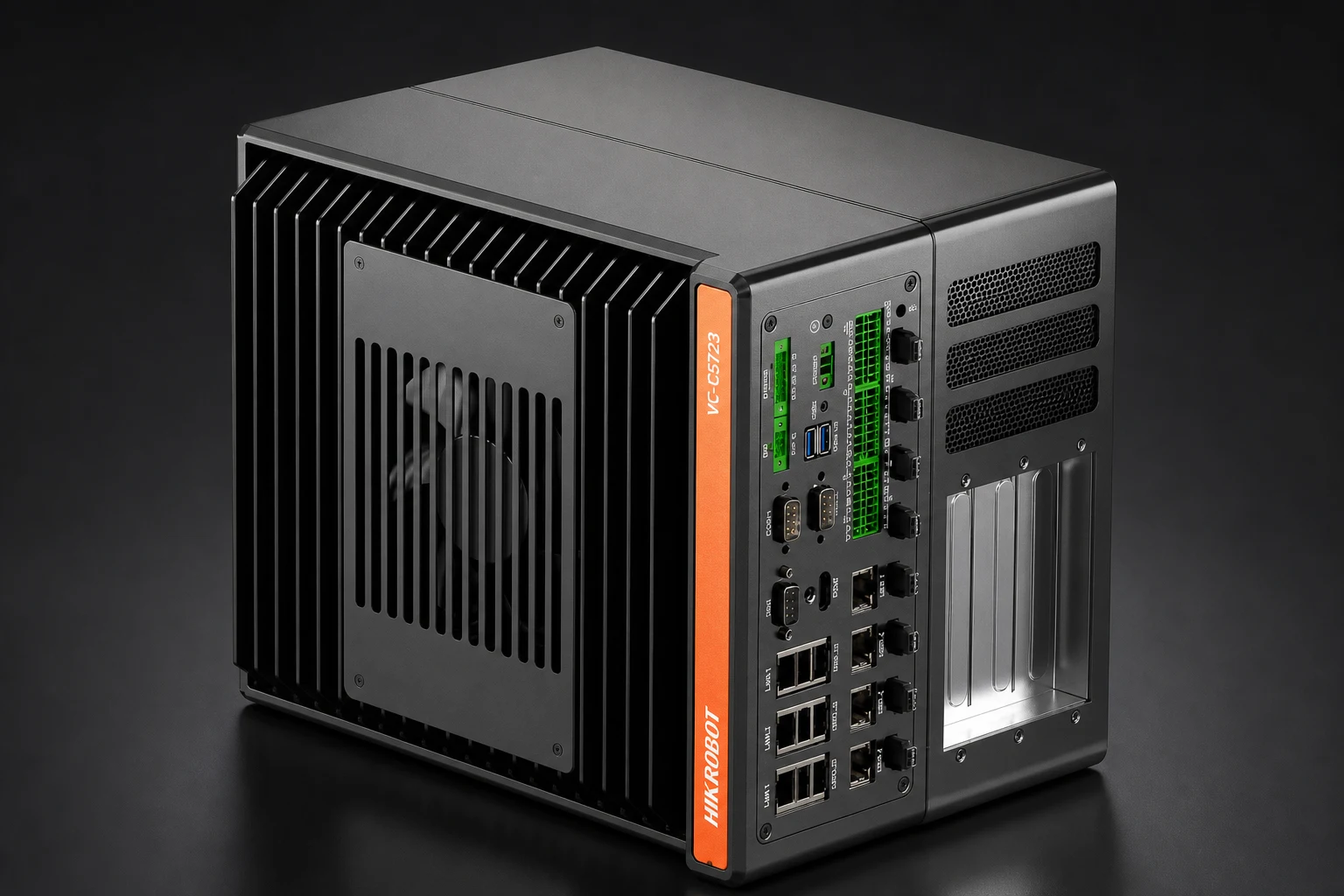
Expanded Core i7 vision processing
Core i7-12700 processing, a Q670 chip and four PCIe interfaces place MV-VC572x at the expanded end of VC5000. Its slots comprise one ×16, one ×8 and two ×4 connections; occupying ×8 reduces the ×16 connection to half bandwidth. Seven GigE ports include four PoE interfaces, combining multi-camera Ethernet acquisition with card-based extension under unactivated Windows 10.
The chassis suits inspection systems that need several GigE cameras plus an added graphics or acquisition card. Machine interaction is handled through eight isolated inputs, twelve isolated outputs, eight isolated low-side driver outputs and four bidirectional differential lines. Two SATA 3.0 connections and one M.2 NVME interface cover storage expansion, while separate 24 VDC inputs feed the controller system and a graphics card.
MV-VC571x retains Core i7-12700 and seven GigE ports in a 105.2 mm-high enclosure with a 264 W typical draw, compared with the 210 mm height and 384 W typical system figure of MV-VC572x. MV-VC552x has the same Q670 and slot topology with Core i5-12400. MV-VC532x provides the equivalent expanded layout in the Core i3-12100 tier, allowing the processor level to be selected without changing the principal card arrangement.
Overview
A vision controller from the top VC5000 series on the Intel Core i7-12700 processor. Seven Gigabit ports, four of them with PoE, so a camera needs a single cable. RAM is chosen by part number: 8, 16 or 32 GB; the 2T suffix adds a 2 TB hard disk for the image archive.
An expandable Q670 chassis: four PCIe slots (×16, ×8 and two ×4), an M.2 NVMe socket and a separate 24 V rail for a graphics card. 210 mm high, 7.5 kg. Choose it when the controller has to host a frame grabber, a second NIC or a GPU for deep learning.
Available versions
One device, different revisions. We ship the current one by default; if a specific revision is already installed on your line, name it in the request and we will match it.
| Part number | PN | Memory | Storage | |
|---|---|---|---|---|
| MV-VC5723-256G70-NN | 308800834 | 8 GB | 256 GB SSD | |
| MV-VC5724-256G70-2T | 308800861 | 16 GB | 256 GB SSD and 2T HDD | |
| MV-VC5725-256G70-2T | 308800865 | 32 GB | 256 GB SSD and 2T HDD | |
| MV-VC5725-256G70-NN | 308800831 | 32 GB | 256 GB SSD |
Specifications
| Digital I/O | Opto-isolated input × 8; Opto-isolated output × 12 ( supports NPN/PNP switching), digital-isolated low-side driver output × 8; Non-isolated bi-directional differential I/O × 4 |
| Screen resolution | 1920 × 1080 @ 60 Hz |
| Operating system | Unactivated Windows 10 |
| Power supply | 24 VDC (4-pin interface for system power supply); 24 VDC (2-pin interface for graphics card power supply) |
| Power consumption | Typ. 384 W (4-pin interface for system power supply); Typ. 228 W (2-pin interface for graphics card power supply) |
| Operating temperature | Graphics card used: 0 °C to 45 °C (32 °F to 113 °F); Graphics card not used: 0 °C to 50 °C (32 °F to 122 °F) (Core™ i7-12700) / 0 °C to 45 °C (32 °F to 113 °F) (Core™ i7-12700) |
| Humidity | 20% RH to 95% RH (no condensation) |
| Dimensions | 302.3 mm × 248 mm × 210 mm (11.9″ × 9.8″ × 8.3″) |
| Weight | Approx. 7.5 kg (16.5 lb.) |
| Certification | CE, KC |
| Chip | Q670 |
| Network ports | GigE interface × 7, including interface for PoE × 4 |
| Usb ports | USB 2.0 × 4, USB 3.0 × 4, built-in USB 2.0 × 1 |
| Serial ports | RS-232 × 2 by default, supports switching to RS-485 and RS-422 |
| Display ports | HDMI interface × 1, VGA interface × 1; Supports independent display output at the same time; Max. resolution 1920 × 1080 @ 60 Hz |
| Expansion slots | PCIe × 16 extended interface × 1, PCIe × 8 extended interface × 1, PCIe × 4 extended interface × 2 (When the PCIe × 8 extended interface is used, the PCIe × 16 will only provide half of the bandwidth.) |
| Storage expansion | SATA 3.0 interface × 2, M.2 NVME interface × 1 |
| Light interface | 24 VDC constant voltage × 8 VDC |
| Temperature (storage/ambient with/without graphics card) | 0 °C to 50 °C (graphics card not used) °C |
Selection and applications
Core i7 multi-camera processing with PCIe cards. PoE acquisition with added graphics processing. Expanded storage and machine I/O control.
Minimum kit: Install MV-VC572x with GigE cameras and mount-matched lenses, GigE cables, selected PCIe cards, a 4-pin 24 VDC system feed, and a 2-pin 24 VDC graphics-card feed when used.
Nearby in the range: MV-VC571x — Prefer it for Core i7-12700 in the 105.2 mm-high enclosure with a 264 W typical draw.; MV-VC552x — Prefer it for Q670 and the same PCIe layout with Core i5-12400.; MV-VC532x — Prefer it for the equivalent expanded chassis in the Core i3-12100 tier..
Cables and accessories for this model
Compatibility per manufacturer data.
- Other
- VC accessories
FAQ
Which expansion slots define the MV-VC572x chassis?
The controller provides one PCIe ×16, one PCIe ×8 and two PCIe ×4 interfaces. Use of the ×8 interface makes the ×16 interface operate at half bandwidth, so the card plan must account for that shared-bandwidth condition.
How does MV-VC572x differ physically from MV-VC571x?
MV-VC572x measures 302.3 × 248 × 210 mm and weighs approximately 7.5 kg. MV-VC571x is 302.3 × 248 × 105.2 mm and approximately 6 kg; both are associated with Core i7-12700 and seven GigE ports.
What network and machine I/O capacity is available?
Seven GigE interfaces include four PoE ports. Machine I/O comprises eight isolated inputs, twelve isolated outputs with NPN/PNP switching, eight isolated low-side driver outputs and four non-isolated bidirectional differential lines.
How must power be provided when a graphics card is installed?
A 4-pin 24 VDC interface supplies the system and is listed at 384 W typical. A separate 2-pin 24 VDC interface supplies graphics-card power and is listed at 228 W typical, so both feeds belong in a card-equipped installation.
What operating-temperature limit follows graphics-card use?
The stated range with a graphics card is 0 °C to 45 °C. Without one, the upper limit reaches 50 °C for the Core i7-12700 configuration. Storage expansion is available through two SATA 3.0 connections and one M.2 NVME interface.