FA lens · HF-E series
Hikrobot MVL-HF1228M-6MPE
- Warranty
- 36 months
Inspection scale and optical setup
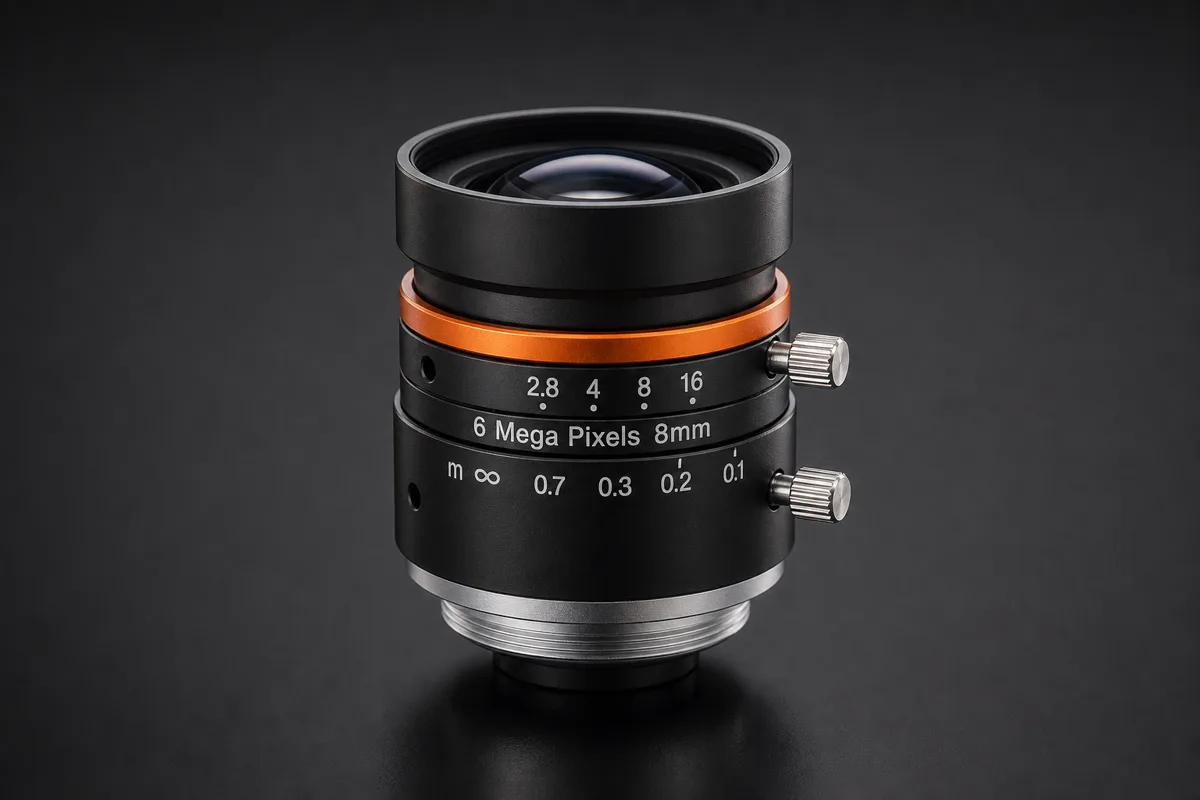
Balanced mid-range coverage is the engineering role of MVL-HF1228M-6MPE. Its fixed 12 mm focal length produces a 40.94° diagonal, 34.14° horizontal and 23.17° vertical view over a Ø 9 mm, 1/1.8-inch image. The C-mount lens carries a 6 MP rating, manual focus and manual iris from F2.8 to F16. Distortion is stated at -0.005%, making geometric deviation a tightly quantified part of the optical selection.
The 34.14° horizontal view suits component presence, connector alignment and feature inspection where an 8 mm lens would include too much surrounding area. A 0.1 m minimum object distance supports close machine layouts while leaving room for lighting around the subject. Manual focus fixes the working plane, and the iris allows depth of field to be increased when illumination permits. The Ø 33 mm × 40.2 mm body and 61.7 g mass provide concrete constraints for lens clearance and camera support.
MVL-HF0828M-6MPE provides a wider 49.46° horizontal view at 8 mm, whereas MVL-HF1628M-6MPE narrows it to 25.94° at 16 mm. Both neighbours retain the same Ø 9 mm image size, C-mount and F2.8 to F16 adjustment. Choose 12 mm when the target framing falls between those two scales and the -0.005% distortion rating matters; choose 8 mm for more scene context or 16 mm for a more restricted region from comparable geometry.
Specifications
| Product type | Fixed focal length, Manual iris, 6MP, FA Lens |
| Mount | C-mount |
| Focal length | 12 mm |
| Aperture | F2.8 to F16 |
| Image circle | Ø 9 mm (1/1.8’’) |
| Minimum object distance (MOD) | 0.1 m |
| Operating temperature | –10 °C to 50 °C |
| Dimensions | Ø 33 mm × 40.2 mm |
| Weight | 61.7 g |
| Certification | RoHS 2.0 |
| Distortion | -0.005 % |
| Field of view diagonal | 40.94 ° |
| Field of view horizontal | 34.14 ° |
| Field of view vertical | 23.17 ° |
| Filter thread | M27 × P0.5 |
| Flange back length | 17.526 mm |
| Focus control | Manual |
| Iris control | Manual |
Selection and applications
Component presence inspection. Connector alignment imaging. Low-distortion feature measurement.
Minimum kit: The minimum imaging set consists of a C-mount camera, the MVL-HF1228M-6MPE lens, an interface cable appropriate to the camera, and that camera's specified power source.
Nearby in the range: MVL-HF0828M-6MPE — Prefer it for wider framing from an 8 mm focal length and 49.46° horizontal field.; MVL-HF1628M-6MPE — Prefer it when a 16 mm focal length and 25.94° horizontal field fit the target..
Family and other versions
Lenses for 1/1.8″ sensors (5–10 MP) · 19 PNs
FAQ
What scene angle does the 12 mm HF-E inspection lens cover?
Coverage is 40.94° diagonal, 34.14° horizontal and 23.17° vertical for the specified Ø 9 mm image. Those values place the lens between the 8 mm and 16 mm HF-E models, which helps select framing before the working distance is fixed.
Why is the distortion figure relevant to measurement tasks?
The listed distortion is -0.005%. That value quantifies the lens's geometric deviation and can be incorporated into the imaging error assessment for edge positions or dimensional work. It does not replace system calibration, but it is the stated optical baseline.
What are the mount, image format and resolution rating?
This is a C-mount lens with a 17.526 mm flange-back length, Ø 9 mm image size and 6 MP classification. The image size is also identified as 1/1.8 inch. Those three entries define the camera-side mechanical and optical match.
How are focus, aperture and front filtering handled?
Focus and iris are set manually. The aperture range is F2.8 to F16, and the front accepts an M27 × P0.5 filter thread. The selected focus plane, depth behavior and filter therefore remain fixed mechanical choices after setup.
Should the 8 mm, 12 mm or 16 mm HF-E focal length be used?
Use 8 mm for a 49.46° horizontal field, this 12 mm model for 34.14°, or 16 mm for 25.94°. All three are C-mount lenses for Ø 9 mm images with F2.8 to F16 manual iris, so the required framing is the main stated difference.