Board level area camera · CB Series
Hikrobot MV-CB060-10UM-S V4.0
- Warranty
- 36 months
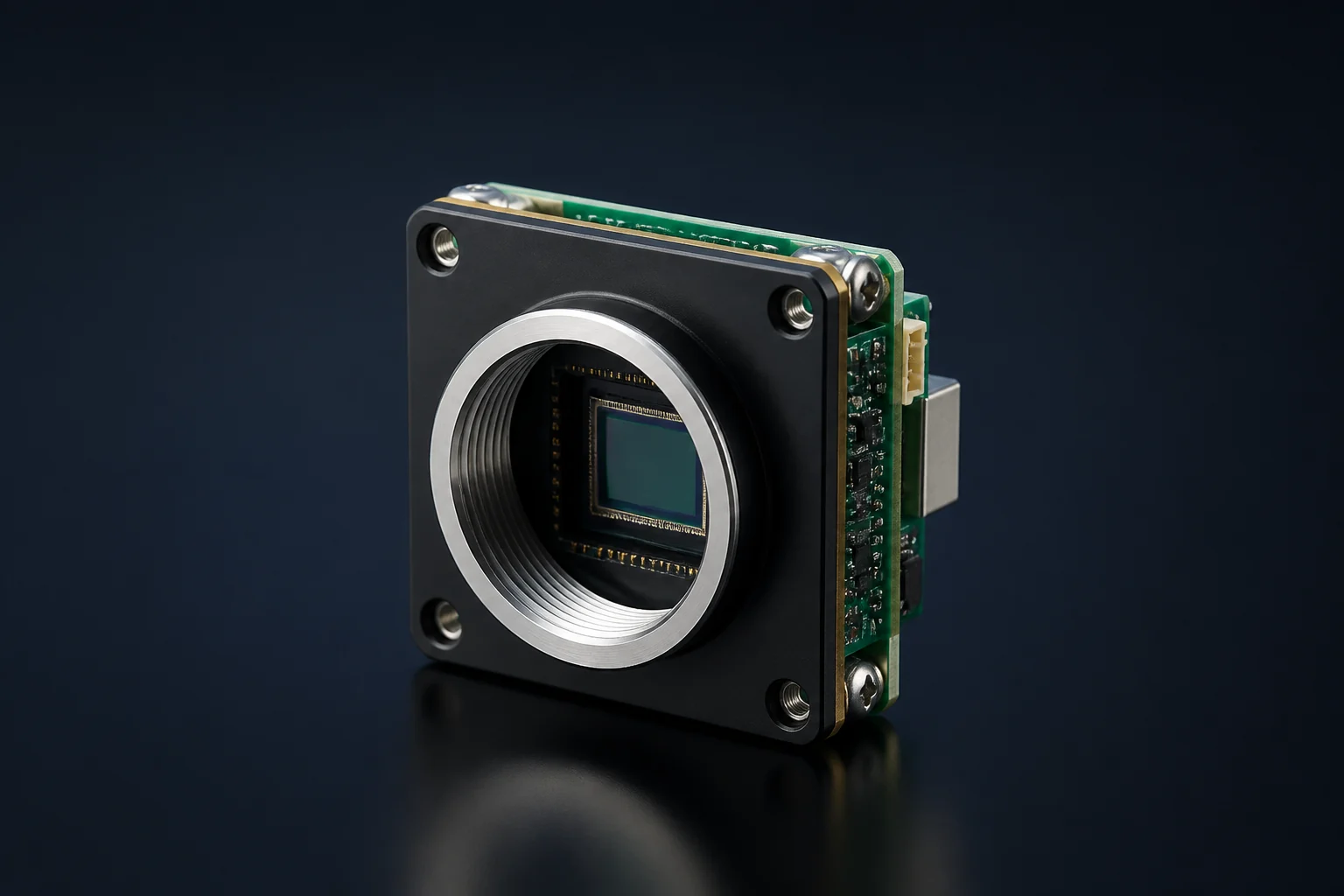
Optical form and operating context
An M12-mount gives MV-CB060-10UM-S V4.0 a compact optical route to 6.3 MP mono capture. Its 1/1.8-inch Sony® IMX178 CMOS sensor outputs 3072 × 2048 Mono 8 at up to 60.9 fps from 2.4 µm pixels. The sensor uses a rolling shutter, and the 35 mm × 35 mm × 8.6 mm assembly weighs approximately 43.5 g.
Fine feature checks, edge extraction and position measurement on stationary components are direct uses for the spatial sampling. Controlled machine motion can also be coordinated with the 8 µs to 1 sec exposure range and two bidirectional non-isolated I/O points. USB 3.0 provides the image path and the 5 VDC supply, with typical consumption of 1.5 W. Gain adjustment covers 0 dB to 24 dB.
MV-CB060-10UM-C V4.0 changes to C-mount and weighs approximately 30 g while preserving mono output and 60.9 fps. MV-CB060-10UM-B V4.0 supplies the same imaging on a mount-free 32.5 mm × 32.5 mm × 1.6 mm board. MV-CB060-10UC-S V4.0 retains M12-mount and dimensions but records Bayer RG 8 color at a typical 1.8 W. Select UM-S for mono M12 optics; select C, B or UC-S according to mount construction and color requirement.
Specifications
| Product type | 6.3 MP USB 3.0 Board Level Camera |
| Sensor type | CMOS, rolling shutter |
| Sensor model | Sony® IMX178 |
| Sensor format | 1/1.8″ |
| Resolution | 3072 × 2048 |
| Pixel size | 2.4 μm × 2.4 μm |
| Maximum frame rate | 60.9 fps @3072 × 2048 Mono 8 |
| Mono color | Mono |
| Dynamic range | 66 dB |
| Exposure time | 8 μs to 1 sec |
| Gain | 0 dB to 24 dB |
| Data interface | USB3.0 |
| Digital I/O | Bi-directional non-isolated I/O × 2 (Line 2, Line 5) |
| Lens mount | M12-mount |
| Power supply | USB3.0 power supply |
| Power consumption | Typ. 1.5 W @ 5 VDC |
| Operating temperature | 0 °C to 50 °C (32 °F to 122 °F) |
| Storage temperature | -30 °C to 70 °C (-22 °F to 158 °F) |
| Humidity | 20% to 80% RH, non-condensing |
| Dimensions | 35 mm × 35 mm × 8.6 mm (1.4″ × 1.4″ × 0.3″) |
| Weight | Approx. 43.5 g (0.1 lb.) |
| Certification | CE-EMC, KC |
| Compatibility | USB3 Vision, GenICam |
Selection and applications
M12 mono feature inspection. Stationary edge extraction. Timed component position measurement.
Minimum kit: Use the camera with an M12-mount lens covering the 1/1.8-inch sensor and a USB 3.0 cable connected to a host that supplies 5 VDC power.
Nearby in the range: MV-CB060-10UM-C V4.0 — Choose it for the same mono image through a C-mount at approximately 30 g.; MV-CB060-10UM-B V4.0 — Choose it when the mono IMX178 must fit a mount-free 1.6 mm board.; MV-CB060-10UC-S V4.0 — Choose it when M12-mount acquisition requires Bayer RG 8 color..
Cables and accessories for this model
Compatibility per manufacturer data.
- Data cables
- USB 3.0
- I/O & power cables
- CB board-level IO
FAQ
What M12 lens coverage is required for MV-CB060-10UM-S V4.0?
The selected M12-mount lens must cover the 1/1.8-inch Sony® IMX178 sensor and provide the required scene width. The active output is 3072 × 2048 with 2.4 µm pixels, and the camera body is 8.6 mm deep.
How fast does MV-CB060-10UM-S V4.0 send full mono frames?
Maximum output is 60.9 fps at 3072 × 2048 Mono 8 over USB 3.0. The rolling-shutter sensor has a 66 dB dynamic range, with exposure from 8 µs to 1 sec and gain from 0 dB to 24 dB.
How should machine timing be arranged for the UM-S camera?
The sensor uses a rolling shutter, so stopping or controlling motion during exposure supports geometry measurement. Line 2 and Line 5 provide bidirectional non-isolated I/O for timing, and exposure can be reduced to 8 µs.
What supply is carried by the MV-CB060-10UM-S V4.0 USB link?
USB 3.0 provides the 5 VDC power source and transports the mono stream. Typical camera consumption is 1.5 W. External trigger or timing wiring can use the two bidirectional non-isolated I/O points.
How does the UC-S sibling change MV-CB060-10UM-S imaging?
MV-CB060-10UC-S V4.0 changes from Mono 8 to Bayer RG 8 color. It keeps the Sony® IMX178, M12-mount, 3072 × 2048 resolution and 60.9 fps limit; typical draw rises from 1.5 W to 1.8 W.