Area camera · CH Series
Hikrobot MV-CH050-10UC V4.0
- Warranty
- 36 months
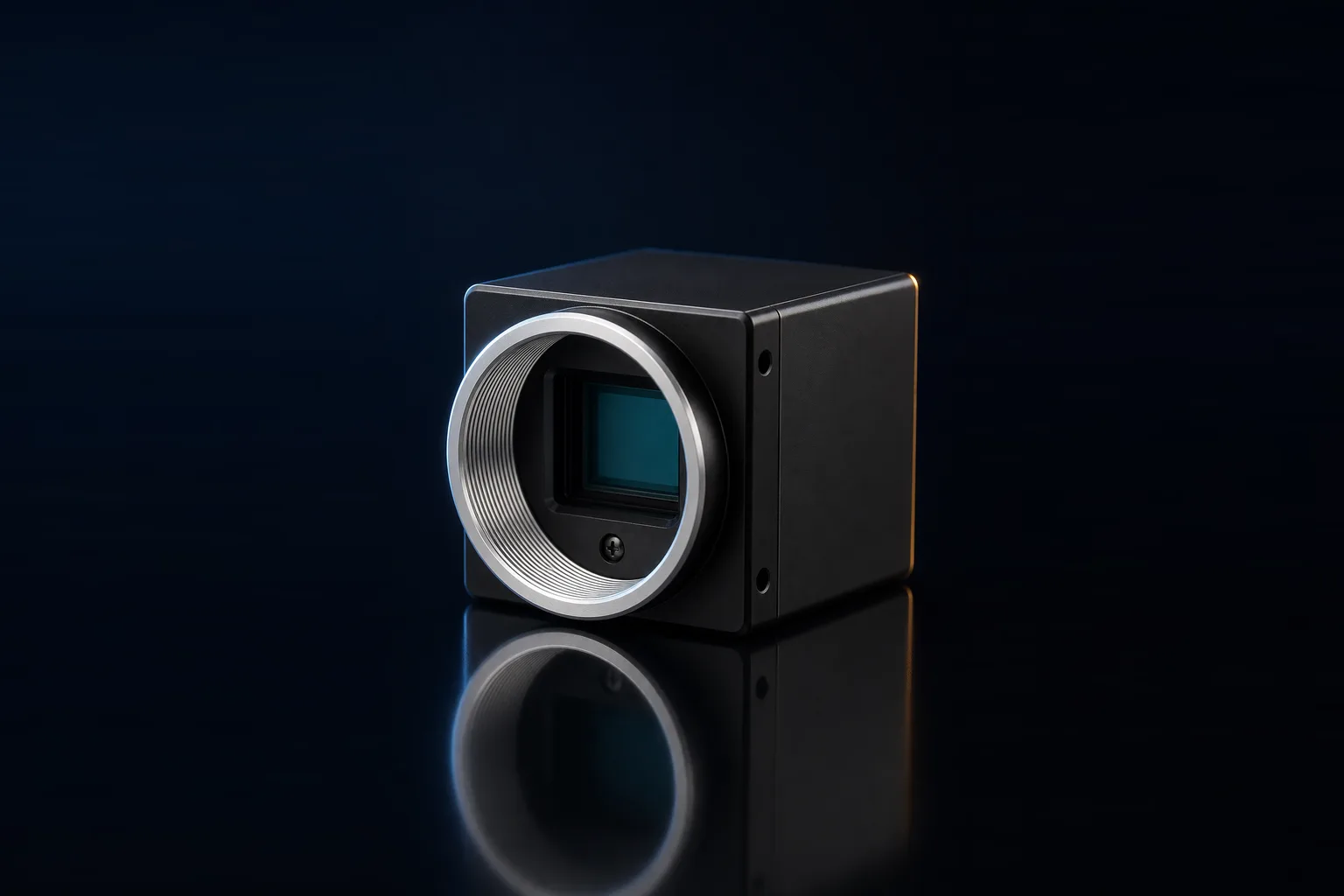
Where the USB color model fits
Direct USB 3.0 acquisition with color output is the defining combination of MV-CH050-10UC V4.0. A Sony IMX250 global-shutter CMOS sensor produces 2448 × 2048 Bayer RG 8 images at 74.1 fps. The 2/3-inch format, 3.45 µm pixels and C-mount place it in compact inspection stations that need color evidence without a Camera Link or Ethernet data path.
Moving packaging, labels and mixed-color components can be inspected without rolling-shutter geometry artifacts. UltraShort exposure covers 1 µs to 14 µs, followed by the standard 15 µs to 10 sec range. USB 3.0 can also supply power, while the P7 connector exposes isolated trigger input and output together with a bidirectional I/O line.
MV-CH050-10CC raises throughput to 140 fps over Camera Link, with a slightly narrower 2432-pixel image. MV-CH050-60UC retains USB 3.0 and 2448 × 2048 color output but uses a Stacked BSI sensor and reaches 79 fps. Choose MV-CH050-10UC V4.0 when the IMX250 color response, 74.1 fps and USB-powered configuration match the station.
Specifications
| Product type | 5 MP USB 3.0 Area Scan Camera |
| Sensor type | CMOS, global shutter |
| Sensor model | Sony® IMX250 |
| Sensor format | 2/3″ |
| Resolution | 2448 × 2048 |
| Pixel size | 3.45 μm × 3.45 μm |
| Maximum frame rate | 74.1 fps @ 2448 × 2048 Bayer RG 8 |
| Mono color | Color |
| Dynamic range | 71 dB |
| Exposure time | UltraShort exposure mode: 1 μs to 14 μs Standard exposure mode: 15 μs to 10 sec |
| Gain | 0 dB to 24 dB |
| Data interface | USB3.0, compatible with USB2.0 |
| Digital I/O | 6-pin P7 connector provides power and I/O, including opto-isolated input × 1 (Line 0), opto-isolated output × 1 (Line 1), bi-directional non-isolated I/O × 1 (Line 2). |
| Lens mount | C-mount |
| Power supply | 9 VDC to 24 VDC, supports USB3.0 power supply |
| Power consumption | Typ. 2.8 W @ 5 VDC (USB3.0 provides power supply) |
| Ingress protection | IP40 (under proper lens installation and wiring) |
| Operating temperature | –10 °C to 50 °C (14 °F to 122 °F) |
| Storage temperature | –30 °C to 70 °C (–22 °F to 158 °F) |
| Humidity | 20% RH to 95% RH (no condensation) |
| Dimensions | 29 mm × 29 mm × 30 mm (1.1″ × 1.1″ × 1.2″) |
| Weight | Approx. 80 g (0.2 lb.) |
| Certification | CE-EMC, KC, UL |
| Compatibility | USB3 Vision, GenICam |
Selection and applications
USB color inspection of moving packaging. Short-exposure checks of colored components. Triggered label and print verification.
Minimum kit: MV-CH050-10UC V4.0, a 2/3-inch C-mount lens, a USB 3.0 cable, and either USB 3.0 bus power or a 9 V DC to 24 V DC supply form the minimum imaging set.
Nearby in the range: MV-CH050-10CC — Use it when Camera Link and 140 fps at 2432 × 2048 are required.; MV-CH050-60UC — Use it for a Stacked BSI sensor and 79 fps at 2448 × 2048 over USB 3.0..
Cables and accessories for this model
Compatibility per manufacturer data.
- Data cables
- USB 3.0
- I/O & power cables
- Hirose 6-pin IO
- Power
- Power
- Mounting
- Camera mounts
FAQ
Can a USB 3.0 port power MV-CH050-10UC V4.0 directly?
Yes. USB 3.0 power is supported, with typical consumption of 2.8 W at 5 V DC. The camera also accepts 9 V DC to 24 V DC, which allows a separate supply when the machine wiring calls for it.
What image rate and pixel format are available at full size?
The maximum listed rate is 74.1 fps at 2448 × 2048 in Bayer RG 8. That full-resolution color stream is carried by USB 3.0; the interface is also listed as compatible with USB 2.0.
How short can exposure be for rapidly moving color targets?
UltraShort mode extends from 1 µs to 14 µs, and standard exposure runs from 15 µs to 10 sec. Combined with the global shutter, the short settings support motion capture when illumination is sufficient.
What lens coverage is needed for this compact USB camera?
The mount is C-mount and the sensor format is 2/3 inch. Select optics that cover that format and resolve 3.45 µm pixels across the 2448 × 2048 image, with focal length set by the required scene width.
Which I/O signals are available for trigger and illumination timing?
The 6-pin P7 connector provides one opto-isolated input, one opto-isolated output and one bidirectional non-isolated I/O line. These lines can connect the camera timing to a part sensor or illumination control.