Area camera · CH Series
Hikrobot MV-CH050-60NM
- Warranty
- 36 months
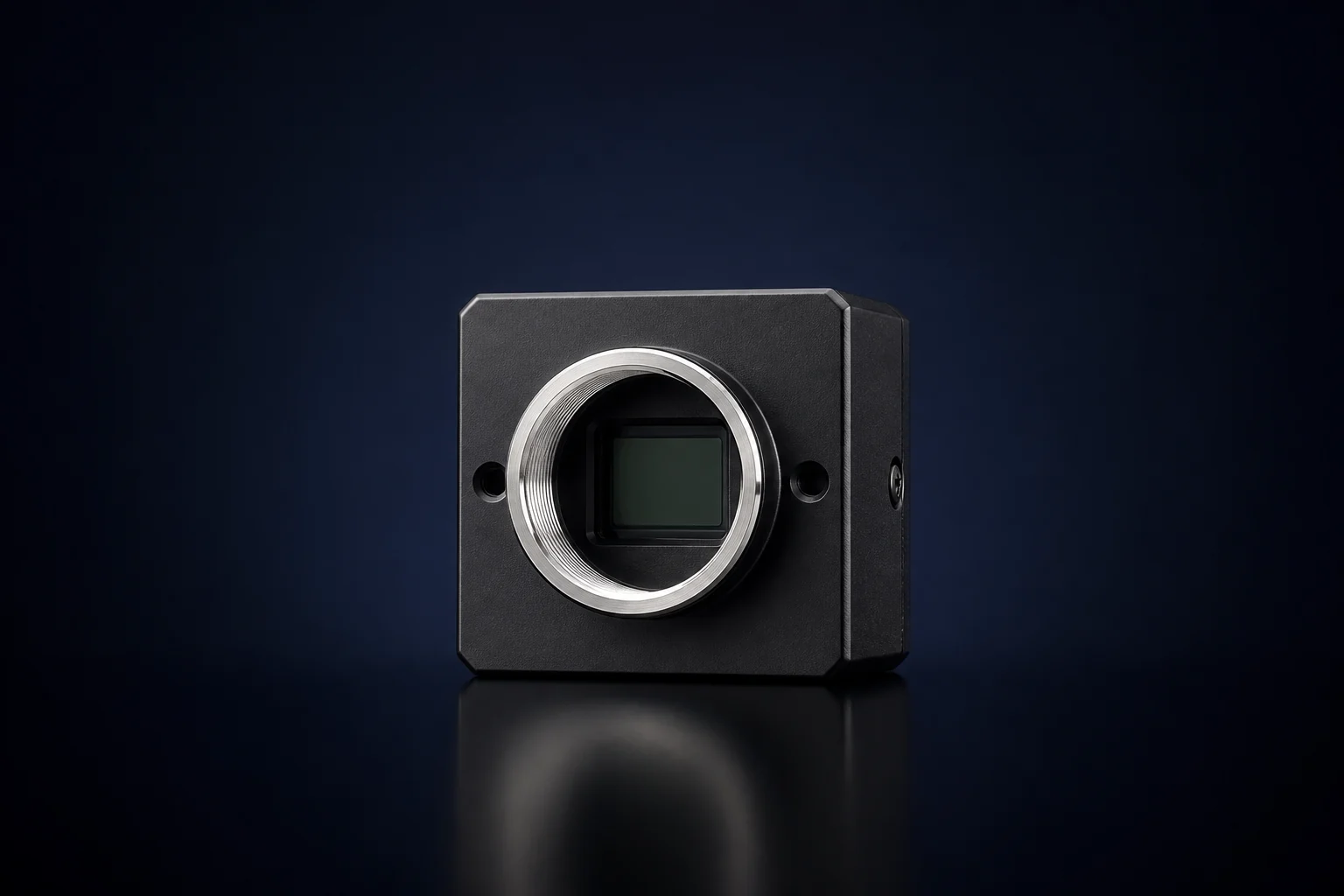
Monochrome tasks in a 2.5 GigE layout
Distributed monochrome inspection is the role of MV-CH050-60NM. Its Stacked BSI CMOS sensor delivers 2448 × 2048 Mono 8 at 60 fps through 2.5 Gigabit Ethernet. A global shutter, 2/3-inch optical format and 3.45 µm pixels make the camera suitable for networked edge, position and surface analysis on moving production parts.
Exposure starts at 5 µs and extends to 10 sec, so the same camera can freeze conveyor motion or integrate a static low-light scene. PoE allows power and image transfer through the Ethernet connection, while 9 V DC to 24 V DC remains available. The 6-pin P7 I/O includes isolated input and output for trigger and lighting timing.
MV-CH050-60NC is the color version with the same 60 fps and 2.5 Gigabit Ethernet link. MV-CH050-10UM provides 74 fps monochrome output through USB 3.0 on an IMX250 sensor. MV-CH050-90TM-C-NF raises monochrome speed to 163.4 fps over 10 Gigabit Ethernet. MV-CH050-60NM fits when PoE network wiring and 60 fps monochrome capture are sufficient.
Specifications
| Product type | 5 MP 2.5 GigE Area Scan Camera |
| Sensor type | CMOS, global shutter |
| Sensor model | Stacked BSI |
| Sensor format | 2/3″ |
| Resolution | 2448 × 2048 |
| Pixel size | 3.45 μm × 3.45 μm |
| Maximum frame rate | 60 fps @ 2448 × 2048 Mono 8 |
| Mono color | Mono |
| Dynamic range | 69.6 dB |
| Exposure time | 5 μs to 10 sec |
| Gain | 0 dB to 24 dB |
| Data interface | 2.5 Gigabit Ethernet (2500 Mbit/s), compatible with Gigabit Ethernet (1000 Mbit/s) |
| Digital I/O | 6-pin P7 connector provides power and I/O, including opto-isolated input × 1 (Line 0), opto-isolated output × 1 (Line 1), bi-directional non-isolated I/O × 1 (Line 2). |
| Lens mount | C-mount |
| Power supply | 9 VDC to 24 VDC, supports PoE |
| Power consumption | Typ. 3.6 W @ 12 VDC |
| Ingress protection | IP40 (under proper lens installation and wiring) |
| Operating temperature | –10 °C to 45 °C (–14 °F to 113 °F) |
| Storage temperature | –30 °C to 80 °C (–22 °F to 176 °F) |
| Humidity | 20% RH to 95% RH (no condensation) |
| Dimensions | 29 mm × 29 mm × 42 mm (1.1″ × 1.1″ × 1.7″) |
| Weight | Approx. 100 g (0.2 lb.) |
| Certification | CE-EMC, KC |
| Compatibility | GigE Vision V2.0, GenICam |
Selection and applications
Networked edge and position inspection. Monochrome surface checks at 60 fps. PoE-triggered capture of moving parts.
Minimum kit: MV-CH050-60NM, a 2/3-inch C-mount lens, a 2.5 Gigabit Ethernet cable, and either PoE or a 9 V DC to 24 V DC supply form the minimum imaging set.
Nearby in the range: MV-CH050-60NC — Select it when color information is required on the same 60 fps 2.5 Gigabit Ethernet platform.; MV-CH050-10UM — Select it for 74 fps monochrome output over USB 3.0.; MV-CH050-90TM-C-NF — Select it for 163.4 fps monochrome output over 10 Gigabit Ethernet..
Cables and accessories for this model
Compatibility per manufacturer data.
- Data cables
- GigE
- I/O & power cables
- Hirose 6-pin IO
- Power
- Power
- Mounting
- Camera mounts
FAQ
Why choose the monochrome member of the 60N camera pair?
MV-CH050-60NM produces Mono 8 rather than Bayer color data while retaining 2448 × 2048, 60 fps and the Stacked BSI platform. It fits checks based on intensity, boundaries, position and surface contrast.
Will the camera also communicate on a Gigabit Ethernet network?
The 2500 Mbit/s interface is listed as compatible with 1000 Mbit/s Gigabit Ethernet. Full operation is specified at 60 fps and 2448 × 2048 Mono 8; the configured image rate must remain within the available network bandwidth.
What are the two supported power arrangements for this model?
The camera accepts 9 V DC to 24 V DC and supports PoE. This permits either power through the Ethernet connection or a separate DC feed. Typical consumption is 3.6 W when operated at 12 V DC.
How should C-mount optics be matched to MV-CH050-60NM?
Use a C-mount lens covering the 2/3-inch sensor. Resolution should be appropriate for the 3.45 µm pixel pitch and 2448 × 2048 monochrome image so that the lens does not obscure the edge or defect detail being measured.
Which operating conditions are permitted around the camera?
The specified working interval is -10 °C to 45 °C with 20% to 95% RH and no condensation. Ingress protection is IP40 after correct lens installation and wiring, so the local environment must stay within that enclosure capability.