Area camera · CH Series
Hikrobot MV-CH120-20UM V4.0
- Warranty
- 36 months
Imaging tasks and alternatives
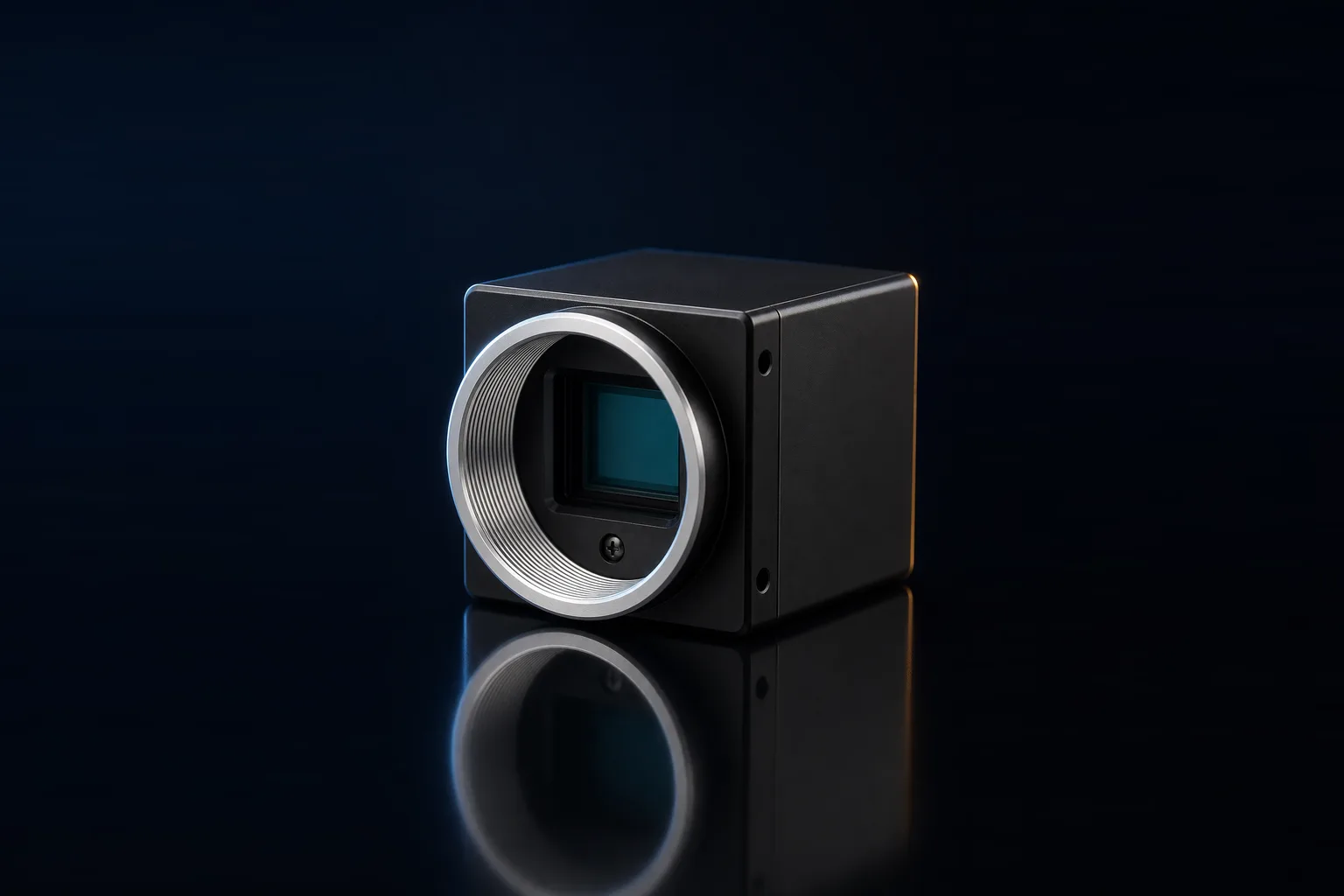
Detailed mono capture beside a host is the operating profile of MV-CH120-20UM V4.0. Its 1-inch OnSemi XGS12000 records 4096 × 3072 Mono 8 frames at up to 28 fps through USB 3.0. The global-shutter CMOS array uses 3.2 µm pixels and provides 68 dB dynamic range. A C-mount is integrated into the 29 mm × 29 mm × 30 mm body, which weighs approximately 80 g and accepts either USB power or a 9 VDC to 24 VDC input.
The absence of a colour mosaic makes this variant suited to geometric measurements, alignment and contrast-based defect detection. At the full 28 fps, consecutive global exposures can follow parts through a workstation without rolling-shutter shape distortion. UltraShort exposures from 52 µs to 161 µs address motion, while settings from 162 µs to 10 sec cover stationary or lower-light scenes. The P7 connector adds an isolated input, isolated output and bidirectional line for machine timing.
MV-CH120-20UM V4.0 is the mono USB member of the 1-inch OnSemi group. MV-CH120-20UC V4.0 has the same 4096 × 3072 resolution and 28 fps but produces Bayer RG 8 colour. MV-CH120-20GM V4.0 keeps mono output and changes the link to Gigabit Ethernet with PoE, reducing the rated frame rate to 9.6 fps. MV-CH120-60UM moves to a 1.1-inch Stacked BSI sensor and 4096 × 3000 at 30.7 fps.
Specifications
| Product type | 12.6 MP USB 3.0 Area Scan Camera |
| Sensor type | CMOS, global shutter |
| Sensor model | OnSemi XGS12000 |
| Sensor format | 1″ |
| Resolution | 4096 × 3072 |
| Pixel size | 3.2 µm × 3.2 µm |
| Maximum frame rate | 28 fps @ 4096 × 3072 Mono 8 |
| Mono color | Mono |
| Dynamic range | 68 dB |
| Exposure time | UltraShort exposure mode: 52 μs to 161 μs Standard exposure mode: 162 μs to 10 sec |
| Gain | 0 dB to 18 dB |
| Data interface | USB 3.0, compatible with USB 2.0 |
| Digital I/O | 6-pin P7 connector provides power and I/O, including opto-isolated input × 1 (Line 0), opto-isolated output × 1(Line 1), and bi-directional non-isolated I/O × 1 (Line 2) |
| Lens mount | C-mount |
| Power supply | 9 VDC to 24 VDC, supports USB power supply |
| Power consumption | Typ. 2.9 W @ 5 VDC (USB 3.0 provides power supply) |
| Ingress protection | IP40 (under proper lens installation and wiring) |
| Operating temperature | –10 °C to 50 °C (14 °F to 122 °F) |
| Storage temperature | –30 °C to 80 °C (–22 °F to 176 °F) |
| Humidity | 20% RH to 95% RH (no condensation) |
| Dimensions | 29 mm × 29 mm × 30 mm (1.1″ × 1.1″ × 1.2″) |
| Weight | Approx. 80 g (0.2 lb.) |
| Certification | CE-EMC, KC, UL |
| Compatibility | USB3 Vision, GenICam |
Selection and applications
Mono geometry measurement at 28 fps. Contrast-based defect inspection at 4096 × 3072. Hardware-triggered USB 3.0 acquisition.
Minimum kit: MV-CH120-20UM V4.0, a C-mount lens and a USB 3.0 cable supplying camera power, or an external 9 VDC to 24 VDC source, complete the basic chain.
Nearby in the range: MV-CH120-20UC V4.0 — Pick it when the same 28 fps frame needs Bayer RG 8 colour.; MV-CH120-20GM V4.0 — Pick it for mono acquisition through Gigabit Ethernet with PoE at 9.6 fps..
Cables and accessories for this model
Compatibility per manufacturer data.
- Data cables
- USB 3.0
- I/O & power cables
- Hirose 6-pin IO
- Power
- Power
- Mounting
- Camera mounts
FAQ
What optics interface and sensor pitch define the mono USB model?
A C-mount serves the 1-inch OnSemi XGS12000. The sensor records 4096 × 3072 with 3.2 µm × 3.2 µm pixels, so those values set the required image circle and spatial resolving target for the lens.
How can MV-CH120-20UM V4.0 be powered at a host station?
USB 3.0 can provide 5 VDC power, with typical camera consumption of 2.9 W at that voltage. The camera also supports an external 9 VDC to 24 VDC supply through its power-and-I/O connection.
Which frame rate is available for full-resolution Mono 8 output?
The maximum is 28 fps at 4096 × 3072 Mono 8 through USB 3.0. USB 2.0 compatibility is listed, but the native USB 3.0 connection is the interface associated with the full-throughput configuration.
Can the camera accept a hardware trigger and control an event output?
Yes. The 6-pin P7 connector includes one opto-isolated input on Line 0, one opto-isolated output on Line 1 and one bidirectional non-isolated I/O on Line 2. These lines complement the sensor's global shutter.
What is the practical distinction from MV-CH120-20GM V4.0?
Both are mono 12.6 MP cameras with the OnSemi XGS12000 and C-mount. The USB model reaches 28 fps and supports USB power; the Gigabit Ethernet model reaches 9.6 fps and supports PoE.