Area camera · CH Series
Hikrobot MV-CH250-90UM V4.0
- Warranty
- 36 months
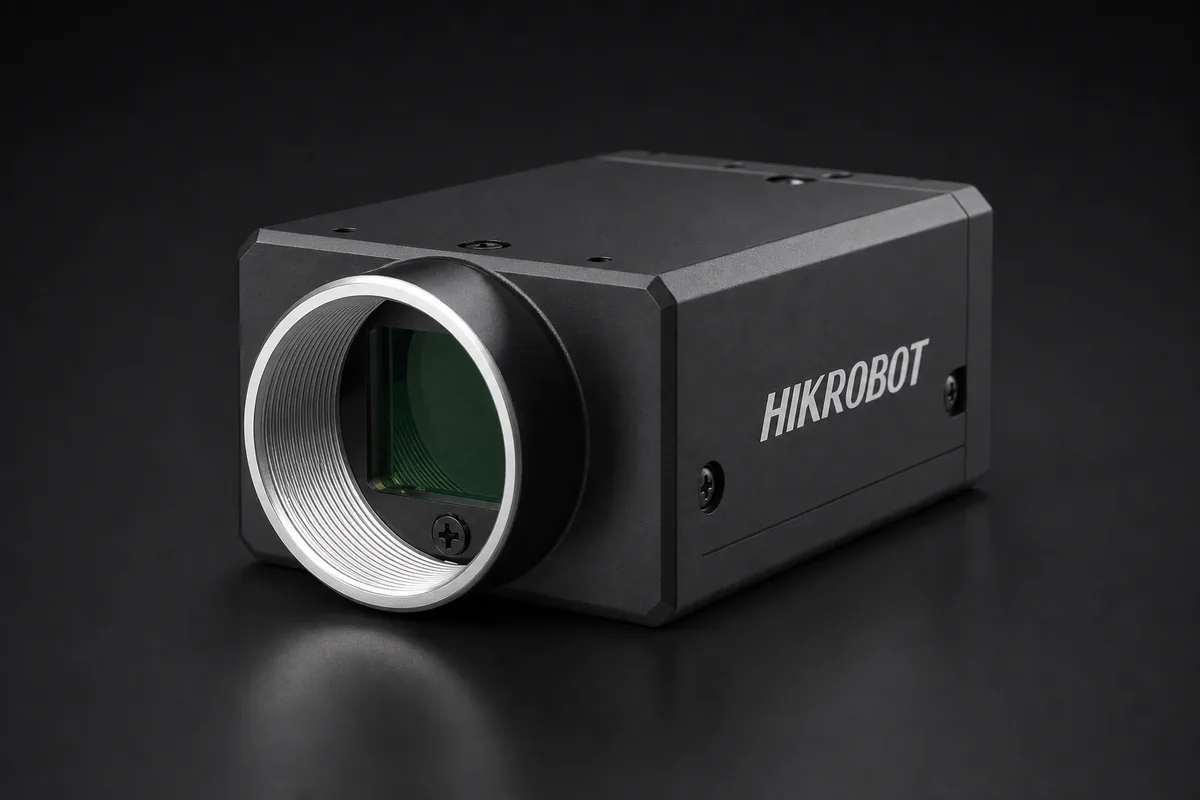
Deployment profile and range position
Monochrome USB 3.0 imaging in a 100 g body characterizes MV-CH250-90UM V4.0. A global-shutter Gpixel GMAX0505 sensor supplies 5120 × 5120 Mono 8 frames at 14 fps, with 2.5 µm pixels across a 1.1-inch format. The C-mount camera measures 29 mm × 44 mm × 59 mm, placing 26.2 MP sampling in a compact host-connected package.
Edge location, dimensional checks, and surface-contrast inspection can use the full monochrome pixel array without Bayer processing. Global exposure supports indexed movement, and the 12 μs to 10 sec range allows short illuminated captures as well as long integration. The USB 3.0 port can deliver the 5 V DC supply for the typical 3.6 W load, while a 6-pin P7 connector provides isolated input and output for triggering.
MV-CH250-90UC V4.0 shares 14 fps, USB 3.0, C-mount, and the compact body but records Bayer BG 8 color. MV-CH250-90VM doubles the full-frame rate to 30 fps through dual USB 3.0 and carries IP40 instead of IP30. MV-CH250-90GM V4.0 reduces the rate to 4.5 fps but moves monochrome transfer to Gigabit Ethernet with PoE.
Specifications
| Product type | 26.2 MP USB 3.0 Area Scan Camera |
| Sensor type | CMOS, global shutter |
| Sensor model | Gpixel GMAX0505 |
| Sensor format | 1.1″ |
| Resolution | 5120 × 5120 |
| Pixel size | 2.5 µm × 2.5 µm |
| Maximum frame rate | 14 fps @5120 × 5120 Mono 8 |
| Mono color | Mono |
| Dynamic range | 65 dB |
| Exposure time | 12 μs to 10 sec |
| Gain | Supports 2.0 ×, 2.5 ×, 3.0 ×, 3.5 ×, 4.0 ×, 4.5 ×, 5.0 × |
| Data interface | USB3.0, compatible with USB2.0 |
| Digital I/O | 6-pin P7 connector provides power and I/O, including opto -isolated input × 1 (Line 0), opto-isolated output × 1 (Line 1), bi-directional non-isolated I/O × 1 (Line 2). |
| Lens mount | C-mount |
| Power supply | 12 VDC to 24 VDC, supports USB3.0 power supply |
| Power consumption | Typ. 3.6 W @ 5 VDC (USB3.0 provides power supply) |
| Ingress protection | IP30 (under proper lens installation and wiring) |
| Operating temperature | -10 °C to 50 °C (14 °F to 122 °F) |
| Storage temperature | -30 °C to 70 °C (-22 °F to 158 °F) |
| Humidity | 20% to 95% RH, non-condensing |
| Dimensions | 29 mm × 44 mm × 59 mm (1.1″ × 1.7″ × 2.3″) |
| Weight | Approx. 100 g (0.2 lb.) |
| Certification | CE-EMC, KC |
| Compatibility | USB3 Vision, GenICam |
Selection and applications
Monochrome edge measurement. Compact surface-contrast inspection. Triggered indexed-part capture.
Minimum kit: To start acquisition, combine the camera, a C-mount lens covering the 1.1-inch sensor, a USB 3.0 host cable, and USB power or a 12–24 V DC source.
Nearby in the range: MV-CH250-90UC V4.0 — Choose it when Bayer BG 8 color is needed at the same 14 fps rate.; MV-CH250-90VM — Choose it for monochrome 30 fps capture through dual USB 3.0.; MV-CH250-90GM V4.0 — Choose it when Gigabit Ethernet and PoE matter more than the 14 fps USB rate..
Cables and accessories for this model
Compatibility per manufacturer data.
- Data cables
- USB 3.0
- I/O & power cables
- Hirose 6-pin IO
- Power
- Power
- Mounting
- Camera mounts
FAQ
What monochrome output is specified for MV-CH250-90UM V4.0?
The full-frame format is 5120 × 5120 Mono 8 at up to 14 fps. Its 26.2 MP Gpixel GMAX0505 uses a 2.5 µm pixel pitch and global shutter, combining detailed square sampling with simultaneous exposure.
How does the exposure range support inspection lighting?
Exposure is adjustable from 12 μs to 10 sec. The short end can be used with strobed light for indexed or moving objects, while the long end permits extended integration when the scene is stationary and illumination is limited.
What are the USB and external power options on this model?
USB 3.0 can provide the camera supply, with typical draw of 3.6 W at 5 V DC. An external input from 12 V DC to 24 V DC is also listed. The data connection supports USB 3.0 and can operate with USB 2.0.
Which optics fit the 1.1-inch sensor in MV-CH250-90UM V4.0?
The camera accepts C-mount lenses and uses a 1.1-inch sensor. Lens selection therefore begins with an image circle covering that format and resolution suitable for the 2.5 µm pixels, followed by focal length for the required scene width.
How does the mono USB model connect to an external trigger?
A 6-pin P7 connector provides one opto-isolated input, one opto-isolated output, and one bidirectional non-isolated I/O line. This gives the station dedicated electrical points for trigger reception and acquisition-status signaling.