Line scan camera · CL series
Hikrobot MV-CL044-91NC
- Warranty
- 36 months
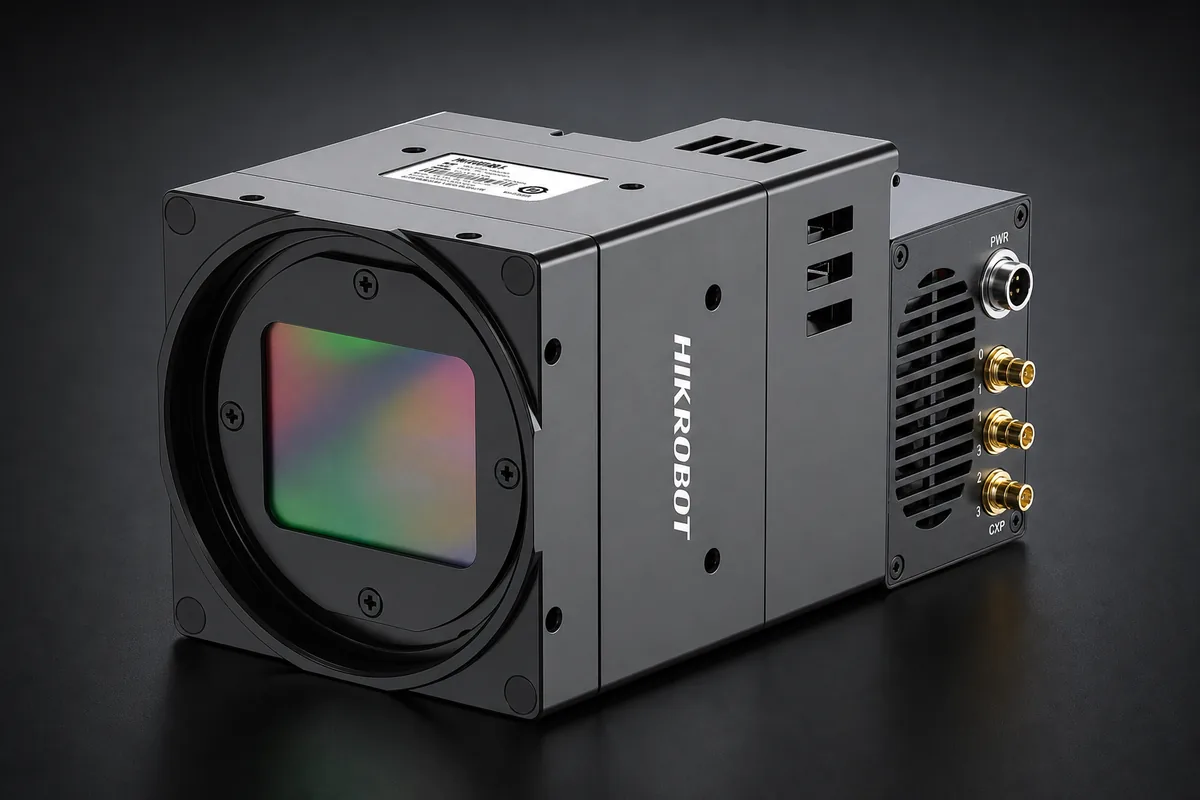
PoE 4K scanning over 2.5 GigE
A 4096 × 3 CMOS array and 2.5 Gigabit Ethernet link place MV-CL044-91NC above the standard Gigabit Ethernet 4K models in transport capacity. The 7 × 7 µm pixels run in 1-Line mode at up to 75.3 kHz, rising to 100 kHz after a reduced region of interest. The Ethernet port also supports 1000 Mbit/s Gigabit Ethernet and 100 Mbit/s Fast Ethernet.
The camera is arranged for moving-web or repeated-part inspection where a 4096-sample line must be synchronized to machine motion. A 12-pin P10 connector provides four bidirectional configurable I/O lines with single-ended or differential signaling. PoE support permits network data and power to share the Ethernet connection, while 12 V DC to 24 V DC remains the stated external supply range.
MV-CL043-A1GC also provides 4096 × 3 with 7 µm pixels, but its Gigabit Ethernet link reaches 28 kHz in standard Bayer 8/Mono 8. MV-CL044-91NM changes the sensor arrangement to 4096 × 4 mono, adding 2-TDI and 4-TDI while retaining 2.5 Gigabit Ethernet and PoE. MV-CL042-B1NC has smaller 3.5 µm pixels and a C-mount body; it reaches 126 kHz after reducing Bayer BRGG 8 width to 2452 pixels or below.
Specifications
| Sensor type | CMOS |
| Resolution | 4096 × 3 px |
| Pixel size | 7 × 7 µm |
| Data interface | 2.5 Gigabit Ethernet (2500 Mbit/s), compatible with Gigabit Ethernet (1000 Mbit/s) and Fast Ethernet (100 Mbit/s) |
| PoE support | yes |
| Digital I/O | 12-pin P10 connector, bi-directional configurable I/O × 4, single-ended/differential supported |
| Lens mount | M42*1.0 |
| Power supply | 12 to 24 VDC |
| Power consumption | 7.2 W |
| Ingress protection | IP40 |
| Operating temperature | -20 to 55 °C |
| Humidity | 20 to 80 % RH |
| Dimensions | 62 × 62 × 46.1 mm |
| Weight | 260 g |
| Compatibility | GigE Vision V2.0, GenICam |
| Flange back length | 12 mm |
| Image mode | 1-Line |
| Max. line rate | 75.3 kHz |
| Max. line rate after roi | 100 kHz |
Selection and applications
4K three-row line inspection. PoE scanning at 75.3 kHz. Reduced-width capture at 100 kHz.
Minimum kit: Pair the MV-CL044-91NC camera with an M42*1.0 line-scan lens, a 2.5 Gigabit Ethernet cable and receiver, and either PoE or a 12 V DC to 24 V DC supply.
Nearby in the range: MV-CL043-A1GC — Prefer it for documented color formats over standard Gigabit Ethernet.; MV-CL044-91NM — Prefer it for mono 1-Line, 2-TDI and 4-TDI modes.; MV-CL042-B1NC — Prefer it for a compact C-mount body with 3.5 µm pixels..
Cables and accessories for this model
Compatibility per manufacturer data.
- Power
- Power
- Mounting
- Camera mounts
FAQ
When does MV-CL044-91NC reach its 100 kHz maximum line rate?
The full-line maximum is 75.3 kHz on the 4096 × 3 array. A reduced region of interest raises the listed ceiling to 100 kHz, so the higher figure applies when the inspection can use fewer pixels across the line.
Can MV-CL044-91NC carry power through the 2.5 GigE link?
Yes, PoE support is listed. The camera can therefore share network data and power on a suitable Ethernet connection, or use its 12 V DC to 24 V DC input. Stated consumption is 7.2 W for sizing the source.
Which lens thread and focal reference apply to MV-CL044-91NC?
The native lens interface is M42*1.0 and the flange back length is 12 mm. Select a line-scan lens that covers all 4096 samples of the three-row array and resolves the 7 × 7 µm pixel pitch over the required inspected width.
How are trigger and control signals connected on MV-CL044-91NC?
The 12-pin P10 connection exposes four bidirectional configurable I/O lines. Single-ended and differential signaling are supported, giving the controller documented electrical choices for coordinating 1-Line acquisition with the moving product.
What environment can the MV-CL044-91NC housing tolerate?
The working range is -20 °C to 55 °C with 20% RH to 80% RH, and the enclosure is IP40. The 62 × 62 × 46.1 mm body therefore belongs in an installation that controls liquid ingress and heavier particulate exposure.