Area camera · CS series
Hikrobot MV-CS200-10GC
- Warranty
- 36 months
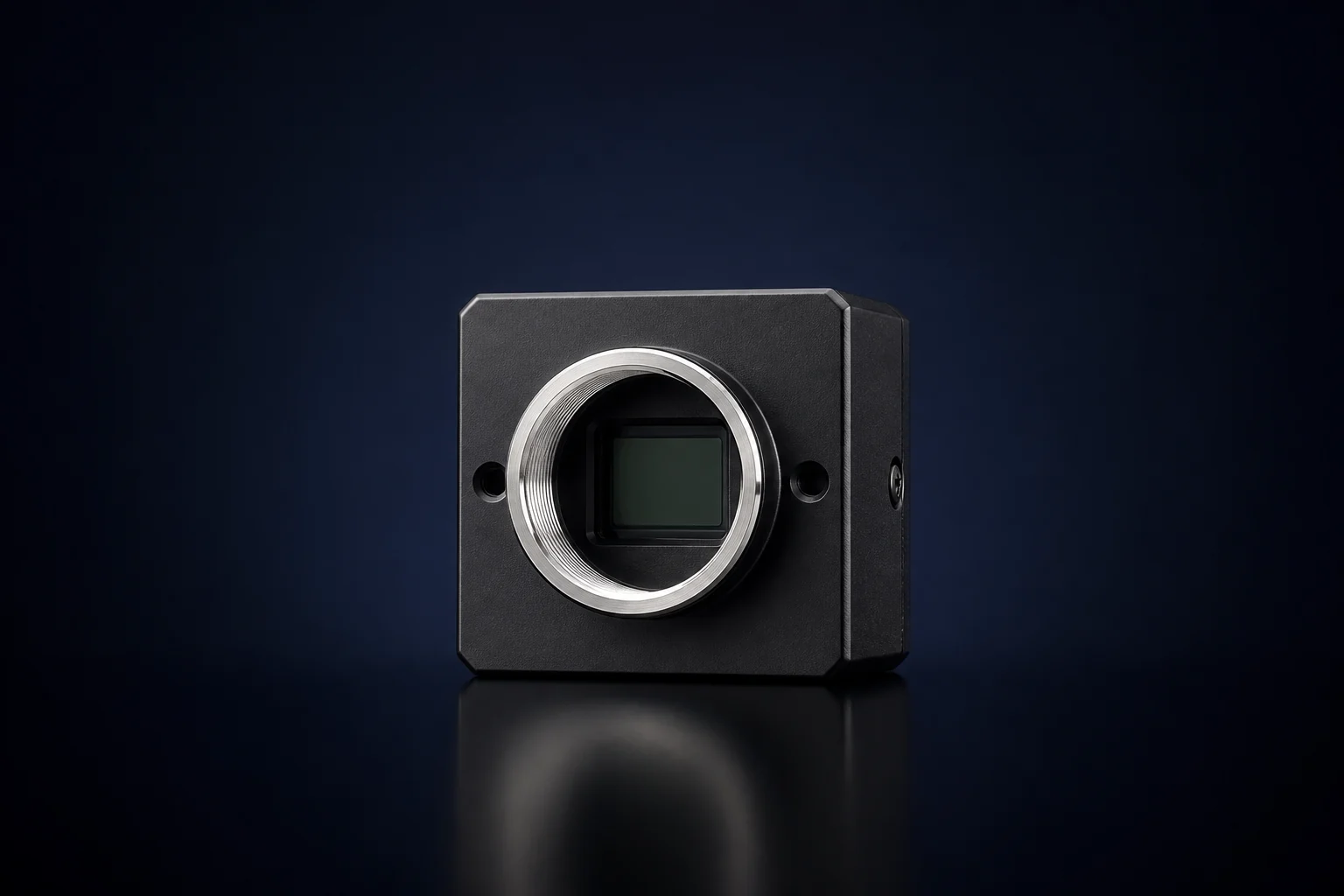
One-inch GigE imaging in the range
A 1-inch Sony IMX183 sensor records 5472 × 3648 frames at 5.9 fps in MV-CS200-10GC. The CMOS array uses a rolling shutter, placing emphasis on high spatial sampling of stationary scenes rather than moving-object geometry. Gigabit Ethernet at 1000 Mbit/s, with 100 Mbit/s Fast Ethernet support, gives the camera a network-oriented connection in a 29 mm × 29 mm × 42 mm C-mount body.
The camera is suited to wide-area detail inspection, stationary surface documentation, print review, and indexed component checks. The larger 1-inch optical format demands matching C-mount coverage, while the -30 °C to 60 °C working range extends placement beyond the 0 °C to 50 °C range of many CU bodies. A 9 V DC to 24 V DC input and PoE support provide alternative supply paths, and the P7 connector carries three machine I/O lines.
MV-CU200-20GC offers a similar resolution class at 5120 × 3840 and the same 5.9 fps, but uses a smaller 1/1.8-inch AR2020 colour sensor. MV-CU120-10GC lowers resolution to 4024 × 3036 and raises the GigE rate to 9.7 fps. MV-CH250-90TC-C-NF records 5120 x 5120 at 41.5 fps with global shutter and 10 Gigabit Ethernet when motion and throughput are central.
Available versions
One device, different revisions. We ship the current one by default; if a specific revision is already installed on your line, name it in the request and we will match it.
| Part number | PN | Note | Version | |
|---|---|---|---|---|
| MV-CS200-10GC | 306301442 / 306302367 | Hirose 6-pin connector, 2.5 W consumption | — | |
| MV-CS200-10GC V5.0 | 306302826 | P7 6-pin connector, 1.5 W consumption | V5.0 |
Specifications
| Sensor type | CMOS, rolling shutter |
| Sensor model | Sony IMX183 |
| Sensor format | 1″ |
| Resolution | 5472 × 3648 px |
| Maximum frame rate | 5.9 fps |
| Data interface | Gigabit Ethernet (1000 Mbit/s), compatible with Fast Ethernet (100 Mbit/s) |
| Digital I/O | 6-pin Hirose connector; opto-isolated input × 1 (Line 0), opto-isolated output × 1 (Line 1), bi-directional non-isolated I/O × 1 (Line 2) |
| Lens mount | C-mount |
| Power supply | 9 VDC to 24 VDC, supports PoE |
| Power consumption | 2.5 W @ 12 VDC |
| Ingress protection | IP40 |
| Operating temperature | -30 to 60 °C |
| Storage temperature | -30 to 70 °C |
| Humidity | 20 to 95 % RH |
| Dimensions | 29 mm × 29 mm × 42 mm |
| Weight | Approx. 100 g |
| Compatibility | GigE Vision V2.0, GenICam |
Selection and applications
One-inch wide-area detail capture. Stationary surface documentation. Cold-environment indexed inspection.
Minimum kit: The minimum setup is MV-CS200-10GC, a C-mount lens covering a 1-inch sensor, a Gigabit Ethernet cable, and either PoE or a 9 V DC to 24 V DC supply.
Nearby in the range: MV-CU200-20GC — Prefer it for 5120 × 3840 colour capture on a 1/1.8-inch sensor at 5.9 fps.; MV-CU120-10GC — Prefer it for 9.7 fps colour GigE imaging when 4024 × 3036 is sufficient.; MV-CH250-90TC-C-NF — Prefer it for 5120 x 5120 global-shutter capture at 41.5 fps over 10 Gigabit Ethernet..
Cables and accessories for this model
Compatibility per manufacturer data.
- Data cables
- GigE
- I/O & power cables
- Hirose 6-pin IO
- Power
- Power
- Mounting
- Camera mounts
FAQ
What optics are needed to cover the one-inch IMX183?
MV-CS200-10GC uses C-mount with a 1-inch Sony IMX183 sensor. Select a lens whose image circle covers that full format and whose resolution suits 5472 × 3648 sampling. Field of view and working distance then determine focal length.
How should motion be controlled with MV-CS200-10GC?
The IMX183 is a rolling-shutter CMOS sensor. For repeatable geometry, hold or index the target during the 5472 × 3648 acquisition. The 5.9 fps rate also points toward detail-rich stationary scenes rather than high-speed event analysis.
Can this camera share power with its Ethernet link?
PoE is supported, and the alternative supply input is 9 V DC to 24 V DC. This gives the system designer a powered-network option or a separate camera feed while retaining the Gigabit Ethernet image connection.
Which machine signals are available at the camera body?
The 6-pin P7 connection provides one opto-isolated input, one opto-isolated output, and one bidirectional non-isolated I/O. These lines can coordinate image capture, illumination, and an auxiliary control signal with an indexed station.
What operating environment can MV-CS200-10GC cover?
The stated working range is -30 °C to 60 °C with 20% to 95% RH. The enclosure is IP40. The installation should remain non-condensing and should protect the camera connections where direct moisture exposure is possible.