Area camera · CT series
Hikrobot MV-CT0CU0016/G
- Warranty
- 36 months
BASE version: what you get
What this version gives you:
- Type-C interface
- IP40 (under proper lens installation and wiring)
- Control interface not supported
Same version, other sensor variant:
Application focus and trade-offs
Direct-to-host colour acquisition at 249 fps is the defining combination here. The Stacked BSI CMOS device in MV-CT0CU0016/G outputs 1440 × 1080 px in colour at 249 fps. A global shutter, 3.45 × 3.45 µm pixel pitch and 1/2.9-inch sensor format define the optical side; USB 3.0 on the Type-C interface defines the data side.
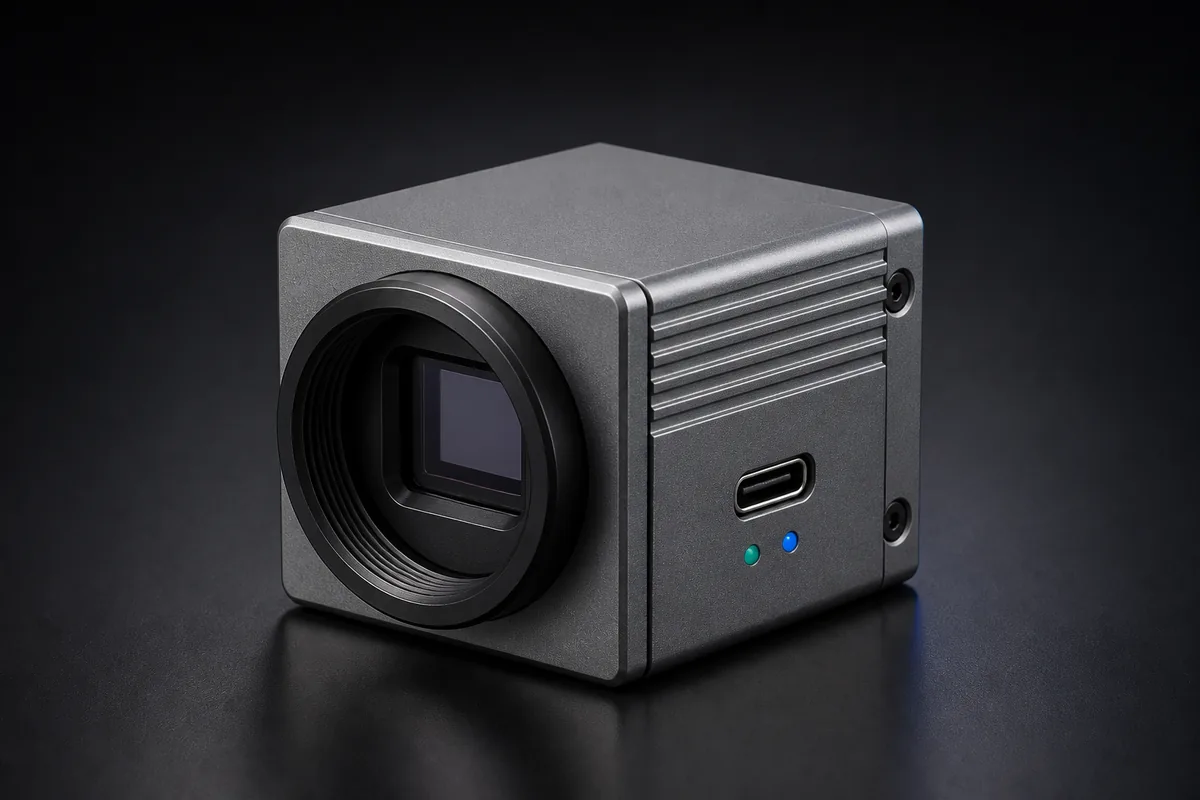
The global shutter and 249 fps ceiling support rapid colour sorting, orientation checks and short-cycle presence inspection, with the full field exposed on the same timing basis. Exposure extends through 23 µs to 10 s. Trigger Width and Trigger Controlled modes allow exposure to follow external timing. The 29 mm × 29 mm × 30 mm (1.1" × 1.1" × 1.2") body accepts C-mount optics. IP40 protection applies with proper lens installation and wiring, and the working range is –30 °C to 60 °C (–22 °F to 140 °F).
At 249 fps, this USB option sits above the GigE twins in acquisition rate. MV-CT0CG0016/G uses Gigabit Ethernet for 1440 × 1080 px colour capture at 78.2 fps. MV-CT0MG0016/G uses Gigabit Ethernet for 1440 × 1080 px monochrome capture at 78.2 fps. MV-CT0CU0020/G provides 1624 × 1240 px at 180.1 fps with a global-shutter colour path over USB 3.0. Retain MV-CT0CU0016/G when Color output, Type-C USB 3.0 and USB power are needed together at 249 fps.
Specifications
| Order code | MV-CT0CU0016/G/NN/NN |
| Product type | 1.6 MP USB 3.0 Area Scan Camera |
| Sensor type | CMOS, global shutter |
| Sensor model | Stacked BSI |
| Sensor format | 1/2.9″ |
| Resolution | 1440 × 1080 px |
| Pixel size | 3.45 × 3.45 μm |
| Maximum frame rate | 249 fps @ 1440 × 1080 Bayer GB 8 |
| Mono color | Color |
| Pixel format | Mono 8, Bayer GB 8/10/10Packed/12/12Packed, YUV422Packed, YUV422_YUYV_Packed, RGB 8, BGR 8 |
| Binning | Supports 1 × 1, 2 × 2, 4 × 4 |
| Decimation | Supports 1 × 1, 2 × 2, 4 × 4 |
| Reverse image | Supports horizontal and vertical reverse image output |
| Dynamic range | 61 dB |
| Exposure time | 23 μs to 10 sec |
| Exposure mode | Off/Once/Continuous exposure mode, supports Trigger Width and Trigger Controlled |
| Gain | 0 dB to 24 dB |
| SNR | 44 dB |
| Data interface | USB 3.0, compatible with USB 2.0 |
| Digital I/O | 8-pin M8 A-Code aviation connector provides power and I/O, including opto -isolated input × 1 (Line 0), opto-isolated output × 1 (Line 1), bi-directional non-isolated I/O × 1 (Line 2). |
| Lens mount | C-mount |
| Operating system | 32/64-bit Windows 7/10, 64-bit Windows 11, 32/64-bit Linux |
| Power supply | 9 VDC to 24 VDC, supports USB 3.0 power supply |
| Power consumption typ | Typ. 1.5 W @ 5 VDC (USB 3.0 provides power supply) |
| Ingress protection | IP40 (under proper lens installation and wiring) |
| Operating temperature | –30 °C to 60 °C (–22 °F to 140 °F) |
| Storage temperature | –30 °C to 80 °C (–22 °F to 176 °F) |
| Humidity | 20% RH to 95% RH (no condensation) |
| Dimensions | 29 mm × 29 mm × 30 mm (1.1″ × 1.1″ × 1.2″) |
| Weight | Approx. 72 g (0.2 lb.) |
| Certification | CE, RoHS, KC |
| Compatibility | USB3 Vision, GenICam |
| Data interface connector | Type-C interface |
| Control interface | Not supported |
| Client software | MVS or third-party software meeting with USB3 Vision Protocol |
Selection and applications
Colour feature capture at 1440 × 1080 px. Triggered colour inspection with a global shutter. Full-frame acquisition up to 249 fps.
| Lenses | MVL-KF1628M-12MP, MVL-KF5024M-25MP |
|---|
Minimum kit: Use MV-CT0CU0016/G with a C-mount lens, a USB 3.0 cable to the Type-C interface, and either USB bus power or 9 V DC to 24 V DC power through the 8-pin M8 A-Code connection.
Nearby in the range: MV-CT0CG0016/G — Prefer it for Gigabit Ethernet transport at 1440 × 1080 px and 78.2 fps.; MV-CT0MG0016/G — Prefer it for Mono output over Gigabit Ethernet at 1440 × 1080 px and 78.2 fps.; MV-CT0CU0020/G — Prefer it for 1624 × 1240 px, 180.1 fps and global-shutter colour capture..
Compatible lens options
- MVL-KF1628M-12MP — C-mount mount; Ø17.6 mm image circle fully covers the 1/2.9 sensor; 12 MP optical class — headroom for this camera
- MVL-KF5024M-25MP — C-mount mount; Ø19.3 mm image circle fully covers the 1/2.9 sensor; 25 MP optical class — headroom for this camera
Cables and accessories for this model
Compatibility per manufacturer data.
- Data cables
- CT: USB Type-CUSB 3.0
- I/O & power cables
- CT: power and I/O
- Power
- Power
- Mounting
- Camera mounts
FAQ
Which suggested lenses cover the sensor in MV-CT0CU0016/G?
For MV-CT0CU0016/G, the C-mount matches are MVL-KF1628M-12MP and MVL-KF5024M-25MP. Their image circles cover the 1/2.9-inch sensor, and the 12 MP and 25 MP lens classes are above the camera’s 1440 × 1080 px matrix. Both therefore match the stated mount, sensor coverage and resolution requirement.
How should power and cabling be arranged for MV-CT0CU0016/G?
The Type-C USB 3.0 connection supports bus power, while the camera also accepts 9 V DC to 24 V DC. The 8-pin M8 A-Code connection provides power and I/O for externally powered wiring. Consumption is typically 1.5 W at 5 V DC (USB 3.0 provides power supply).
What data interface and peak acquisition rate does MV-CT0CU0016/G provide?
Data uses USB 3.0 through the Type-C interface and is compatible with USB 2.0. The stated full-frame ceiling is 249 fps at 1440 × 1080 Bayer GB 8. MVS and software meeting the USB3 Vision protocol are supported for acquisition.
How do shutter timing and exposure affect motion work with MV-CT0CU0016/G?
The CMOS sensor uses a global shutter, so all pixels share the exposure timing for moving-part capture. Full-frame rate is 249 fps, and the exposure range is 23 µs to 10 s. Trigger Width and Trigger Controlled operation are available.
Which image-reduction and I/O functions are available on MV-CT0CU0016/G?
Binning and decimation each support 1 × 1, 2 × 2 and 4 × 4 operation. Horizontal and vertical reverse-image output is available. The 8-pin M8 A-Code I/O provides one opto-isolated input, one opto-isolated output and one bidirectional non-isolated line for sequencing.
What enclosure conditions and temperature range apply to MV-CT0CU0016/G?
Operation is rated from –30 °C to 60 °C (–22 °F to 140 °F), with 20% RH to 95% RH (no condensation). The housing is 29 mm × 29 mm × 30 mm (1.1" × 1.1" × 1.2") and weighs approximately 72 g (0.2 lb.). Its IP40 rating applies under proper lens installation and wiring, so the station must provide conditions consistent with that protection level.