3D laser profile sensor · DP2000 series Laser Profiler
Hikrobot MV-DP2060
- Warranty
- 36 months
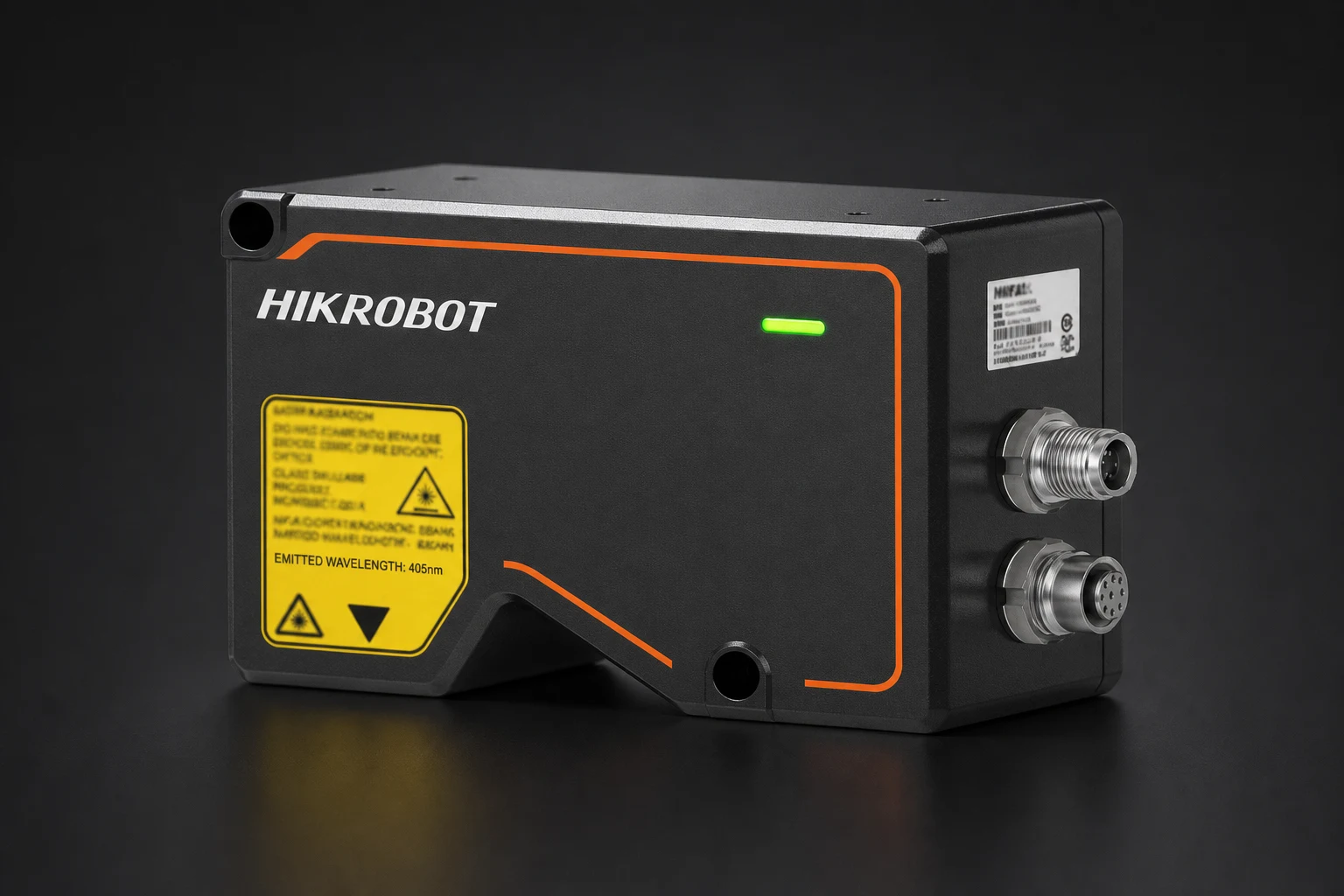
ROI-speed profiling over moderate relief
A 26 mm Z range and 63.5 mm working distance position MV-DP2060 for moderate relief in a compact measurement station. The X field opens from 26.5 mm near to 35.5 mm far, and the nominal profile contains 2048 points. Full-range scanning is 660 Hz, while ROI operation raises the maximum to 10 kHz; stated repeatability is 0.49 µm.
Use the full height envelope when steps or formed surfaces can occupy most of the 26 mm range, then restrict the ROI when a smaller height window permits faster acquisition. Profile, depth, brightness and original-image outputs are available over Gigabit Ethernet. A 12-pin M12 interface combines 24 VDC power with differential inputs, one differential output and an RS-232 channel on the 01P execution.
MV-DP2060 trades profile density and peak rate against nearby models. MV-DP2062 records 3200 points and reaches 23.9 kHz across an 11 mm Z range, whereas MV-DP3060 retains roughly the same 20.5 to 27 mm height class and reaches 46.7 kHz on its 01P execution. Select MV-DP2060 when 26 mm of Z coverage and a 10 kHz ROI ceiling meet the line requirement.
Overview
A DP2000 series laser profiler — the base class: the sensor projects a laser line across the part and measures height at every point of the section, up to 3200 points per profile.
Used where a profile is needed rather than a picture: weld bead control, adhesive bead height, gap and flush, warpage, parcel volume. Data goes to VM3D or 3DMVS, and to third-party software over a standard protocol.
Available versions
One device, different revisions. We ship the current one by default; if a specific revision is already installed on your line, name it in the request and we will match it.
| Part number | PN | Laser wavelength | Laser class | Sensor | Note | Version | |
|---|---|---|---|---|---|---|---|
| MV-DP2060-01D | 306400528 | 405 nm | Class 3R | Dual-mode image sensor | — | V2.0 | |
| MV-DP2060-01P | 306400439 | — | — | — | — | — | |
| MV-DP2060-03P | 306400536 | — | — | — | no vendor datasheet published | V2.0 |
Specifications
| Resolution | 2048 |
| Scan frame rate | 660 Hz (within max. measurement range), max. 10 kHz in ROI mode Hz |
| Data interface | Gigabit Ethernet (1000 Mbit/s), compatible with Fast Ethernet (100 Mbit/s) |
| Digital I/O | 12-pin M12 interface provides power and I/O, including differential input × 3 (Line 0/3/6), differential output × 1 (Line 1), and RS-232 × 1 |
| Working distance | 63.5 mm |
| Resolution z-axis | 1.50 μm to 2.71 μm |
| Repeatability z-axis | 0.49 μm @ data that sensor tests gauge block on optical platform |
| Measurement range z-axis | 26 mm |
| Power supply | 24 VDC |
| Power consumption | Typ. 13.8 W @ 24 VDC |
| Ingress protection | IP67 |
| Operating temperature | Working 0 °C to 45 °C; Storage –30 °C to 80 °C °C |
| Storage temperature | –30 °C to 80 °C (–22 °F to 176 °F) |
| Humidity | 20% RH to 85% RH (no condensation) |
| Dimensions | 240 mm × 90.5 mm × 58 mm (9.4″ × 3.6″ × 2.3″) |
| Weight | Approx. 1447 g (3.2 lb.) |
| Field of view | 26.5 mm @ near field of view; 31 mm @ reference distance; 35.5 mm @ far field of view |
| Accuracy | 0.008 |
| Resolution x-axis | 13.2 µm to 18.5 µm |
| Software | 3DMVS, VM3D, or third-party 3D software |
| Data output | Original image, profile data, depth image, brightness image |
| Data output type | Original image, profile data, depth image, brightness image |
| Data points per profile | 2048 |
| Digital I/O (V1) | 12-pin M12, differential input ×3 (0/3/6), differential output ×1 (1), RS-232 ×1 ports |
| Digital I/O (V2.0) | 12-pin M12, opto-isolated input ×2 (0/9), differential input ×2 (3/6), differential output ×1 (1) ports |
| High frame rate mode | 1.7 to 23.9 kHz |
| Laser class | Class 3R |
| Laser wavelength | 405 nm |
| Measurement range X (near/ref/far) | 27 / 31.5 / 36 mm |
Selection and applications
Moderate-relief measurement through a 26 mm Z range. ROI profile capture at up to 10 kHz. Profile, depth and brightness output over Gigabit Ethernet.
Minimum kit: MV-DP2060, a Gigabit Ethernet cable, a 12-pin M12 power and I/O cable matched to the execution, a 24 VDC supply, and a 3DMVS, VM3D or third-party 3D software host form the minimum acquisition kit.
Nearby in the range: MV-DP2062 — Prefer it for 3200-point profiles and rates up to 23.9 kHz within an 11 mm Z range.; MV-DP3060 — Prefer its 01P execution when a 27 mm Z range and rates up to 46.7 kHz are required..
Cables and accessories for this model
Compatibility per manufacturer data.
- Other
- 3D accessories
FAQ
How does ROI operation change the scan rate of MV-DP2060?
Across the maximum 26 mm measurement range, the stated scan rate is 660 Hz. Restricting the measurement window in ROI mode raises the maximum to 10 kHz. This allows acquisition speed to be exchanged for a smaller active height region.
What measurement envelope should a fixture provide around MV-DP2060?
The working distance is 63.5 mm and the Z envelope is 26 mm. Across that depth, the X field changes from 26.5 mm at the near limit through 31 mm at the reference position to 35.5 mm at the far limit.
Which profile outputs can MV-DP2060 send to the processing host?
The listed outputs include original images, profile data, depth images and brightness images. They are transported over Gigabit Ethernet at 1000 Mbit/s, with compatibility for 100 Mbit/s Fast Ethernet where the acquisition load permits.
How do the listed MV-DP2060 interface executions differ at the I/O connector?
The 01P connection lists three differential inputs, one differential output and one RS-232 port on a 12-pin M12. The 01P V2.0 entry instead lists two opto-isolated inputs, two differential inputs and one differential output on the same connector format.
What power and environmental limits apply to an MV-DP2060 station?
The profiler uses 24 VDC and has listed typical-consumption entries of 21 W and 13.8 W across its source variants. It is rated IP67, works from 0 to 45 °C and stores from -30 to 80 °C, with 20 to 85% RH without condensation.
Which software environments can receive measurements from MV-DP2060?
3DMVS, VM3D and third-party 3D software are listed for measurement handling. The 2048-point profile and the available image outputs pass through Gigabit Ethernet, so the host configuration should follow the chosen full-range or ROI scan rate.