Frame grabber · GE Series
Hikrobot MV-GE1104P
- Warranty
- 36 months
Powered GigE acquisition profile
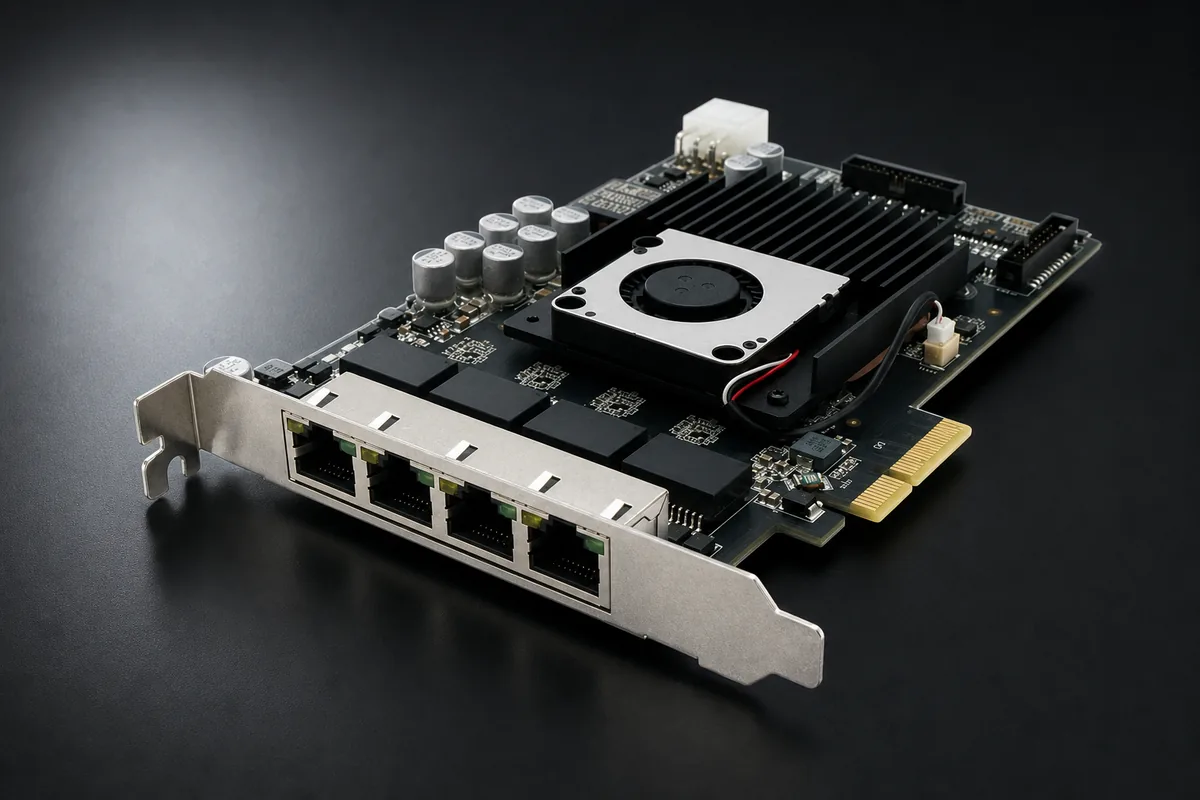
Per-port PoE is the defining feature of MV-GE1104P, a four-input GigE frame grabber with RJ45 camera connections at 1 Gbit/s. Each channel can deliver up to 15.4 W, while a 512 MB DDR3 buffer stages the image traffic. The PCI-E gen2 × 2 host link is rated at 860 MB/s maximum and 800 MB/s sustained transfer, and the board consumes 4.7 W typical before camera-power load.
The card suits a four-view inspection cell where network data and power should reach each camera through one RJ45 run. PoE operation requires an ATX power connection in the host. Windows and 64-bit Linux support through Ubuntu 24.04 allow the same four-port architecture to be deployed in either environment, while the 0 to 60 °C working range defines the required conditions around the acquisition computer.
Compared with MV-GE1104, the P variant adds 15.4 W PoE on every channel, extends host support to Ubuntu 18.04 through 24.04, lowers typical board consumption from 10 W to 4.7 W without PoE, and changes the interconnect from PCI-E gen2 × 4 to gen2 × 2. MV-GE1004 is the higher-throughput powered option at 1600 MB/s sustained with 1 GB DDR3, but its stated PoE ceiling is 15 W per port.
Specifications
| Camera ports | RJ45 × 4 |
| Cameras supported | 4 max |
| Camera connection speed | 1 Gbps |
| Interconnect | PCI-E gen2 × 2 |
| Delivery bandwidth | 860 MB/s (max. transmission bandwidth), 800 MB/s (sustained transmission bandwidth) |
| On-board memory | 512 MB DDR3-RAM |
| Power output | PoE, each channel provides 15.4 W max |
| PoE support | PoE, each channel provides 15.4 W at most (ATX power required for PoE) |
| Power consumption | 4.7 W typ. (without PoE) |
| Operating temperature | 0 to 60 °C |
| Storage temperature | -20 to 70 °C |
| Humidity | 10 to 95 % RH |
| Dimensions | 181 × 126.3 × 21.6 mm |
| Certification | CE-EMC,KC |
| Supported OS | Windows 7/10/11, Ubuntu 18.04 to 24.04 on 64-bit Linux |
| Client software | MVS |
Selection and applications
Four-camera PoE acquisition. Single-cable GigE camera wiring. Linux or Windows image intake.
Minimum kit: Place MV-GE1104P in a PCI-E gen2 × 2 host, attach up to four GigE cameras with RJ45 network cables, and provide the required ATX feed for up to 15.4 W of PoE per channel.
Nearby in the range: MV-GE1104 — Prefer it for a PCI-E gen2 × 4 four-port path at 800 MB/s sustained.; MV-GE1004 — Prefer it for 1600 MB/s sustained transfer and the expanded machine-I/O set.; MV-GE2204P — Prefer it for 9.5 KB jumbo frames and 3 W consumption with four PoE ports..
Cameras that connect to this board
RJ45 × 4 · up to 4 cameras · 860 MB/s:
Matched by interface and port count.
FAQ
How much PoE power can MV-GE1104P deliver per camera?
Each of the four RJ45 channels can provide up to 15.4 W through PoE. An ATX power connection is required for PoE operation. The board itself draws 4.7 W typical when camera power is excluded.
What bandwidth is shared by the four MV-GE1104P ports?
The PCI-E gen2 × 2 host path is specified for 860 MB/s maximum and 800 MB/s sustained transfer. Four 1 Gbit/s camera links feed this path, with a 512 MB DDR3-RAM on-board buffer.
Can MV-GE1104P run in a 64-bit Linux acquisition host?
Yes. Ubuntu 18.04 through 24.04 on 64-bit Linux is listed, alongside Windows 7, 10 and 11. MVS is the named client software for the supported host environments.
What environmental limits should be observed for MV-GE1104P?
The working-temperature interval is 0 to 60 °C and humidity is 10 to 95% RH. Storage is allowed from -20 to 70 °C. The host enclosure should maintain the board inside those stated conditions.
How does the MV-GE1104P host link differ from MV-GE1104?
MV-GE1104P uses PCI-E gen2 × 2 and provides up to 15.4 W PoE per channel, whereas MV-GE1104 uses PCI-E gen2 × 4. Both support four 1 Gbit/s cameras, have 512 MB DDR3 and sustain 800 MB/s.
Why choose the MV-GE1004 board instead of MV-GE1104P?
MV-GE1004 is appropriate when the host path must sustain 1600 MB/s rather than 800 MB/s or when 1 GB of DDR3 buffer is needed instead of 512 MB. Both provide four powered 1 Gbit/s RJ45 channels.