Smart camera · SC6000 series
Hikrobot MV-SC6050M
- Warranty
- 36 months
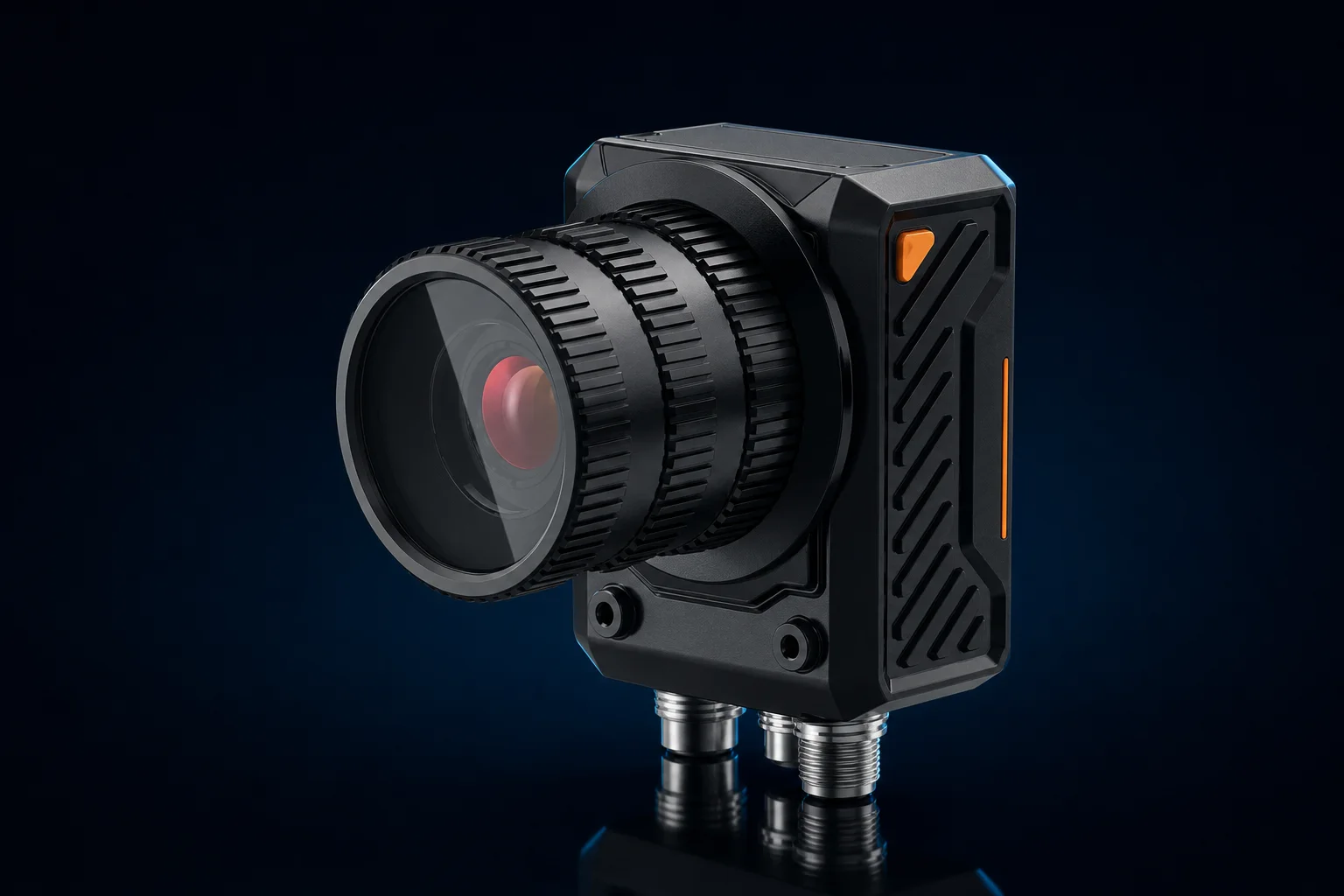
Mid-range mono detail and timing
A 2432 × 2048 mono frame at up to 80 fps positions MV-SC6050M for inspections that need more detail than the 120 fps SC6000 pair but cannot drop to the 40 fps high-resolution tier. Its 1/1.45-inch CMOS sensor uses 3.45 µm pixels, global shutter and exposure from 16 µs to 1 sec. Deep-learning OCR, object recognition and defect detection run through the stated VM Platform configurations.
Edge location, part geometry, print contrast and surface-defect checks can use the mono output without carrying colour channels. The global shutter supports moving targets, while the exposure range covers short capture and longer integration. A 17-pin M12 interface combines 24 VDC power, isolated and configurable I/O, RS-232 and an external light output up to 30 W; Gigabit Ethernet provides the network path.
MV-SC6016M reaches 120 fps at 1408 × 1024 for a faster, lower-resolution station. MV-SC6120M increases the mono image to 4096 × 2944 and runs up to 40 fps. MV-SC6050C matches the 2432 × 2048 and 80 fps operating point in colour, making it the direct alternative when chromatic information forms part of the acceptance rule.
Available versions
Same device, different configuration. We match the part number to your working distance and field of view.
| Part number | PN | Lens | Focusing | Light source | Version | |
|---|---|---|---|---|---|---|
| MV-SC6050M-00C-NNN V2.0 | 308600838 | C-mount, lens not included | C-mount | no built-in light | V2.0 | |
| MV-SC6050M-16M-XBN | 308600854 | 16 mm | mechanical | — | — |
Specifications
| Sensor type | CMOS, global shutter |
| Sensor format | 1/1.45″ |
| Resolution | 2432 × 2048 |
| Pixel size | 3.45 µm × 3.45 µm |
| Maximum frame rate | 80 fps |
| Mono color | Mono |
| Exposure time | 16 μs to 1 sec |
| Gain | 0 dB to 18 dB |
| Data interface | Gigabit Ethernet (1000 Mbit/s) |
| Digital I/O | 17-pin M12 male connector provides power and I/O, providing opto-isolated input × 2 (Line 0/1), opto-isolated output × 2 (Line 4/5), configurable non-isolated input/output × 2 (Line 2/3), RS-232 × 1, light source output (max. 30 W) × 1 (C-mount) / 17-pin M12 connector provides power and I/O, including opto-isolated input × 2 (Line 0/1), opto-isolated output × 2 (Line 4/5), configurable non-isolated input/output × 2 (Line 2/3), RS-232 × 1, and light source output (max. 30 W) × 1 (mechanical) |
| Storage | 64 GB |
| Power supply | 24 VDC |
| Power consumption | Approx. 12.5 W @ 24 VDC (without external light source); Approx. 42.5 W @ 24 VDC (with external light source) (C-mount) / External light source and built-in light source cannot be used at the same time; Avg. 12 W @ 24 VDC (with no external light source and the built-in light source disabled); Avg. 42 W @ 24 VDC (with external light source); Avg. 16.6 W @ 24 VDC (built-in light source is enabled); Max. 18 W @ 24 VDC (with no external light source and the built-in light source disabled); Max. 48 W @ 24 VDC (with external light source or the built-in light source enabled) (mechanical) |
| Ingress protection | IP67 (under proper installation of waterproof lens cap) |
| Operating temperature | 0 °C to 50 °C (32 °F to 122 °F) |
| Storage temperature | –30 °C to 70 °C (–22 °F to 158 °F) |
| Humidity | 20% RH to 95% RH, no condensation (C-mount) / 20% RH to 95% RH (no condensation) (mechanical) |
| Dimensions | 116.3 mm × 68.6 mm × 101.8 mm (4.6″ × 2.7″ × 4.0″) (C-mount) / 77 mm × 98 mm × 115.7 mm (3.0″ × 3.9″ × 4.6″) (mechanical) |
| Weight | Approx. 530 g (1.2 lb.) (C-mount) / Approx. 750 g (1.7 lb.) (mechanical) |
| Certification | CE-EMC,KC |
| Algorithms | Adopts AI deep learning algorithm to achieve OCR, object recognition, defect detection, etc. |
| Software | VM Platform (C-mount) / Vision Master Platform (include deep learning module) (mechanical) |
| Communication protocol | TCP , UDP , ModBus, Serial Port, Profinet, EtherNet/IP, Fins, MC, FTP , etc. (C-mount) / TCP, UDP, MODBUS, Serial Port, PROFINET, EtherNet/IP, Fins, MC, FTP, etc. (mechanical) |
| Indicator | Power indicator (PWR), network indicator (LNK), status indictor (STS), and user-defined indicator (U1/U2) |
Selection and applications
Mono feature inspection at 2432 × 2048. Moving-part analysis at up to 80 fps. Deep-learning OCR with machine I/O.
Minimum kit: Use a C-mount configuration of MV-SC6050M with a C-mount lens, suitable external light, a Gigabit Ethernet cable, a 17-pin M12 power and I/O cable, and a 24 VDC supply.
Nearby in the range: MV-SC6016M — Prefer it for 1408 × 1024 mono capture at up to 120 fps.; MV-SC6120M — Prefer it for 4096 × 2944 mono inspection when 40 fps is enough.; MV-SC6050C — Prefer it when the 2432 × 2048, 80 fps inspection requires colour..
Cables and accessories for this model
Compatibility per manufacturer data.
- Data cables
- ID Ethernet, M12 8-pinSC cables, M12 17-pin
- Power
- Power
- Optics
- M12 lenses
- Mounting
- Camera mounts
- Protection
- Covers & filters
FAQ
What inspection trade-off is represented by 2432 × 2048 at 80 fps?
MV-SC6050M provides more image samples than the 1408 × 1024 MV-SC6016M but a lower maximum than its 120 fps. Against MV-SC6120M, it runs faster at 80 fps but has fewer samples than that model's 4096 × 2944 frame.
How do the C-mount and mechanical power cases differ?
The C-mount figures are approximately 12.5 W without external light and 42.5 W with it at 24 VDC. For the mechanical form, average draw is 12 W with lights disabled, 16.6 W with the built-in light, and 42 W with external light; the maximum can reach 48 W.
Can built-in and external illumination operate together?
No. The mechanical configuration states that its external and built-in light sources cannot be used at the same time. The 17-pin M12 connection includes one light-source output up to 30 W, so illumination mode must be chosen in the station design.
Which timing and I/O features support motion capture?
The sensor has a global shutter, exposure from 16 µs to 1 sec and acquisition up to 80 fps. The camera provides two opto-isolated inputs, two opto-isolated outputs and two configurable non-isolated lines for trigger and result timing.
How are onboard algorithms connected to factory control?
OCR, object recognition and defect detection run in VM Platform or Vision Master Platform with the deep-learning module, depending on configuration. Gigabit Ethernet at 1000 Mbit/s supports PROFINET, EtherNet/IP, Modbus, TCP and UDP for result exchange.