Area camera · CA Series
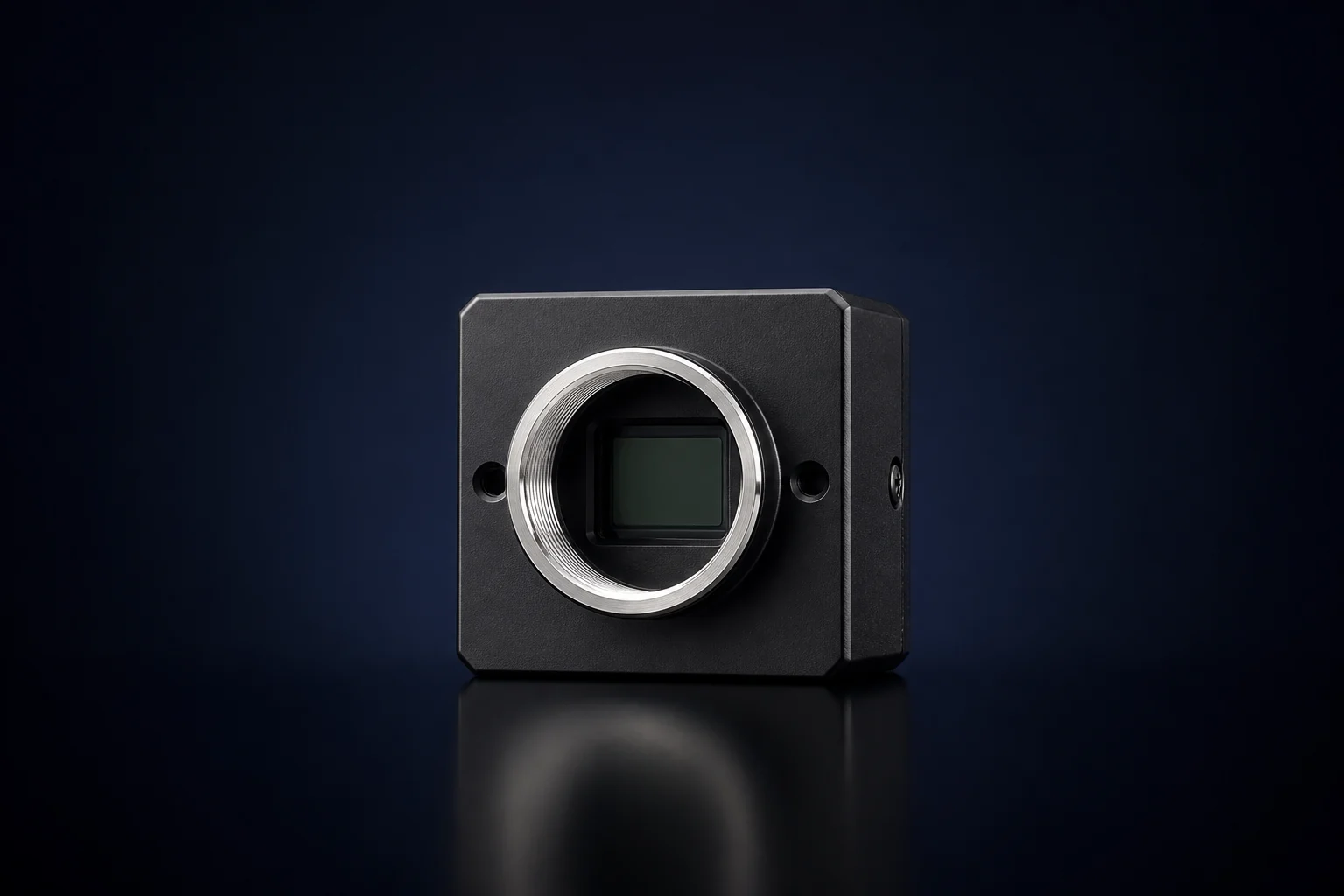
Hikrobot MV-CA004-10GM V3.0
- Lead time
- from 5 days
- Warranty
- 36 months
Discontinued
The manufacturer has discontinued this model.
Last buy date at the manufacturer: 2025-12-30.
Manufacturer-listed replacement:
Monochrome speed on a Gigabit Ethernet link
Monochrome 720 × 540 acquisition at 312.9 fps defines MV-CA004-10GM V3.0. Its 1/2.9-inch Sony IMX287 CMOS sensor has 6.9 × 6.9 µm pixels and a global shutter, with images sent over Gigabit Ethernet. Exposure spans 1 µs to 10 sec, and the C-mount camera occupies a 29 × 29 × 42 mm housing.
This combination addresses fast presence, edge and position checks that do not require color information. The global shutter captures the frame at one instant, while the short exposure limit can reduce motion displacement under sufficient illumination. A 6-pin Hirose connection supplies one isolated input, one isolated output and one bidirectional line for machine timing. PoE or 9–24 V DC powers the unit.
Choose MV-CA004-10GM V3.0 when mono processing and a Gigabit Ethernet path are required together. MV-CA004-10GC V3.0 has the same Sony IMX287, 720 × 540 frame and 312.9 fps limit but outputs color. MV-CA004-10UM retains mono output and raises full-frame speed to 526.5 fps over USB 3.0. MV-CA013-20GC offers 1280 × 1024 over Gigabit Ethernet at 90 fps when more spatial detail matters.
Specifications
| Shutter | global |
| Sensor model | Sony® IMX287 |
| Nominal optical sensor format | 1/2.9″ |
| Sensor resolution | 720×540 px |
| Maximum frame rate | 312.9 fps @ resolution 720×540 px |
| Color mode | mono |
| Lens mount | C-mount |
| Data interface | GigE (Fast Ethernet compatible) |
| Sensor technology | CMOS |
| Pixel size | 6.9×6.9 µm |
| Dynamic range | 74 dB |
| Signal-to-noise ratio | 41 dB |
| Exposure time | 1…10000000 µs |
| Auto exposure | Off, Once, Continuous |
| Gain | 0…20 dB |
| Pixel format | Mono8, Mono10, Mono10p, Mono12, Mono12p |
| Binning | not available |
| Decimation | not available |
| Image buffer | 128 MB |
| Protocol compatibility | GigE Vision, GenICam |
| Communication protocol versions | GigE Vision 1.2 |
| Third party software protocol | GigE Vision |
| Client software | MVS |
| Operating systems | Windows 7 (32/64-bit), Windows 10 (32/64-bit), Linux (32/64-bit) |
| Digital I/O lines | 1 input, opto-isolated, line 0; 1 output, opto-isolated, line 1; 1 bidirectional line, non-isolated, line 2 |
| Power supply | 9…24 V |
| Power delivery | PoE |
| PoE support | yes |
| Power consumption | 3.1 W (typical) @ DC, supply voltage 12 V |
| Ingress protection | IP30 @ with lens and cables properly installed |
| Working temperature | 0…50 °C |
| Storage temperature | -30…70 °C |
| Humidity | 20…80 % @ non-condensing |
| Dimensions | 29×29×42 mm |
| Weight | 68 g (approx.) |
| Certification | CE, RoHS, KC |
| Reverse image | horizontal, vertical |
Documents
Selection and applications
Monochrome edge inspection. Fast presence and position checks. Machine-synchronized image capture.
Minimum kit: Use the camera with a C-mount lens, a Gigabit Ethernet cable, and either PoE or a 9–24 V DC supply.
Nearby in the range: MV-CA004-10GC V3.0 — Prefer color output at the same 720 × 540 resolution and 312.9 fps; MV-CA004-10UM — Prefer mono USB 3.0 acquisition at up to 526.5 fps; MV-CA013-20GC — Prefer 1280 × 1024 Gigabit Ethernet acquisition when 90 fps meets the cycle.
Cables and accessories for this model
Compatibility per manufacturer data.
- Data cables
- GigE
- I/O & power cables
- Hirose 6-pin IO
- Power
- Power
- Mounting
- Camera mounts
FAQ
Why use the mono variant for a fast inspection station?
MV-CA004-10GM V3.0 records mono 720 × 540 frames at up to 312.9 fps with a global-shutter Sony IMX287. It fits inspections based on intensity, edges or position where the documented color output of MV-CA004-10GC V3.0 is unnecessary.
What exposure controls are available for moving targets?
Exposure ranges from 1 µs to 10 sec and gain from 0 to 20 dB. The 1 µs lower limit can restrict subject travel during an exposure when lighting is sufficient, while the global shutter aligns exposure timing across the complete 720 × 540 frame.
How can the camera receive data connection and power?
Images travel over Gigabit Ethernet, with Fast Ethernet operation also listed. Power can arrive through PoE or a separate 9–24 V DC input. Typical power consumption is 3.1 W at 12 V DC, and the power/I/O connection uses a 6-pin Hirose connector.
What trigger and output connections does the camera expose?
The 6-pin Hirose interface includes one opto-isolated input on Line 0, one opto-isolated output on Line 1 and one bidirectional non-isolated I/O on Line 2. This arrangement supports a machine event input plus output signalling around acquisition.
What mechanical and ambient constraints should be planned?
The body measures 29 × 29 × 42 mm and weighs approximately 68 g. It is rated IP30 with proper lens installation and wiring, operates from 0 to 50 °C at 20–80% RH without condensation, and accepts a C-mount lens for its 1/2.9-inch sensor.