Area camera · CA Series
Hikrobot MV-CA050-20UM
- Warranty
- 36 months
Discontinued
The manufacturer has discontinued this model.
Last buy date at the manufacturer: 2025-12-30.
Manufacturer-listed replacement:
Speed, applications and neighbours
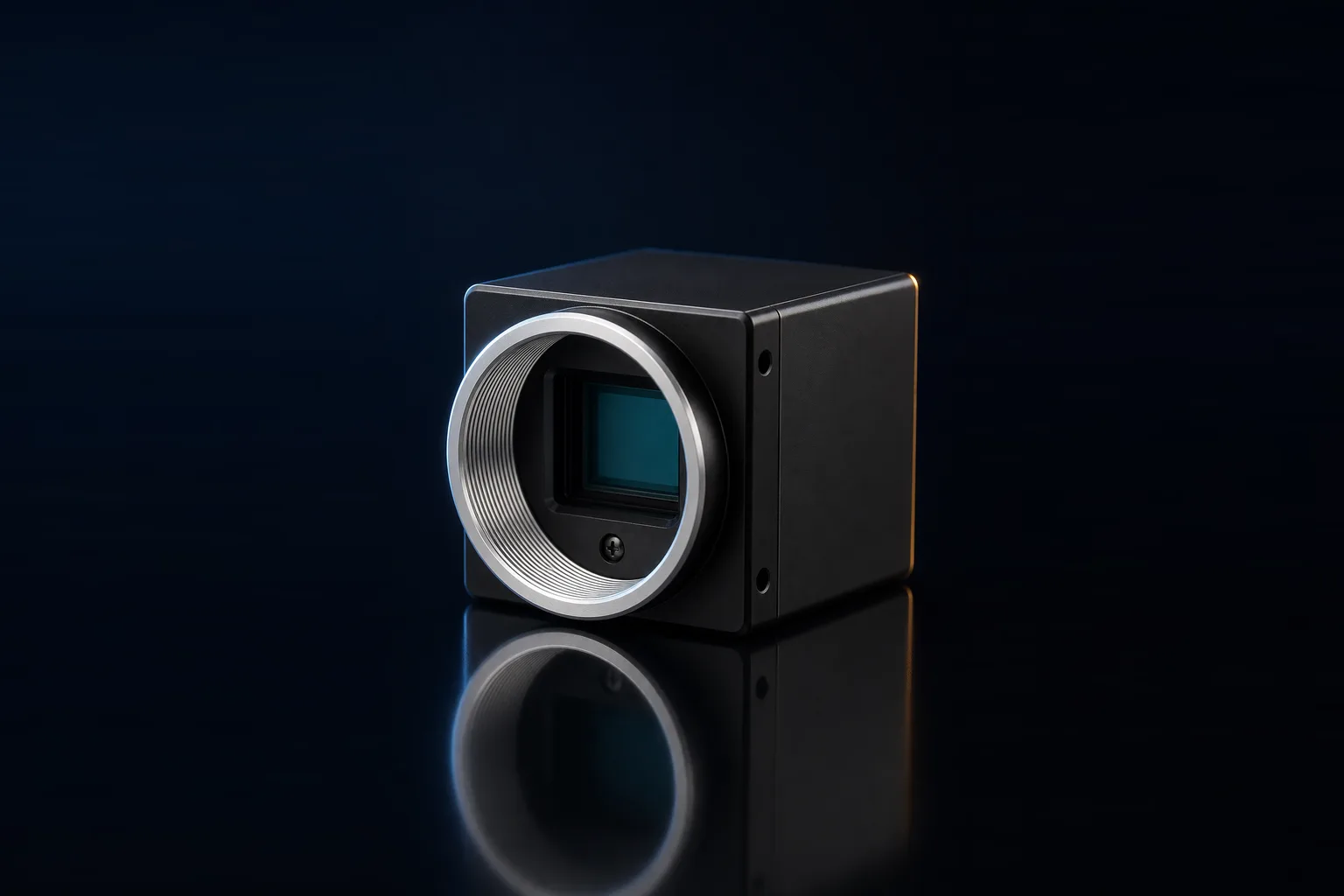
Full-resolution acquisition at 71.8 fps is the defining feature of MV-CA050-20UM. Its monochrome PYTHON5000 CMOS sensor combines a 1-inch format, 4.8 µm pixels and a 2592 × 2048 array with a global shutter. USB 3.0 connects the compact 29 mm × 29 mm × 30 mm C-mount camera directly to the processing host and can provide its operating power.
The frame rate and simultaneous exposure suit moving-component inspection, rapid presence checks and feature measurement where a 5.3 MP frame must be captured repeatedly within the machine cycle. Exposure spans 59 µs to 10 sec, and the 6-pin Hirose I/O supplies isolated input and output for deterministic triggering and strobe timing. The monochrome output also supports intensity-based edge, shape and surface analysis without a color result.
MV-CA050-20GM preserves the same PYTHON5000 sensor, 1-inch optics and resolution but changes to Gigabit Ethernet with PoE and 22 fps, making it the network-oriented option at a lower image rate. MV-CA050-12UM uses a smaller 2/3-inch IMX264, 2448 × 2048 resolution and 47 fps. Choose MV-CA050-20UM when the 1-inch field geometry and 71.8 fps USB stream are both required.
Specifications
| Product type | 5.3 MP USB 3.0 Area Scan Camera |
| Sensor type | CMOS, global shutter |
| Sensor model | PYTHON5000 |
| Sensor format | 1″ |
| Resolution | 2592 × 2048 |
| Pixel size | 4.8 µm × 4.8 µm |
| Maximum frame rate | 71.8 fps @ 2592 × 2048 |
| Mono color | Mono |
| Dynamic range | 57.5 dB |
| Exposure time | 59 μs to 10 sec |
| Gain | 0 dB to 15 dB |
| Data interface | USB3.0, compatible with USB2.0 |
| Digital I/O | 6-pin Hirose connector provides power and I/O, including opto-isolated input × 1 (Line 0), opto-isolated output × 1(Line 1), bi-directional non-isolated I/O × 1 (Line 2) |
| Lens mount | C-mount |
| Power supply | 12 VDC, supports USB3.0 power supply |
| Power consumption | Typ. 3.5 W @ 5 VDC (USB3.0 provides power supply) |
| Ingress protection | IP30 (under proper lens installation and wiring) |
| Operating temperature | 0 °C to 50 °C (32 °F to 122 °F) |
| Storage temperature | –30 °C to 70 °C (–22 °F to 158 °F) |
| Humidity | 20% RH to 80% RH (no condensation) |
| Dimensions | 29 mm × 29 mm × 30 mm (1.1″ × 1.1″ × 1.2″) |
| Weight | Approx. 56 g (0.12 lb.) |
| Certification | CE-EMC, KC, FCC-SDoC |
| Compatibility | USB3 Vision, GenICam |
Selection and applications
High-rate monochrome inspection of moving parts. Global-shutter measurement at 2592 × 2048. USB-triggered shape and surface analysis.
Minimum kit: MV-CA050-20UM, a 1-inch C-mount lens, a USB 3.0 cable, and either USB 3.0 power or a 12 V DC supply make up the minimum acquisition set.
Nearby in the range: MV-CA050-20GM — Prefer it when Gigabit Ethernet with PoE is required at 22 fps.; MV-CA050-12UM — Prefer it for 2448 × 2048 imaging on a 2/3-inch sensor..
Cables and accessories for this model
Compatibility per manufacturer data.
- Data cables
- USB 3.0
- I/O & power cables
- Hirose 6-pin IO
- Power
- Power
- Mounting
- Camera mounts
FAQ
What optical coverage is required for MV-CA050-20UM?
MV-CA050-20UM uses a C-mount and a 1-inch PYTHON5000 sensor. The selected C-mount lens must cover the full 1-inch image area and resolve 2592 × 2048 pixels at a 4.8 µm pitch across the required field.
Can the USB link also power the MV-CA050-20UM camera?
Yes. USB 3.0 power is supported, with typical consumption of 3.5 W at 5 V DC in that configuration. A 12 V DC input is also listed, allowing the power arrangement to follow the host and machine wiring design.
What does the 71.8 fps figure represent on MV-CA050-20UM?
It is the stated maximum rate at the full 2592 × 2048 resolution. The interface is USB 3.0 and is compatible with USB 2.0, but acquisition planning for the full image rate should be based on the USB 3.0 connection.
How short can exposure be for fast moving features?
The exposure range begins at 59 µs and extends to 10 sec. Combined with the global shutter, the short end supports strobed or brightly illuminated captures in which every row represents the same exposure interval.
What are the operating limits for an enclosed installation?
Operation is specified from 0 °C to 50 °C and 20% RH to 80% RH without condensation. The camera is IP30 with correct lens installation and wiring, and its body is 29 mm × 29 mm × 30 mm.