Area camera · CA Series
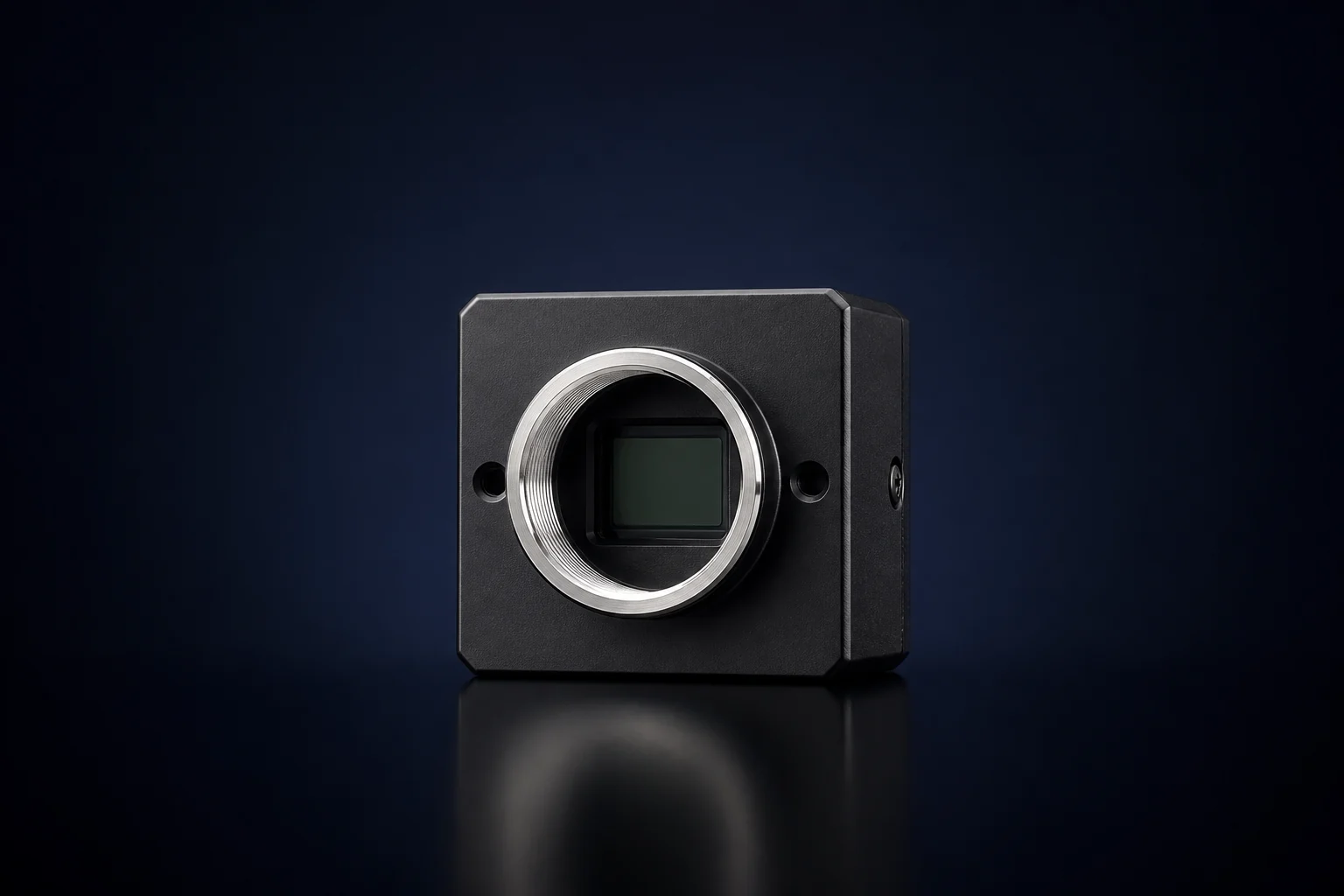
MV-CA050-20GM Discontinued GigE Area-Scan Camera
- Warranty
- 36 months
Discontinued
The manufacturer has discontinued this model.
Last buy date at the manufacturer: 2025-12-30.
Manufacturer-listed replacement:
Where this GigE model fits
A 1-inch PYTHON5000 sensor and 4.8 µm pixels give MV-CA050-20GM a distinct optical footprint among the 5 MP cameras in the lineup. The monochrome CMOS array produces 2592 × 2048 frames at 22 fps with a global shutter. Gigabit Ethernet supports a networked camera position, while the C-mount body measures 29 mm × 29 mm × 42 mm and accepts either 12 V DC or PoE.
This combination suits dimensional inspection, feature location and surface checks where the object moves during exposure but the required acquisition rate is moderate. The global shutter holds feature geometry across the frame, and the 65 µs to 10 sec exposure range covers triggered machine cycles as well as static low-rate work. PoE can combine power and data on the Ethernet connection; the 6-pin Hirose connection adds isolated trigger input and output plus a bidirectional line.
MV-CA050-20UM uses the same PYTHON5000, 1-inch format and 2592 × 2048 resolution, but USB 3.0 raises its listed rate to 71.8 fps; select it for a host-adjacent, higher-rate station. MV-CA050-12UM provides 2448 × 2048 at 47 fps from a smaller 2/3-inch IMX264 over USB 3.0. MV-CA050-20GM is the choice when the 1-inch optical path and Ethernet with PoE matter more than the higher USB frame rates.
Specifications
| Product type | 5.3 MP GigE Area Scan Camera |
| Sensor type | CMOS, global shutter |
| Sensor model | PYTHON5000 |
| Sensor format | 1″ |
| Resolution | 2592 × 2048 |
| Pixel size | 4.8 µm × 4.8 µm |
| Maximum frame rate | 22 fps @ 2592 × 2048 |
| Mono color | Mono |
| Dynamic range | 57.5 dB |
| Exposure time | 65 μs to 10 sec |
| Gain | 0 dB to 15 dB |
| Data interface | Gigabit Ethernet, compatible with Fast Ethernet |
| Digital I/O | 6-pin Hirose connector provides power and I/O, including opto -isolated input × 1 (Line 0), opto-isolated output × 1 (Line 1), bi-directional non-isolated I/O × 1 (Line 2). |
| Lens mount | C-mount |
| Power supply | 12 VDC, supports PoE |
| Power consumption | Typ. 3.3 W @ 12 VDC |
| Ingress protection | IP30 (under proper lens installation and wiring) |
| Operating temperature | 0 °C to 50 °C (32 °F to 122 °F) |
| Storage temperature | –30 °C to 70 °C (–22 °F to 158 °F) |
| Humidity | 20% RH to 80% RH (no condensation) |
| Dimensions | 29 mm × 29 mm × 42 mm (1.1″ × 1.1″ × 1.7″) |
| Weight | Approx. 68 g (0.15 lb.) |
| Certification | CE-EMC, KC, FCC-SDoC |
| Compatibility | GigE Vision V1.2, GenICam |
Selection and applications
Networked monochrome dimensional inspection. Triggered feature location on moving parts. Surface analysis with a 1-inch sensor.
Minimum kit: MV-CA050-20GM, a 1-inch C-mount lens, a Gigabit Ethernet cable, and either a 12 V DC supply or PoE are the minimum components for acquisition.
Nearby in the range: MV-CA050-20UM — Prefer it when USB 3.0 and 71.8 fps suit a host-adjacent station.; MV-CA050-12UM — Prefer it for a 2/3-inch IMX264 and 47 fps over USB 3.0..
Cables and accessories for this model
Compatibility per manufacturer data.
- Data cables
- GigE
- I/O & power cables
- Hirose 6-pin IO
- Power
- Power
- Mounting
- Camera mounts
FAQ
What lens format should be paired with MV-CA050-20GM?
Its lens interface is C-mount and the PYTHON5000 has a 1-inch sensor format. A suitable lens therefore needs a C-mount and an image circle that covers 1 inch while resolving the 2592 × 2048 array and its 4.8 µm pixels.
Does MV-CA050-20GM support power through Ethernet?
The camera supports PoE as well as a 12 V DC input. Typical consumption is 3.3 W at 12 V DC. PoE allows the Ethernet link to carry both image data and operating power when the connected network equipment provides it.
What full-resolution speed does the Gigabit Ethernet model provide?
The listed maximum is 22 fps at 2592 × 2048. The data interface is Gigabit Ethernet and remains compatible with Fast Ethernet; system sizing should use the full-resolution rate and selected pixel format for the intended acquisition.
Which trigger signals are available on the Hirose connection?
The 6-pin Hirose connector carries one opto-isolated input on Line 0, one opto-isolated output on Line 1 and one bidirectional non-isolated channel on Line 2. These lines support sensor trigger and illumination timing around the global exposure.
How does MV-CA050-20GM differ from the MV-CA050-20UM version?
Both are monochrome global-shutter cameras built around the 1-inch PYTHON5000 at 2592 × 2048. MV-CA050-20GM uses Gigabit Ethernet and reaches 22 fps; MV-CA050-20UM uses USB 3.0 and reaches 71.8 fps.
Typical applications
MV-CA050-20GM is a discontinued monochrome GigE area-scan camera documented here for installed-base identification and migration planning.
Discontinued model
MV-CA050-20GM, PN 306300053, is discontinued and recorded as E1/EOL, with a last-buy date of 2025-12-30. No availability is promised. Use the area-scan-cameras category to review current alternatives.
Legacy imaging specification
The camera uses a monochrome PYTHON5000 1-inch CMOS global-shutter sensor with 4.8 × 4.8 µm pixels. Resolution is 2592 × 2048 (5.31 MP), and the listed full-resolution rate is 22 fps.
Interface and mechanics
The Gigabit Ethernet interface is compatible with Fast Ethernet. The camera uses a C-mount and a 29 × 29 × 42 mm housing. Listed certifications are CE-EMC, KC and FCC-SDoC.
Migration points
The declared replacements are MV-CS050-60GM V5.0, PN 306302815, and MV-CS050-20GM V2.0, PN 306301724. Both are described as 2/3-inch replacements, so field of view and optics must be recalculated when moving from the legacy 1-inch sensor.
FAQ
Should the replacement be MV-CS050-60GM V5.0 or MV-CS050-20GM V2.0, and what differs beyond speed?
Hikrobot declares MV-CS050-60GM V5.0 (PN 306302815) and MV-CS050-20GM V2.0 (PN 306301724) as replacements; check their full specifications in the official datasheets.
How will moving from a 1-inch to a 2/3-inch sensor change field of view, focal length, and use of the existing lens?
The legacy camera has a 1-inch sensor, while both declared replacements are described as 2/3-inch models. Field of view and optics must be recalculated for the smaller sensor.