Area camera · CE Series
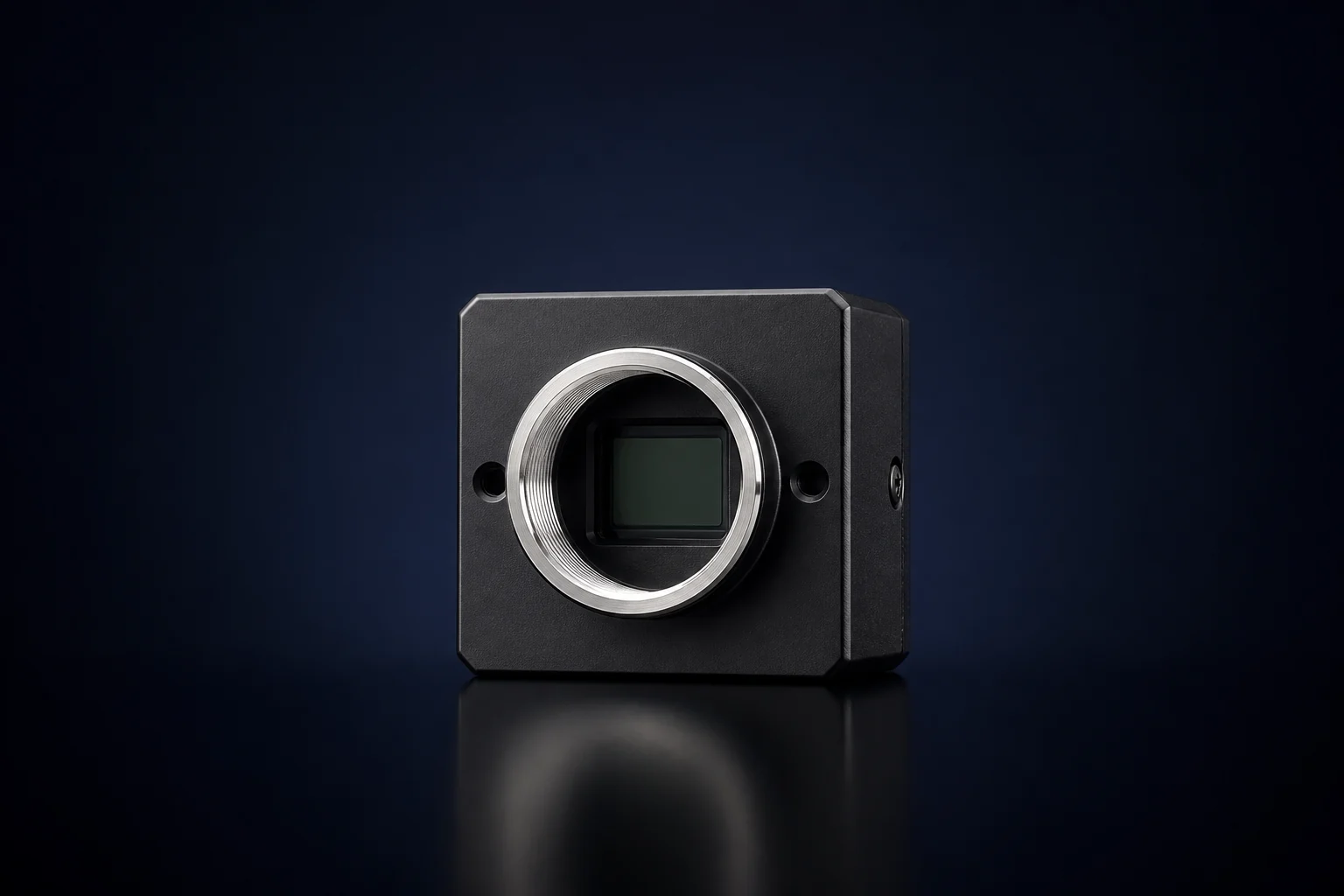
Hikrobot MV-CE013-80GM V3.0
- Warranty
- 36 months
Discontinued
The manufacturer has discontinued this model.
Last buy date at the manufacturer: 2025-12-30.
Manufacturer-listed replacement:
Mono imaging tasks and neighbours
Mono imaging at 89.9 fps gives the MV-CE013-80GM V3.0 its role in fast intensity-based inspection. The 1280 × 1024 SS CMOS sensor combines a global shutter, 4.0 µm pixels and a 1/2.7-inch optical format. Gigabit Ethernet provides the data path, with Fast Ethernet compatibility where that network mode is required.
The global exposure is suited to moving edges, part presence and repeated position checks on a conveyor. An exposure range from 31 µs to 1 sec supports both short captures and longer stationary acquisitions, while gain spans 0 dB to 20 dB. PoE simplifies a networked station to one data-and-power route, and the 6-pin Hirose connector adds isolated input and output plus bidirectional I/O.
MV-CE013-80GC V3.0 is the direct color counterpart at the same resolution and 89.9 fps, and draws a typical 2.6 W rather than 2.4 W at 12 VDC. For more spatial samples, MV-CE050-31GC V3.0 reaches 2592 × 1944 in color at 24 fps over Gigabit Ethernet. MV-CE060-10UM moves to USB3.0, 3072 × 2048 and 42.7 fps when resolution has priority over this model's higher capture rate.
Specifications
| Product type | 1.3 MP GigE Area Scan Camera |
| Sensor type | CMOS, global shutter |
| Sensor model | SS |
| Sensor format | 1/2.7″ |
| Resolution | 1280 × 1024 |
| Pixel size | 4.0 µm × 4.0 µm |
| Maximum frame rate | 89.9 fps @ 1280 × 1024 |
| Mono color | Mono |
| Dynamic range | 60 dB |
| Exposure time | 31 μs to 1 sec |
| Gain | 0 dB to 20 dB |
| Data interface | Gigabit Ethernet, compatible with Fast Ethernet |
| Digital I/O | 6-pin Hirose connector provides power and I/O, including opto-isolated input × 1 (Line 0), opto-isolated output × 1 (Line 1), bi-directional non-isolated I/O × 1 (Line 2). |
| Lens mount | C-mount |
| Power supply | 9 VDC to 24 VDC, supports PoE |
| Power consumption | Typ. 2.4 W @ 12 VDC |
| Ingress protection | IP30 (under proper lens installation and wiring) |
| Operating temperature | 0 °C to 50 °C (32 °F to 122 °F) |
| Storage temperature | –30 °C to 70 °C (–22 °F to 158 °F) |
| Humidity | 20% RH to 80% RH (no condensation) |
| Dimensions | 29 mm × 29 mm × 42 mm (1.1″ × 1.1″ × 1.7″) |
| Weight | Approx. 96 g (0.21 lb.) |
| Certification | CE-EMC, KC, CE-LVD, UL |
| Compatibility | GigE Vision V2.0, GenICam |
Selection and applications
Mono edge capture on moving parts. High-rate presence and position checks. Networked acquisition with isolated I/O.
Minimum kit: Start with the MV-CE013-80GM V3.0, a C-mount lens, a Gigabit Ethernet cable, and either PoE or a 9 VDC to 24 VDC supply connected through the 6-pin Hirose port.
Nearby in the range: MV-CE013-80GC V3.0 — Prefer it when the same 1280 × 1024 global-shutter stream must be color.; MV-CE050-31GC V3.0 — Prefer it when 2592 × 1944 color capture is needed at 24 fps.; MV-CE060-10UM — Prefer it for 3072 × 2048 USB3.0 acquisition at 42.7 fps..
Cables and accessories for this model
Compatibility per manufacturer data.
- Data cables
- GigE
- I/O & power cables
- Hirose 6-pin IO
- Power
- Power
- Mounting
- Camera mounts
FAQ
Why use the mono MV-CE013-80GM V3.0 for moving parts?
Its SS CMOS sensor is mono and uses a global shutter, so every row belongs to the same exposure interval. At 1280 × 1024 the camera reaches 89.9 fps, providing closely spaced frames for moving-edge, position and presence analysis.
What C-mount lens coverage is required by this camera?
The optical interface is C-mount and the sensor format is 1/2.7 inch. A suitable lens therefore needs image coverage for that format. Its resolving performance should also be selected around the 1280 × 1024 array and 4.0 µm pixel pitch.
What are the power choices for MV-CE013-80GM V3.0?
Power can arrive through PoE on the Gigabit Ethernet route or through the 6-pin Hirose connector at 9 VDC to 24 VDC. Typical consumption is 2.4 W at 12 VDC, which is the figure to use when sizing the supply allocation.
Can the camera exchange isolated signals with machine controls?
Yes. Line 0 is one opto-isolated input and Line 1 is one opto-isolated output. Line 2 is a bidirectional non-isolated I/O. All three signal functions are presented on the 6-pin Hirose power-and-I/O connector.
What environmental limits apply to the compact GigE housing?
The housing is rated IP30 with proper lens installation and wiring. Operation is specified from 0 °C to 50 °C at 20% RH to 80% RH without condensation; storage extends from –30 °C to 70 °C.