Area camera · CH Series
Hikrobot MV-CH100-60UC
- Warranty
- 36 months
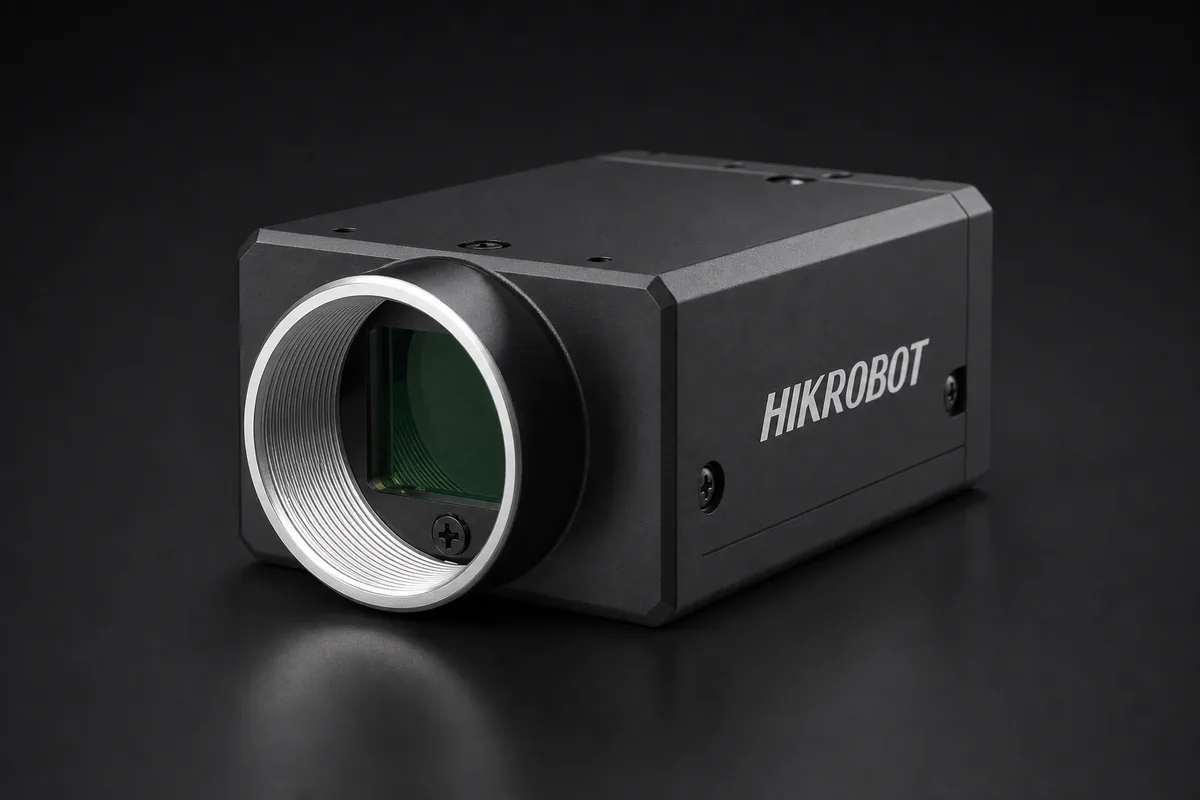
USB color throughput and frame coverage
Color acquisition at 36 fps across 4096 × 2460 gives MV-CH100-60UC a balance of image height and USB throughput. The 10.1 MP camera uses a 1-inch Stacked BSI CMOS sensor, 3.45 µm pixels and a global shutter, with Bayer GR 8 output over USB 3.0. It addresses detailed color checks in a directly connected inspection station.
The 2460-line image supports broad components that require more vertical context than a 4096 × 2160 frame. Exposure from 80 µs to 10 sec and simultaneous global-shutter capture allow triggered inspection of moving or stationary targets. USB can provide camera power, while a 9 V DC to 24 V DC input and P7 I/O are available for machine wiring.
MV-CH100-60GC keeps the same sensor and 4096 × 2460 color image but delivers 11.6 fps over Gigabit Ethernet with PoE. MV-CH089-10UC uses an IMX267 and a shorter 4096 × 2160 image at 32 fps. MV-CH120-11UC extends height to 3000 pixels at 30.3 fps over USB 3.0. Select MV-CH100-60UC for 36 fps and the intermediate-height Stacked BSI frame.
Specifications
| Product type | 10.1 MP USB 3.0 Area Scan Camera |
| Sensor type | CMOS, global shutter |
| Sensor model | Stacked BSI |
| Sensor format | 1″ |
| Resolution | 4096 × 2460 |
| Pixel size | 3.45 µm × 3.45 µm |
| Maximum frame rate | 36 fps @ 4096 × 2460 Bayer GR 8 |
| Mono color | Color |
| Dynamic range | 58.2 dB |
| Exposure time | 80 μs to 10 sec |
| Gain | 0 dB to 24 dB |
| Data interface | USB 3.0, compatible with USB 2.0 |
| Digital I/O | 6-pin P7 connector provides power and I/O, including opto-isolated input × 1 (Line 0), opto-isolated output × 1 (Line 1), bi-directional non-isolated I/O × 1 (Line 2). |
| Lens mount | C-mount |
| Power supply | 9 VDC to 24 VDC, supports USB power supply |
| Power consumption | Typ. 4.0 W @ 5 VDC (USB 3.0 provides power supply) |
| Ingress protection | IP40 (under proper lens installation and wiring) |
| Operating temperature | –10 °C to 50 °C (14 °F to 122 °F) |
| Storage temperature | –30 °C to 70 °C (–22 °F to 158 °F) |
| Humidity | 20% RH to 95% RH (no condensation) |
| Dimensions | 29 mm × 44 mm × 59 mm (1.1″ × 1.7″ × 2.3″) |
| Weight | Approx. 113 g (0.2 lb.) |
| Certification | CE-EMC, KC |
| Compatibility | USB3 Vision, GenICam |
Selection and applications
Detailed color inspection at 36 fps. USB capture of broad moving assemblies. Triggered checks needing added image height.
Minimum kit: MV-CH100-60UC, a 1-inch C-mount lens, a USB 3.0 cable, and either USB bus power or a 9 V DC to 24 V DC supply form the minimum imaging set.
Nearby in the range: MV-CH100-60GC — Prefer it for the same 4096 × 2460 color image over Gigabit Ethernet with PoE.; MV-CH089-10UC — Prefer it for a 4096 × 2160 IMX267 color image at 32 fps over USB 3.0.; MV-CH120-11UC — Prefer it for a taller 4096 × 3000 color image at 30.3 fps over USB 3.0..
Cables and accessories for this model
Compatibility per manufacturer data.
- Data cables
- USB 3.0
- I/O & power cables
- Hirose 6-pin IO
- Power
- Power
- Mounting
- Camera mounts
FAQ
How much full-resolution throughput does this USB model provide?
The listed maximum is 36 fps at 4096 × 2460 in Bayer GR 8. The camera uses USB 3.0 and is compatible with USB 2.0, while the full-rate operating point follows the USB 3.0 connection.
Can MV-CH100-60UC draw power from the USB connection?
USB power is supported, with typical consumption of 4.0 W at 5 V DC when USB 3.0 provides the supply. A separate 9 V DC to 24 V DC source can also power the camera.
What lens should cover the 4096 × 2460 Stacked BSI sensor?
The camera uses C-mount and a 1-inch sensor with 3.45 µm pixels. Select a lens that covers that optical format and resolves the full 4096 × 2460 image at the required magnification.
How are trigger and strobe timing connected to the camera?
The 6-pin P7 connector provides one opto-isolated input, one opto-isolated output and one bidirectional non-isolated line. These signals can synchronize the global exposure with a detector and illumination.
Which temperature, humidity and ingress limits apply?
The working range is -10 °C to 50 °C and 20% to 95% RH without condensation. IP40 applies when lens installation and wiring are correct, setting the environmental boundary for the camera body.