Line scan camera · CL series
Hikrobot MV-CL042-91GC
- Warranty
- 36 months
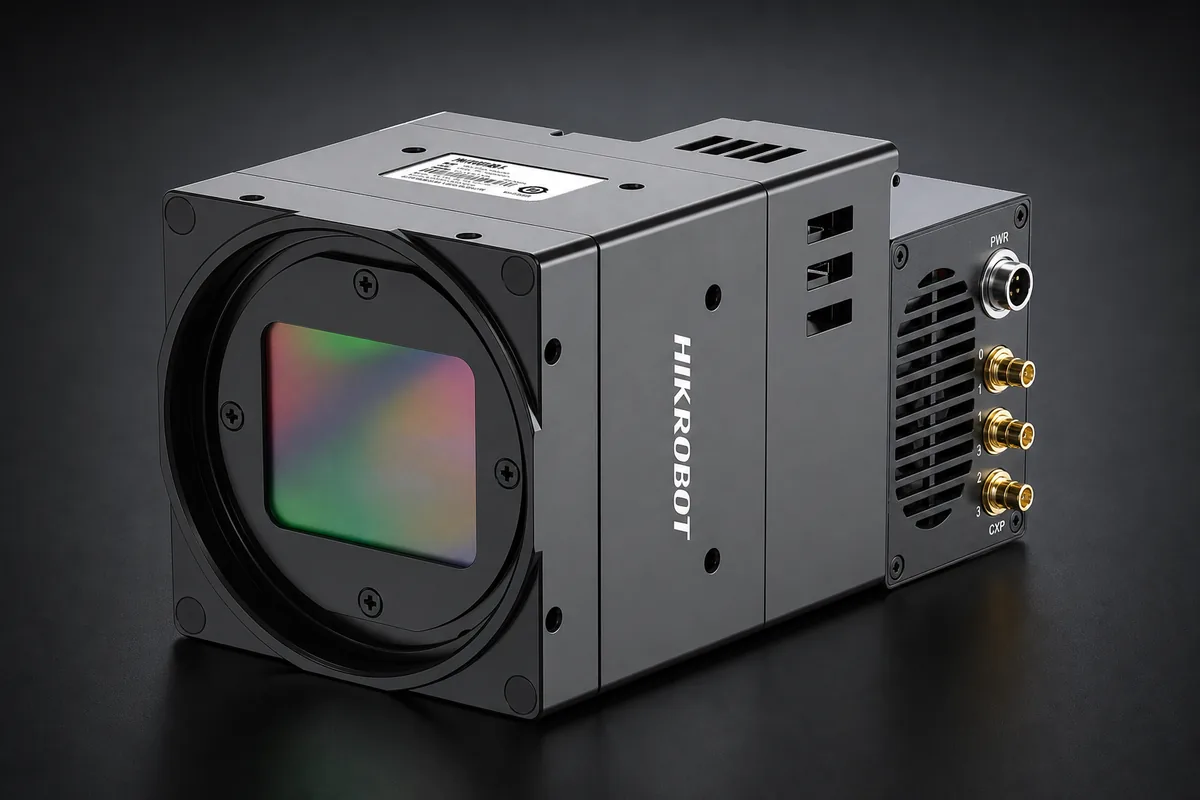
Networked 4K line capture in a compact body
A 4096 × 2 CMOS line, 7 × 7 µm pixels and Gigabit Ethernet place MV-CL042-91GC in the networked 4K section of the CL Series. It reaches 28 kHz in standard operation and 80 kHz in high-bandwidth operation. The link runs at 1000 Mbit/s and remains compatible with 100 Mbit/s Fast Ethernet, while exposure can be adjusted from 5 µs to 10 ms.
The 4096-pixel line suits continuous surface or edge inspection that needs twice the cross-object sampling count of a 2048-pixel model. Four configurable I/O lines, with single-ended or differential signaling, can connect line timing to the transport controller. The camera occupies 62 × 62 × 41 mm, draws 6.6 W from a 12 V DC to 24 V DC supply, and carries an IP40 enclosure rating.
MV-CL042-91GM uses the same resolution, pixel pitch, network rates and housing dimensions, and its specification lists 1-Line/2-TDI imaging and 5.8 W consumption. MV-CL042-B1NC changes the transport to 2.5 Gigabit Ethernet, the mount to C-mount and the pixel pitch to 3.5 µm, reaching 75.4 kHz in Bayer BRGG 8. MV-CL044-91NC provides a 4096 × 3 array and reaches 75.3 kHz at full line length.
Specifications
| Sensor type | CMOS |
| Resolution | 4096 × 2 px |
| Pixel size | 7 × 7 um |
| Dynamic range | 65.6 dB |
| Exposure time | 5 us to 10 ms |
| SNR | 40 dB |
| Data interface | Gigabit Ethernet (1000 Mbit/s), compatible with Fast Ethernet (100 Mbit/s) |
| Digital I/O | 4 configurable input/output lines; single-ended/differential supported |
| Lens mount | M42*1.0 |
| Power supply | 12 to 24 VDC |
| Power consumption | 6.6 W |
| Ingress protection | IP40 |
| Operating temperature | -20 to 55 C |
| Humidity | 5 to 90 % RH |
| Dimensions | 62 × 62 × 41 mm |
| Weight | 280 g |
| Compatibility | GigE Vision V2.0, GenICam |
| Flange back length | 12 mm |
| Max line rate (high-bandwidth) | 80 kHz |
| Max line rate (standard) | 28 kHz |
Selection and applications
Networked 4K surface scanning. Line capture at 80 kHz. Differentially timed web inspection.
Minimum kit: Pair the MV-CL042-91GC camera with an M42*1.0 line-scan lens, a Gigabit Ethernet cable, and a 12 V DC to 24 V DC power source.
Nearby in the range: MV-CL042-91GM — Prefer it when 1-Line and 2-TDI modes are required at the same network rates.; MV-CL042-B1NC — Prefer it for 2.5 Gigabit Ethernet and a compact C-mount body.; MV-CL044-91NC — Prefer it for a 4096 × 3 array with PoE support..
Cables and accessories for this model
Compatibility per manufacturer data.
- Power
- Power
- Mounting
- Camera mounts
FAQ
What network rates and line rates apply to MV-CL042-91GC?
The camera uses 1000 Mbit/s Gigabit Ethernet and is compatible with 100 Mbit/s Fast Ethernet. Its listed maximum line rates are 28 kHz in standard mode and 80 kHz in high-bandwidth mode on the 4096 × 2 CMOS array.
Which optical interface should be planned for MV-CL042-91GC?
An M42*1.0 lens mount and 12 mm flange back length are built into the 62 × 62 × 41 mm body. The line-scan lens should cover the 4096-pixel sensor line and provide sufficient resolution for its 7 × 7 µm pixel pitch.
How is MV-CL042-91GC powered and connected to machine timing?
The supply range is 12 V DC to 24 V DC and stated consumption is 6.6 W. Four configurable input/output lines are available, with single-ended and differential signals supported for timing integration beside the Ethernet data link.
What temperature and enclosure limits govern MV-CL042-91GC?
Working temperature is -20 °C to 55 °C and humidity is 5% RH to 90% RH. The housing is rated IP40. The camera should therefore be installed where its temperature limits are maintained and exposure to liquids or substantial dust is controlled.
What practical difference separates MV-CL042-91GC and MV-CL042-91GM?
Both list 4096 × 2 resolution, 7 µm pixels, 28 kHz standard and 80 kHz high-bandwidth operation. Their stated consumption is 6.6 W for MV-CL042-91GC and 5.8 W for MV-CL042-91GM. MV-CL042-91GM lists 1-Line/2-TDI imaging.