Vision sensor · SC2000E series
Hikrobot MV-SC2004EM
- Warranty
- 36 months
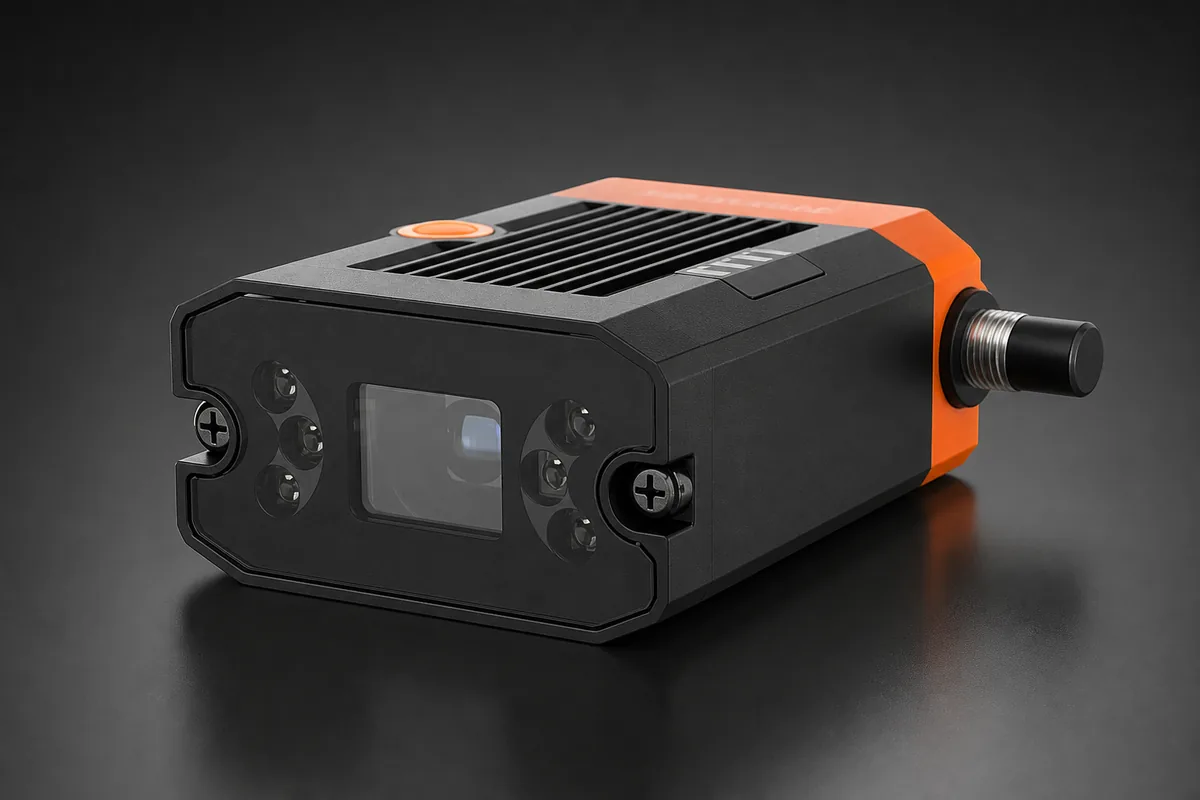
Mono inspection with compact body choices
A 704 × 540 mono frame at 60 fps positions MV-SC2004EM for fast grayscale inspection with moderate spatial detail. Its 1/2.9-inch CMOS sensor uses 6.9 µm pixels and a global shutter, with exposure adjustable from 16 µs to 1 sec. Two physical configurations use 6.72 mm and 12.4 mm designations: the former is 46 × 38 × 25 mm and approximately 160 g, while the latter is 46 × 57.6 × 25 mm and approximately 220 g.
The onboard functions address contrast, grayscale size, edge width, dimensions, brightness, angles, OCR, category recognition and pattern or contour presence. Global-shutter timing and the 60 fps ceiling fit triggered checks on successively presented parts. A 17-pin M12 connector carries 100 Mbit/s Fast Ethernet, 12–24 V DC power, RS-232 and non-isolated I/O, including two configurable lines and an external button input.
MV-SC2004EC is the color counterpart at the same 704 × 540 resolution and 60 fps and explicitly includes color operations. MV-SC2016EM retains mono capture and the same rate but increases the image to 1408 × 1024 with 3.45 µm pixels. MV-SC1003M is also mono but runs at 15 fps and 640 × 480. Use MV-SC2004EM for the faster lower-resolution mono task, and MV-SC2016EM when more spatial sampling is required.
Available versions
Same device, different configuration. We match the part number to your working distance and field of view.
| Part number | PN | Lens | Note | |
|---|---|---|---|---|
| MV-SC2004EM-06S-WBN-Mini V3.0 | 308600950 | 6.72 mm | Mini housing | |
| MV-SC2004EM-12S-WBN V3.0 | 308601047 | 12.4 mm | — | |
| MV-SC2004EM-15S-WBN V3.0 | 308601048 | 14.8 mm | — |
Specifications
| Sensor type | CMOS, global shutter |
| Sensor format | 1/2.9″ |
| Resolution | 704 × 540 |
| Pixel size | 6.9 µm × 6.9 µm |
| Maximum frame rate | 60 fps |
| Mono color | Mono |
| Exposure time | 16 μs to 1 sec |
| Gain | 0 dB to 15 dB |
| Data interface | Fast Ethernet (100 Mbit/s) |
| Digital I/O | 17-pin M12 connector provides power, Ethernet, serial port, and digital I/O, including non-isolated input × 1 (Line 2), non-isolated output × 1 (Line 3), configurable non-isolated I/O × 2 (Line 0/1), RS-232 × 1, and external button input × 1 (BUTTON). Output signals support NPN only. (6.72 mm) / 17-pin M12 connector provides power, Ethernet, serial port, and digital I/O, including non-isolated input × 1 (Line 2), non-isolated output × 1 (Line 3), configurable non-isolated I/O × 2 (Line 0/1), RS-232 × 1, and external button input × 1 (BUTTON) (12.4 mm) |
| Storage | Supports solution importing and exporting, up to 8 solutions and 40 modules can be stored. |
| Power supply | 12 VDC to 24 VDC |
| Power consumption | Avg. 4 W @ 24 VDC; Max. 11 W @ 24 VDC (6.72 mm) / Avg. 6 W @ 24 VDC; Max. 22 W @ 24 VDC (12.4 mm) |
| Ingress protection | IP65 |
| Operating temperature | 0 °C to 50 °C (32 °F to 122 °F) |
| Storage temperature | –30 °C to 70 °C (–22 °F to 158 °F) |
| Humidity | 20% RH to 95% RH (no condensation) |
| Dimensions | 46 mm × 38 mm × 25 mm (1.8″ × 1.5″ × 1.0″) (6.72 mm) / 46 mm × 57.6 mm × 25 mm (1.8″ × 2.3″ × 1.0″) (12.4 mm) |
| Weight | Approx. 160 g (0.4 lb.) (6.72 mm) / Approx. 220 g (0.5 lb.) (12.4 mm) |
| Certification | CE-EMC,KC |
| Algorithms | Measurement: P2P measurement, P2L measurement, contrast measurement, greyscale size, edge width measurement, width measurement, brightness average value, L2L angle, diameter measurement, and line angle; Existence: Anomaly judge, spot existence, edge existence, contour existence, pattern existence, circle existence, and line existence; Count: Spot count, edge count, contour count, and pattern count; Recognition: Category recognition, classification registration, and OCR; Logic: Calculator, logic judge, condition judge, combination judge, format output, If module, and character comparison; Location: Fixture |
| Software | SCMVS |
| Communication protocol | RS-232, TCP, UDP, FTP, PROFINET, Modbus, EtherNet/IP, MELSEC/SLMP, FINS, Keyence KV |
| Indicator | Power indicator (PWR), network indicator (LNK), and status indicator (STS) |
Selection and applications
Fast grayscale presence checks. Onboard OCR and measurement. Compact or extended-body installation.
Minimum kit: To commission MV-SC2004EM, use the selected sensor configuration, a 17-pin M12 cable for Fast Ethernet and I/O, and a 12–24 V DC supply sized for its stated load.
Nearby in the range: MV-SC2004EC — Select it when the 704 × 540 inspection requires color measurement and recognition.; MV-SC2016EM — Prefer it for 1408 × 1024 mono sampling at the same 60 fps limit.; MV-SC1003M — Use it for a smaller 640 × 480 head where 15 fps is adequate..
Cables and accessories for this model
Compatibility per manufacturer data.
- Power
- Power
- Optics
- M12 lenses
- Lighting
- SC lighting
- Mounting
- Reader mounts
- Protection
- Covers & filters
- I/O modules
- Reader IO box
FAQ
What image characteristics define the MV-SC2004EM mono version?
It uses a 1/2.9-inch mono CMOS sensor with a global shutter, 704 × 540 resolution and 6.9 µm pixels. The maximum rate is 60 fps, exposure runs from 16 µs to 1 sec, and gain adjustment covers 0 dB to 15 dB.
Which inspections can MV-SC2004EM perform without color data?
Available tools include grayscale size, contrast, brightness, widths, angles and diameter, plus spot, edge, contour, pattern, circle and line existence. OCR, category recognition, classification registration and fixture location are also listed.
How do the two MV-SC2004EM physical configurations compare?
The 6.72 mm configuration measures 46 × 38 × 25 mm and weighs approximately 160 g; the 12.4 mm configuration is 46 × 57.6 × 25 mm and approximately 220 g. Both are described with IP65 protection.
What power figures apply to each MV-SC2004EM configuration?
With a 24 V DC reference, the 6.72 mm version averages 4 W and reaches 11 W, while the 12.4 mm version averages 6 W and reaches 22 W. The accepted supply range for the sensor is 12–24 V DC.
How is MV-SC2004EM connected to Ethernet and machine I/O?
A 17-pin M12 connector combines Fast Ethernet, power, RS-232 and digital signals. The listed lines comprise one input, one output, two configurable I/O points and one external-button input; output signals support NPN only.