Area camera · CA Series
Hikrobot MV-CA003-21UC
- Warranty
- 36 months
Discontinued
The manufacturer has discontinued this model.
Last buy date at the manufacturer: 2025-12-30.
Manufacturer-listed replacement:
USB capture for rapid color events
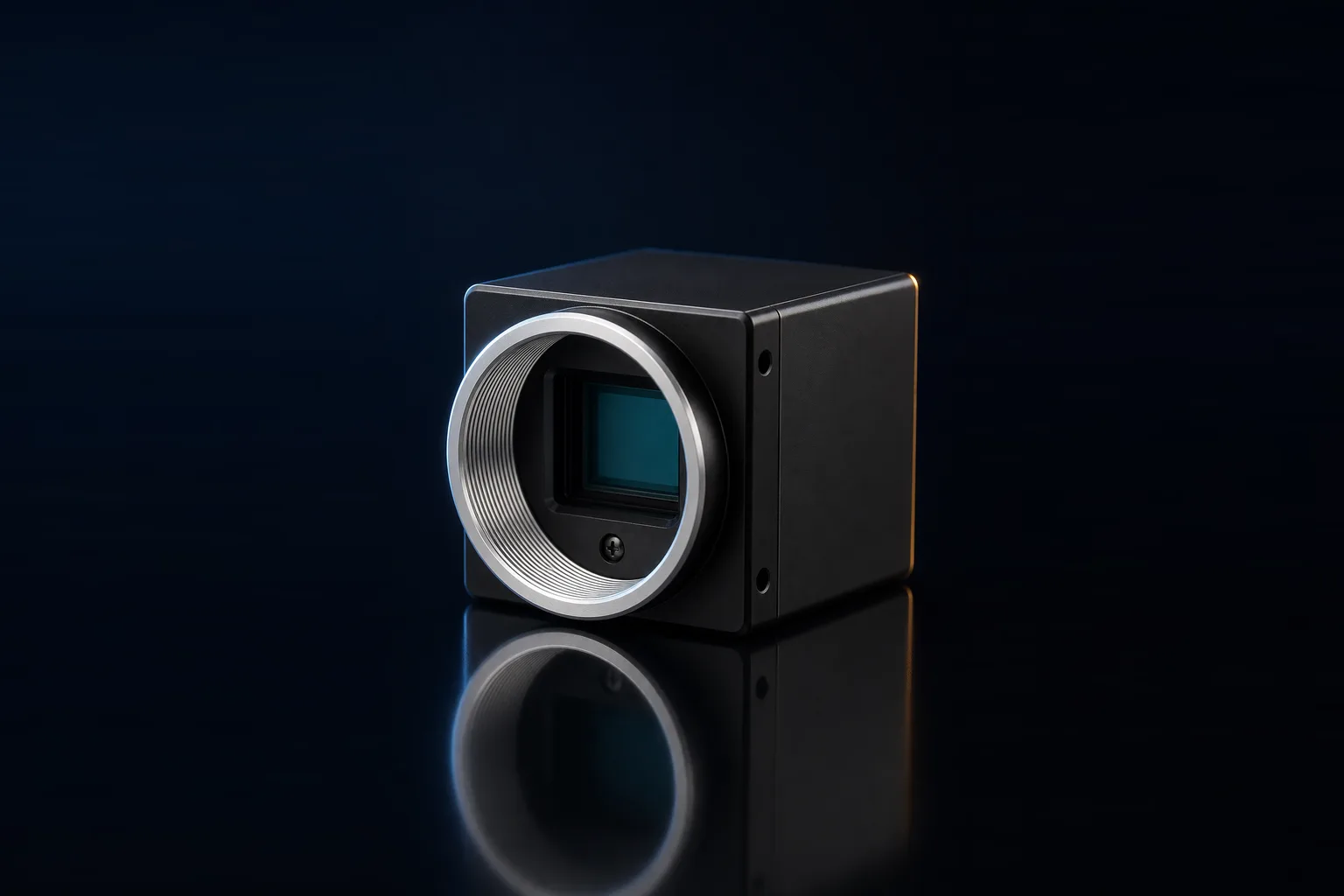
A 640 × 480 color frame at up to 814.5 fps makes timing the central attribute of MV-CA003-21UC. Its 1/4-inch PYTHON300 CMOS sensor combines a global shutter with 4.8 × 4.8 µm pixels, while USB 3.0 carries the image stream. The 29 × 29 × 30 mm body, C-mount and 40 µs to 10 sec exposure range support a compact, close-coupled high-speed imaging head.
Use the camera to separate rapidly recurring color states, count moving items or examine brief mechanical sequences where 0.3 MP is sufficient. Global exposure keeps each frame temporally coherent, and the opto-isolated input and output can connect acquisition to a machine event. USB 3.0 can supply power at a typical 3.3 W at 5 V DC; a 12 V DC supply and a third bidirectional I/O line are also supported.
Pick MV-CA003-21UC for the highest listed full-frame rate among these neighbours. MV-CA003-20GC sends 672 × 512 over Gigabit Ethernet at 336 fps, trading speed for a network link. MV-CA004-10UC increases the color frame to 720 × 540 and uses the Sony IMX287 at 526.5 fps. MV-CA004-10UM keeps those USB dimensions and rate but records mono rather than color.
Specifications
| Product type | 0.3 MP USB 3.0 Area Scan Camera |
| Sensor type | CMOS, global shutter |
| Sensor model | PYTHON300 |
| Sensor format | 1/4″ |
| Resolution | 640 × 480 |
| Pixel size | 4.8 μm × 4.8 μm |
| Maximum frame rate | 814.5 fps @ 640 × 480 |
| Mono color | Color |
| Dynamic range | 59 dB |
| Exposure time | 40 μs to 10 sec |
| Gain | 0 dB to 15 dB |
| Data interface | USB3.0, compatible with USB2.0 |
| Digital I/O | 6-pin Hirose connector provides power and I/O, including opto-isolated input × 1 (Line 0), opto-isolated output × 1(Line 1), bi-directional non-isolated I/O × 1 (Line 2) |
| Lens mount | C-mount |
| Power supply | 12 VDC, supports USB3.0 power supply |
| Power consumption | Typ. 3.3 W @ 5 VDC (USB3.0 provides power supply) |
| Ingress protection | IP30 (under proper lens installation and wiring) |
| Operating temperature | 0 °C to 50 °C (32 °F to 122 °F) |
| Storage temperature | –30 °C to 70 °C (–22 °F to 158 °F) |
| Humidity | 20% RH to 80% RH (no condensation) |
| Dimensions | 29 mm × 29 mm × 30 mm (1.1″ × 1.1″ × 1.2″) |
| Weight | Approx. 56 g (0.12 lb.) |
| Certification | CE-EMC, KC, UL, FCC-SDoC |
| Compatibility | USB3 Vision, GenICam |
Selection and applications
Rapid color state separation. High-rate item counting. Short mechanical sequence capture.
Minimum kit: Combine the camera with a C-mount lens, a USB 3.0 cable, and either USB 3.0 port power or a 12 V DC supply.
Nearby in the range: MV-CA003-20GC — Prefer Gigabit Ethernet and PoE for 672 × 512 capture at 336 fps.; MV-CA004-10UC — Prefer color 720 × 540 output with 6.9 µm pixels at 526.5 fps.; MV-CA004-10UM — Prefer mono 720 × 540 USB 3.0 capture at 526.5 fps..
Cables and accessories for this model
Compatibility per manufacturer data.
- Data cables
- USB 3.0
- I/O & power cables
- Hirose 6-pin IO
- Power
- Power
- Mounting
- Camera mounts
FAQ
Why is this color camera suited to rapidly moving subjects?
The PYTHON300 is a CMOS global-shutter sensor, and the camera reaches 814.5 fps at 640 × 480. Every frame is exposed at one instant, while the high rate provides closely spaced observations for counting, state detection or sequence analysis on moving subjects.
Can the USB connection provide power as well as image data?
Yes. The power entry lists 12 V DC and support for USB 3.0 power. Typical consumption is 3.3 W at 5 V DC when USB 3.0 supplies power, allowing a single USB connection for data and power when the host port can meet that requirement.
What signals are available on the six-pin Hirose connector?
The 6-pin Hirose connection provides power and I/O. It includes one opto-isolated input on Line 0, one opto-isolated output on Line 1, and one bidirectional non-isolated I/O on Line 2, giving documented paths for triggering and machine signalling.
How should a lens be matched to the compact sensor format?
Use a C-mount lens that covers the 1/4-inch sensor and resolves the 4.8 × 4.8 µm pixel pitch. Focal length then follows from the required scene coverage and working distance.
What are the operating and enclosure limits for integration?
The 29 × 29 × 30 mm camera weighs approximately 56 g and carries an IP30 rating with proper lens installation and wiring. Its working range is 0 to 50 °C and 20–80% RH without condensation; storage is listed from –30 to 70 °C.