Area camera · CS Series
MV-CS016-10GM GigE Area-Scan Camera
- Warranty
- 36 months
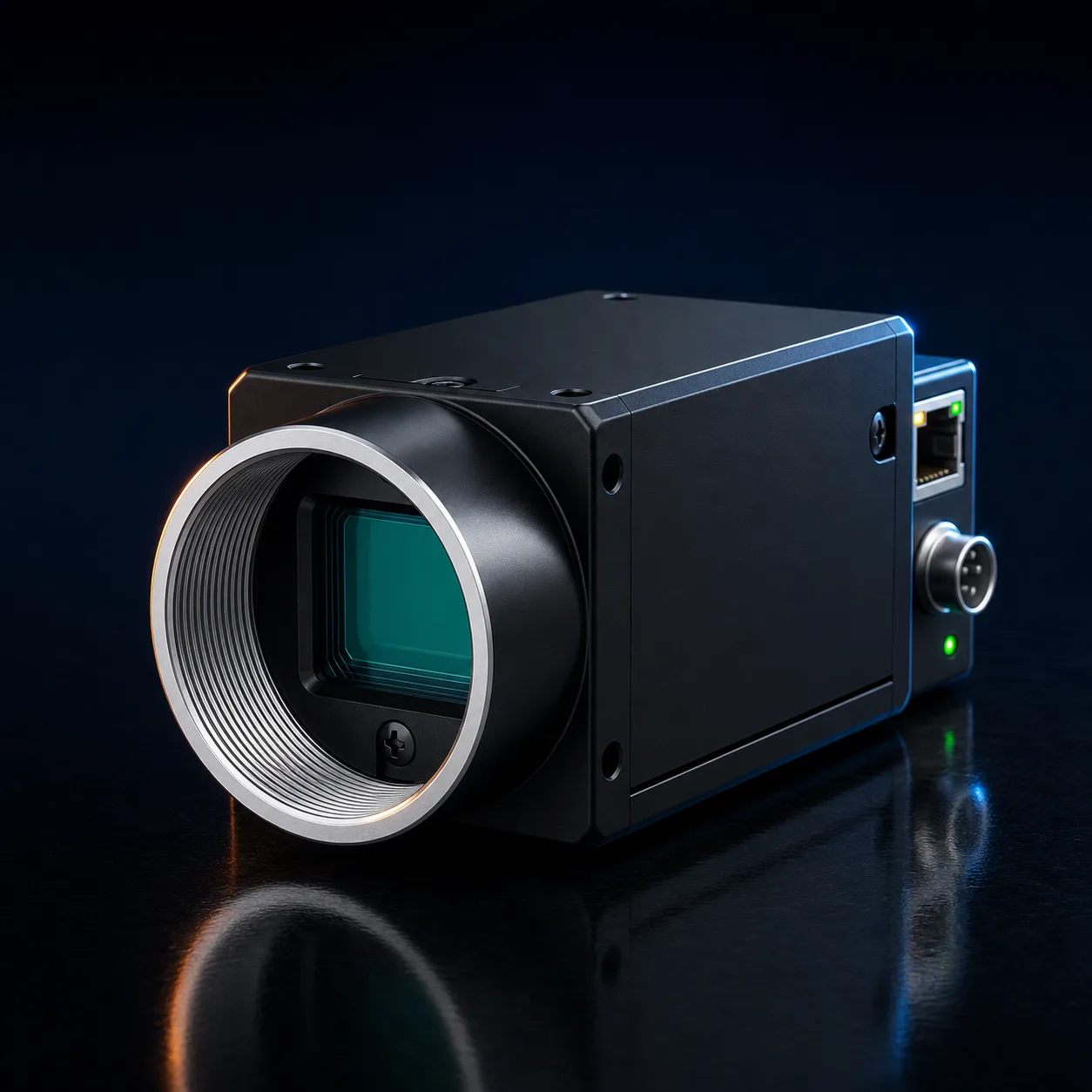
IMX296 imaging, optics and range context
Sony IMX296 global-shutter capture at 1440 × 1080 is the central capability of MV-CS016-10GM. The 1/2.9-inch CMOS sensor has 3.45 µm pixels and reaches 65.2 fps through Gigabit Ethernet. Its 29 mm × 29 mm × 42 mm body uses C-mount, creating a compact 1.6 MP imaging head for networked inspection where edge placement and moving geometry must be recorded together.
The resolution suits presence, position, outline and feature-location work when the target needs more sampling than lower-resolution models provide. A global shutter keeps the image geometry consistent while parts move, and the 65.2 fps ceiling supports repeated inspection on a production cycle. The specified 9–24 V DC input and Gigabit Ethernet form separate power and data paths, while the Hirose connector also carries three I/O lines.
MV-CS016-10GC shares the IMX296 sensor, 1440 × 1080 format, 65.2 fps rate and Gigabit Ethernet, and explicitly provides color output and PoE. MV-CS016-11GM changes to the IMX273 and increases the network rate to 78.2 fps. MV-CS016-10UM combines that IMX273 sensor with USB 3.0 and 249.1 fps in a 30 mm-deep body. Select MV-CS016-10GM for its exact IMX296, GigE and lens-recommendation set.
Specifications
| Sensor type | CMOS, global shutter |
| Sensor model | Sony IMX296 |
| Sensor format | 1/2.9″ |
| Resolution | 1440 × 1080 px |
| Pixel size | 3.45 × 3.45 μm |
| Maximum frame rate | 65.2 fps |
| Data interface | Gigabit Ethernet, compatible with Fast Ethernet |
| Digital I/O | 6-pin Hirose connector; opto-isolated input ×1, opto-isolated output ×1, bi-directional non-isolated I/O ×1 |
| Lens mount | C-mount |
| Power supply | 9 to 24 VDC |
| Power consumption typ | 2.4 W @ 12 VDC |
| Ingress protection | IP40 |
| Operating temperature | -30 to 60 °C |
| Humidity | 20 to 80 % RH |
| Dimensions | 29 × 29 × 42 mm |
| Weight | 100 g |
| Compatibility | GigE Vision V2.0, GenICam |
Selection and applications
IMX296 global-shutter feature capture. Networked inspection at 1440 × 1080. Position and outline checks at 65.2 fps.
| Lenses | MVL-KF1628M-12MP, C-mount, Ø17.6 mm image circle, MVL-KF5024M-25MP, C-mount, Ø19.3 mm image circle |
|---|
Minimum kit: MV-CS016-10GM, a listed C-mount lens, a Gigabit Ethernet cable, and a 9–24 V DC supply.
Nearby in the range: MV-CS016-10GC — Prefer it when color output and PoE are specified with the IMX296.; MV-CS016-11GM — Prefer it for the IMX273 sensor and a 78.2 fps GigE rate.; MV-CS016-10UM — Prefer it for IMX273 capture at 249.1 fps through USB 3.0..
Compatible lens options
- MVL-KF1628M-12MP — C-mount mount; Ø17.6 mm image circle fully covers the 1/2.9 sensor; 12 MP optical class — headroom for this camera
- MVL-KF5024M-25MP — C-mount mount; Ø19.3 mm image circle fully covers the 1/2.9 sensor; 25 MP optical class — headroom for this camera
Cables and accessories for this model
Compatibility per manufacturer data.
- Data cables
- GigE
- I/O & power cables
- Hirose 6-pin IO
- Power
- Power
- Mounting
- Camera mounts
FAQ
Which suggested lenses are listed for MV-CS016-10GM?
The listed C-mount choices are MVL-KF1628M-12MP and MVL-KF5024M-25MP. Their stated image circles are Ø17.6 mm and Ø19.3 mm respectively, both covering the camera's 1/2.9-inch sensor and exceeding its 1440 × 1080 resolution class.
What is the image format of the Sony IMX296 sensor?
The CMOS sensor produces 1440 × 1080 pixels on a 1/2.9-inch format, with a 3.45 µm × 3.45 µm pixel pitch. These values set the sampling grid and the sensor coverage required from the chosen C-mount lens.
How quickly can this Gigabit Ethernet model acquire frames?
The maximum stated frame rate is 65.2 fps at 1440 × 1080. Gigabit Ethernet carries the stream and also supports Fast Ethernet operation, while the camera's global shutter provides geometrically consistent frames of moving parts.
What power connection is specified for MV-CS016-10GM?
The camera accepts 9–24 V DC and has typical consumption of 2.4 W at 12 V DC. Data uses Gigabit Ethernet, and the 6-pin Hirose connector provides the power and I/O side of the installation.
Which external signals can connect through the camera port?
The Hirose port exposes one opto-isolated input, one opto-isolated output and one bidirectional non-isolated I/O. The body is IP40 and specified for operation from –30 °C to 60 °C.
Typical applications
MV-CS016-10GM is a compact GigE area-scan camera for 2D machine-vision systems that require global-shutter capture, C-mount optics and GenICam integration.
Image acquisition
The camera uses a Sony IMX296 CMOS global-shutter sensor with 1440 × 1080 resolution (1.56 MP). The 1/2.9-inch sensor has 3.45 × 3.45 µm pixels, and the listed maximum frame rate is 65.2 fps.
Network and machine I/O
The Gigabit Ethernet interface is compatible with Fast Ethernet. The camera supports GigE Vision V2.0 and GenICam. A 6-pin Hirose connector provides one opto-isolated input, one opto-isolated output and one bidirectional non-isolated I/O.
Power and mechanics
Power input is 9–24 VDC; typical consumption is 2.4 W at 12 VDC. The C-mount housing measures 29 × 29 × 42 mm and weighs 100 g. The listed enclosure rating is IP40, and the working-temperature range is –30 to 60 °C.
Lens selection
The consolidated record identifies MVL-KF1628M-12MP and MVL-KF5024M-25MP as C-mount options that cover the sensor. This establishes basic mount and image-circle compatibility only; focal length must be selected from the required field of view and working distance.
FAQ
Which C-mount focal length and illumination geometry fit the 1/2.9-inch sensor, field of view, and working distance?
The record suggests MVL-KF1628M-12MP and MVL-KF5024M-25MP as sensor-covering C-mount options. It does not establish the application field of view or optical performance, so focal length remains application-specific.
Are the Hirose trigger/I/O levels, 9–24 VDC power, IP40 enclosure, and –30 to 60 °C range suitable for the machine?
The supplied specifications are 9–24 VDC, IP40 and –30 to 60 °C. The 6-pin Hirose connection has one opto-isolated input, one opto-isolated output and one bidirectional non-isolated I/O.