Area camera · CE Series
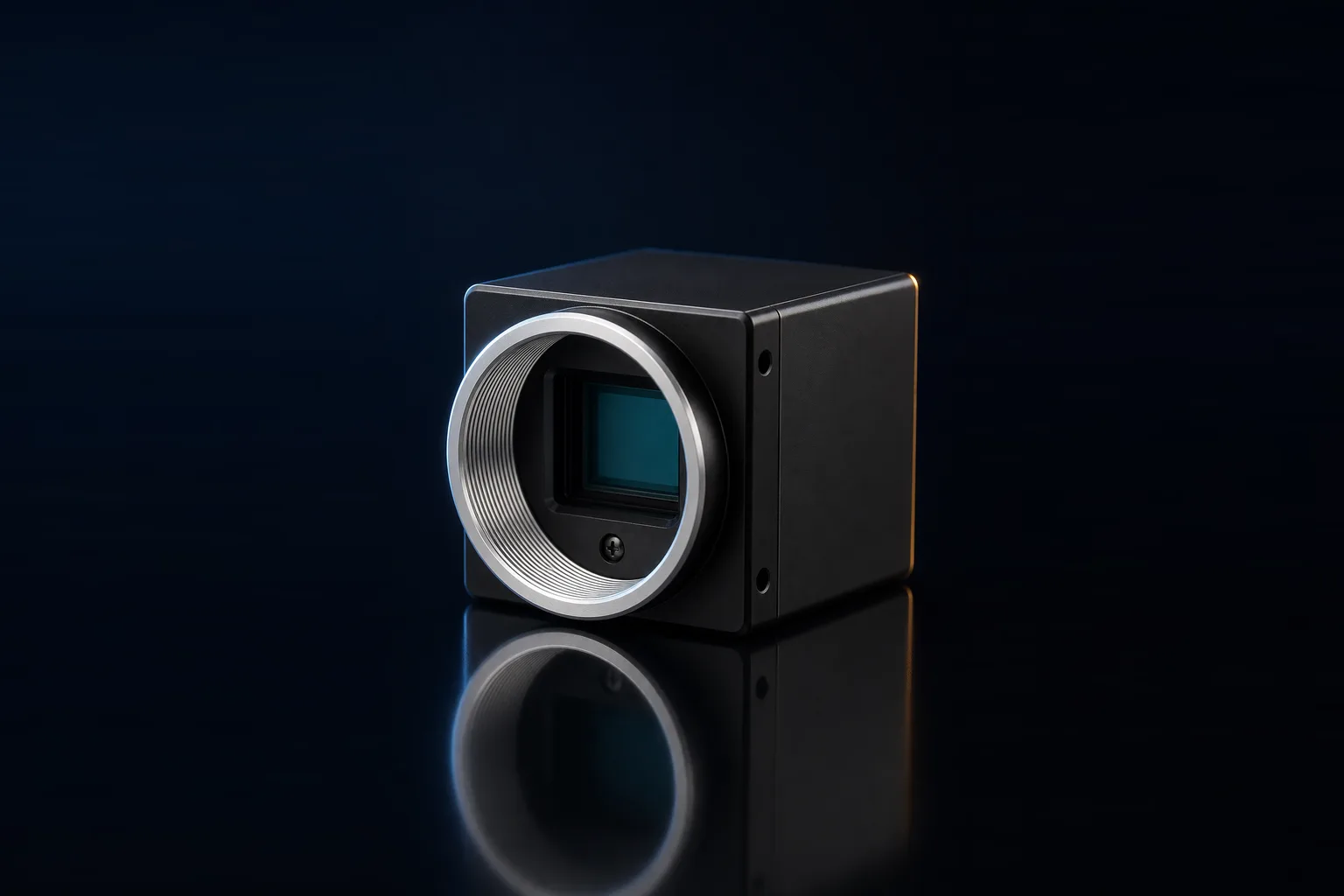
Hikrobot MV-CE120-10UM V2.0
- Warranty
- 36 months
Discontinued
The manufacturer has discontinued this model.
Last buy date at the manufacturer: 2025-12-30.
Manufacturer-listed replacement:
Mono detail with a local USB link
Mono acquisition at 4000 × 3036 and 31.9 fps defines MV-CE120-10UM V2.0. Its 1/1.7-inch Sony IMX226 CMOS sensor uses a rolling shutter and 1.85 µm pixels, coupling fine spatial sampling to a USB3.0 data path. USB2.0 compatibility is retained for host connectivity.
The camera is suited to static dimensional measurement, edge analysis and dense component checks where color is not part of the decision. Exposure begins at 20 µs and extends to 0.5 sec, while the 70.5 dB dynamic range and 0 dB to 27 dB gain range provide camera-side adjustment. USB3.0 power and a 29 mm × 29 mm × 30 mm housing keep the imaging head compact.
MV-CE120-10UC V2.0 is the color counterpart at the same resolution and rate, with a 30 µs minimum exposure and 3.42 W typical draw instead of 3.18 W. MV-CE120-10GM moves to Gigabit Ethernet and PoE, providing 4024 × 3036 at 9.6 fps. MV-CE200-10UM retains mono USB3.0 operation but increases resolution to 5472 × 3648 on a 1-inch sensor at 19.2 fps.
Specifications
| Product type | 12.1 MP USB 3.0 Area Scan Camera |
| Sensor type | CMOS, rolling shutter |
| Sensor model | Sony® IMX226 |
| Sensor format | 1/1.7″ |
| Resolution | 4000 × 3036 |
| Pixel size | 1.85 μm × 1.85 μm |
| Maximum frame rate | 31.9 fps @4000 × 3036 |
| Mono color | Mono |
| Dynamic range | 70.5 dB |
| Exposure time | 20 μs to 0.5 sec |
| Gain | 0 dB to 27 dB |
| Data interface | USB3.0, compatible with USB2.0 |
| Digital I/O | 6-pin Hirose connector provides power and I/O, including opto-isolated input × 1 (Line 0), opto-isolated output × 1(Line 1), and bi-directional non-isolated I/O × 1 (Line 2) |
| Lens mount | C-mount |
| Power supply | 9 VDC to 24 VDC, USB3.0 power supply |
| Power consumption | Typ. 3.18 W @ 5 VDC (USB3.0 provides power supply) |
| Ingress protection | IP30 (under proper lens installation and wiring) |
| Operating temperature | 0 °C to 50 °C (32 °F to 122 °F) |
| Storage temperature | -30 °C to 70 °C (-22 °F to 158 °F) |
| Humidity | 20% to 80% RH, non-condensing |
| Dimensions | 29 mm × 29 mm × 30 mm (1.1″ × 1.1″ × 1.2″) |
| Weight | Approx. 80 g (0.2 lb.) |
| Certification | CE-EMC, KC, UL |
| Compatibility | USB3 Vision, GenICam |
Selection and applications
Mono edge measurement at 4000 × 3036. Dense component checks on indexed parts. Short-exposure USB3.0 acquisition.
Minimum kit: Start with the MV-CE120-10UM V2.0, a C-mount lens, a USB3.0 cable, and either USB3.0 bus power or a 9 VDC to 24 VDC supply through the 6-pin Hirose connection.
Nearby in the range: MV-CE120-10UC V2.0 — Prefer it for color output at the same 4000 × 3036 and 31.9 fps.; MV-CE120-10GM — Prefer it for 4024 × 3036 acquisition over Gigabit Ethernet with PoE at 9.6 fps.; MV-CE200-10UM — Prefer it for 5472 × 3648 mono USB3.0 imaging at 19.2 fps..
Cables and accessories for this model
Compatibility per manufacturer data.
- Data cables
- USB 3.0
- I/O & power cables
- Hirose 6-pin IO
- Power
- Power
- Mounting
- Camera mounts
FAQ
Why choose mono output for detailed edge measurements?
MV-CE120-10UM V2.0 records mono images at 4000 × 3036, keeping the image focused on intensity structure rather than color. Its 31.9 fps maximum supports repeated measurements of static or indexed edges.
How should optics match the IMX226 and its pixel pitch?
The Sony IMX226 has a 1/1.7-inch format and 1.85 µm × 1.85 µm pixels, while the camera accepts C-mount lenses. Select a C-mount optic that covers the sensor and resolves the required detail across 4000 × 3036.
What are the USB and external DC power arrangements?
USB3.0 can supply the camera at a typical 3.18 W from 5 VDC. The external power path accepts 9 VDC to 24 VDC through the 6-pin Hirose connector, which also carries the camera's discrete I/O channels.
Which discrete channels can be wired into the station?
Line 0 is one opto-isolated input, Line 1 is one opto-isolated output and Line 2 is one bidirectional non-isolated I/O. These are available through the 6-pin Hirose connector alongside external power.
How does MV-CE200-10UM change resolution and speed?
MV-CE200-10UM increases mono resolution to 5472 × 3648 and uses a 1-inch Sony IMX183 rolling-shutter sensor at 19.2 fps. MV-CE120-10UM V2.0 provides 4000 × 3036 at the higher 31.9 fps rate on a 1/1.7-inch Sony IMX226.