Vision sensor · SC3000 series
Hikrobot MV-SC3013XC
- Lead time
- from 5 days
- Warranty
- 36 months
Fast color capture with large pixels
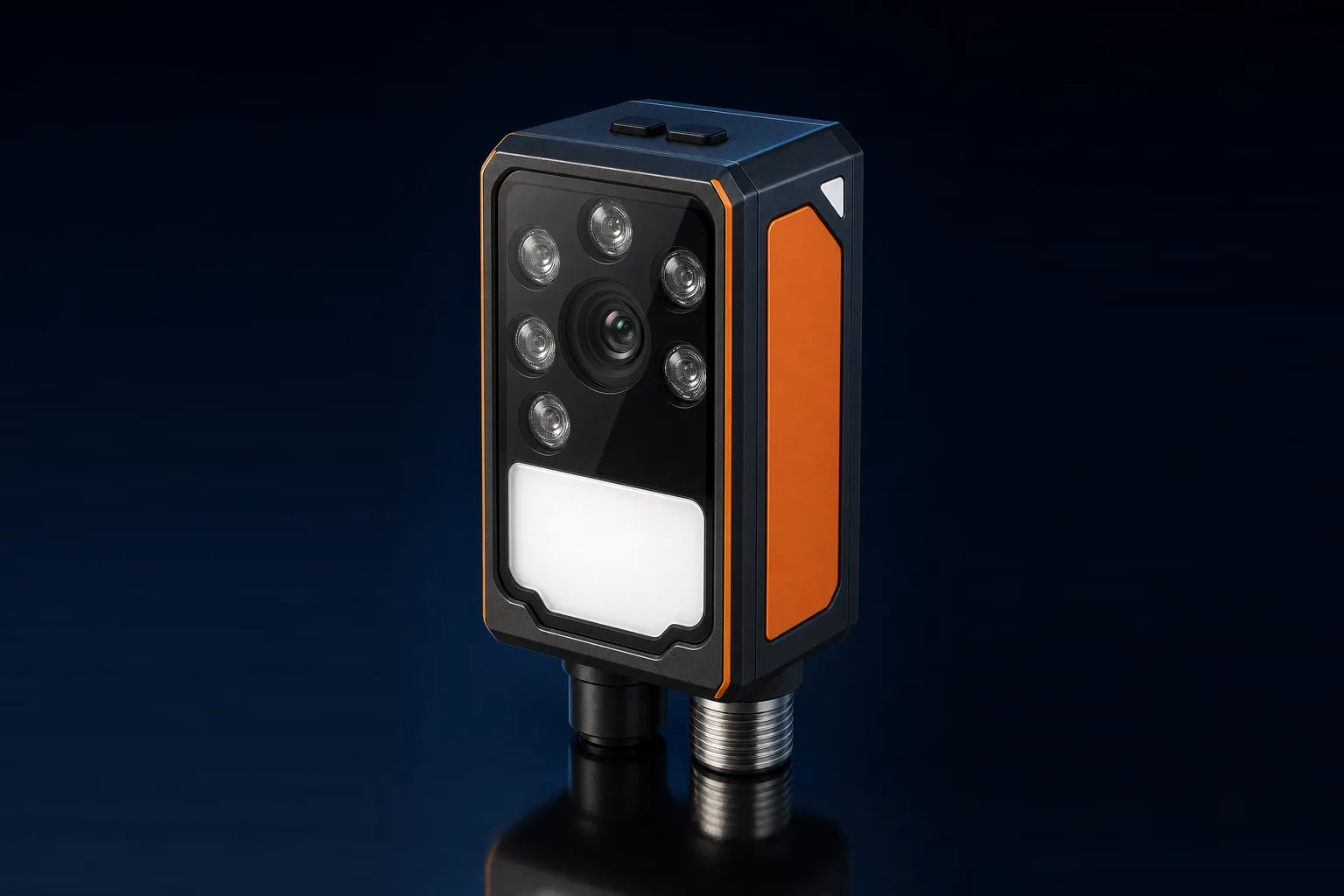
Large 6.9 µm pixels on a 1/1.45-inch sensor distinguish MV-SC3013XC from the denser SC3000X options. The color CMOS imager uses a global shutter, records 1216 × 1024 pixels and reaches 60 fps. Exposure extends from 6 µs to 1 sec. A 16 mm focal length and mechanically autofocused M12 mount work with a white spot source, while red, blue or IR point illumination can be selected for the target.
The sensor combines color tools with OCR, code recognition, object detection, anomaly detection, measurements and coordinate transformation. Global-shutter capture at 60 fps supports indexed or moving parts, while the 6 µs lower exposure boundary provides a route to short captures under adequate light. Three opto-isolated inputs, three opto-isolated outputs and RS-232 share the 12-pin M12 power/I/O connection; network traffic uses Fast Ethernet.
MV-SC3013XM retains 1216 × 1024, 60 fps, 6.9 µm pixels and global-shutter timing but changes to mono. MV-SC3030XC keeps color and global shutter, increases resolution to 2048 × 1536 and reduces the rate to 40 fps. MV-SC3060XC reaches 3200 × 1920 but uses a rolling shutter at 20 fps. Choose MV-SC3013XC for fast color decisions and the larger pixel pitch; move upward when the task needs more spatial samples.
Specifications
| Sensor resolution | 1216×1024 px |
| Maximum frame rate | 60 fps |
| Vision algorithms | Measurement: P2P measurement, P2L measurement, contrast measurement, grayscale …CollapseMeasurement: P2P measurement, P2L measurement, contrast measurement, grayscale size, edge width measurement, width measurement, brightness analysis, L2L angle, color measurement, color size, diameter measurement, line angle / Existence: Spot existence, edge existence, contour existence, pattern existence, circle existence, line existence, anomaly judge, existence detection / Count: Spot count, edge count, contour count, pattern count, learning-based count, color count / Recognition: Multi-object count, code recognition, color contrast, color recognition, category recognition, classification registration, object detection registration, OCR, learning OCR, character horizontal stripe detection / Logic: Calculator, If module, logic judge, format output, condition judge, character comparison, combination judge / Location: Calibration convert, single point alignment, point rectify, point grasp, scale transformation, fixture / Deep learning: DL classification, DL object detection / Defect detection: Anomaly detection / Industry tools: OCR and defect detection |
| Data interface | RS-232; Fast Ethernet |
| Ingress protection | IP67 @ with waterproof lens cover properly installed |
| Code recognition | yes |
| Sensor technology | CMOS |
| Shutter | global |
| Nominal optical sensor format | 1/1.45″ |
| Pixel size | 6.9×6.9 µm |
| Color mode | color |
| Exposure time | 6…1000000 µs |
| Gain | 0…15 dB |
| Pixel format | RGB8, Mono8 |
| Focal length | 16 mm |
| Lens mount | M12 |
| Focus mode | auto |
| Lens cap | polarizing cap, diffuser cap, transparent cap |
| Aiming system | LED |
| Integrated light color | white |
| Stored solution count | ≤32 (max.) |
| Protocol compatibility | RS-232, TCP, UDP, FTP, PROFINET, Modbus, EtherNet/IP, MELSEC, SLMP, FINS, Keyence KV |
| Client software | SCMVS |
| Digital I/O lines | 3 inputs, opto-isolated, lines 0, 1, 2; 3 outputs, opto-isolated, lines 3, 4, 5 |
| Digital input count | 3 |
| Digital output count | 3 |
| Output signal type | opto-isolated |
| Digital I/O connector | M12 12-pin |
| Power supply | 24 V |
| Power consumption | 7 W (average) @ DC, built-in light on, supply voltage 24 V; 22 W (max.) @ DC, built-in light on, supply voltage 24 V |
| Working temperature | 0…50 °C |
| Storage temperature | -30…70 °C |
| Humidity | 20…95 % @ non-condensing |
| Shock resistance: acceleration | 30 g |
| Vibration peak to peak amplitude | 1.5 mm |
| Vibration resistance: frequency | 10…55 Hz |
| Dimensions | 80.1×43×44.3 mm (straight configuration); 58.5×43×65.4 mm (right-angle configuration) |
| Weight | 190 g (approx.) |
| Certification | CE, KC |
| Top trigger button | yes |
| Aiming emitter count | 1 |
| Integrated light optional color | red, blue, IR |
| OK/NG status indicator | 360° visual indication |
| Port inventory | Ethernet Fast Ethernet (100 Mbit/s) (data), RS-232 (serial) |
| Shock count per direction | 500 |
| Shock pulse duration | 11 ms |
| Shock pulse waveform | half-sine |
| Shock resistance: directions | 6 |
| Solution export | yes |
| Solution import | yes |
| Transmission speed | 100 Mbit/s |
| Vibration duration per axis | 2 h |
Documents
Selection and applications
Fast color feature recognition. Global-shutter moving-part checks. Large-pixel code and OCR capture.
Minimum kit: Start with MV-SC3013XC, its mechanically autofocused 16 mm M12 optical assembly and selected spot light, a Fast Ethernet cable, a 12-pin M12 I/O cable and a 24 V DC supply.
Nearby in the range: MV-SC3013XM — Choose it for mono processing with the same 1216 × 1024 and 60 fps base; MV-SC3030XC — Prefer it when color resolution must rise to 2048 × 1536 at 40 fps; MV-SC3060XC — Use it for 3200 × 1920 color sampling when a 20 fps rolling shutter suits the scene.
Cables and accessories for this model
Compatibility per manufacturer data.
- Data cables
- ID data cablesID Ethernet, M12 8-pinGigE
- I/O & power cables
- ID power, M12 12-pin
- Power
- Power
- Optics
- M12 lenses
- Lighting
- SC lightingID/SC lighting
- Mounting
- Camera mounts
- Protection
- Covers & filters
FAQ
What does the 6.9 µm pixel pitch mean for MV-SC3013XC selection?
The color imager combines 6.9 µm pixels with a 1/1.45-inch format and 1216 × 1024 resolution. This is the largest pixel pitch among the SC3000X models compared here, while the device still reaches 60 fps.
How quickly can MV-SC3013XC expose and acquire a frame?
Full-frame acquisition reaches 60 fps and uses a global shutter. Exposure can be set from 6 µs to 1 sec, providing both a short lower limit for motion capture and a long upper limit for static, lower-signal scenes.
Which color-oriented tools are included in MV-SC3013XC?
The unit lists color measurement, color size, color count, color contrast and color recognition. It also includes code recognition, OCR, object detection, anomaly detection, coordinate conversion and fixture functions.
What lens, light and aiming arrangement does MV-SC3013XC use?
The sensor has a 16 mm focal length, M12 mount and mechanical autofocus. A white spot light is standard, red, blue or IR point lights are optional, and one LED supplies the aiming reference.
How are MV-SC3013XC power and trigger connections organized?
The unit takes 24 V DC through a 12-pin M12 connection that also supplies three opto-isolated inputs, three opto-isolated outputs and RS-232. Fast Ethernet handles communication, and the top button can trigger the device.