Vision sensor · SC3000 series
Hikrobot MV-SC3060XC
- Warranty
- 36 months
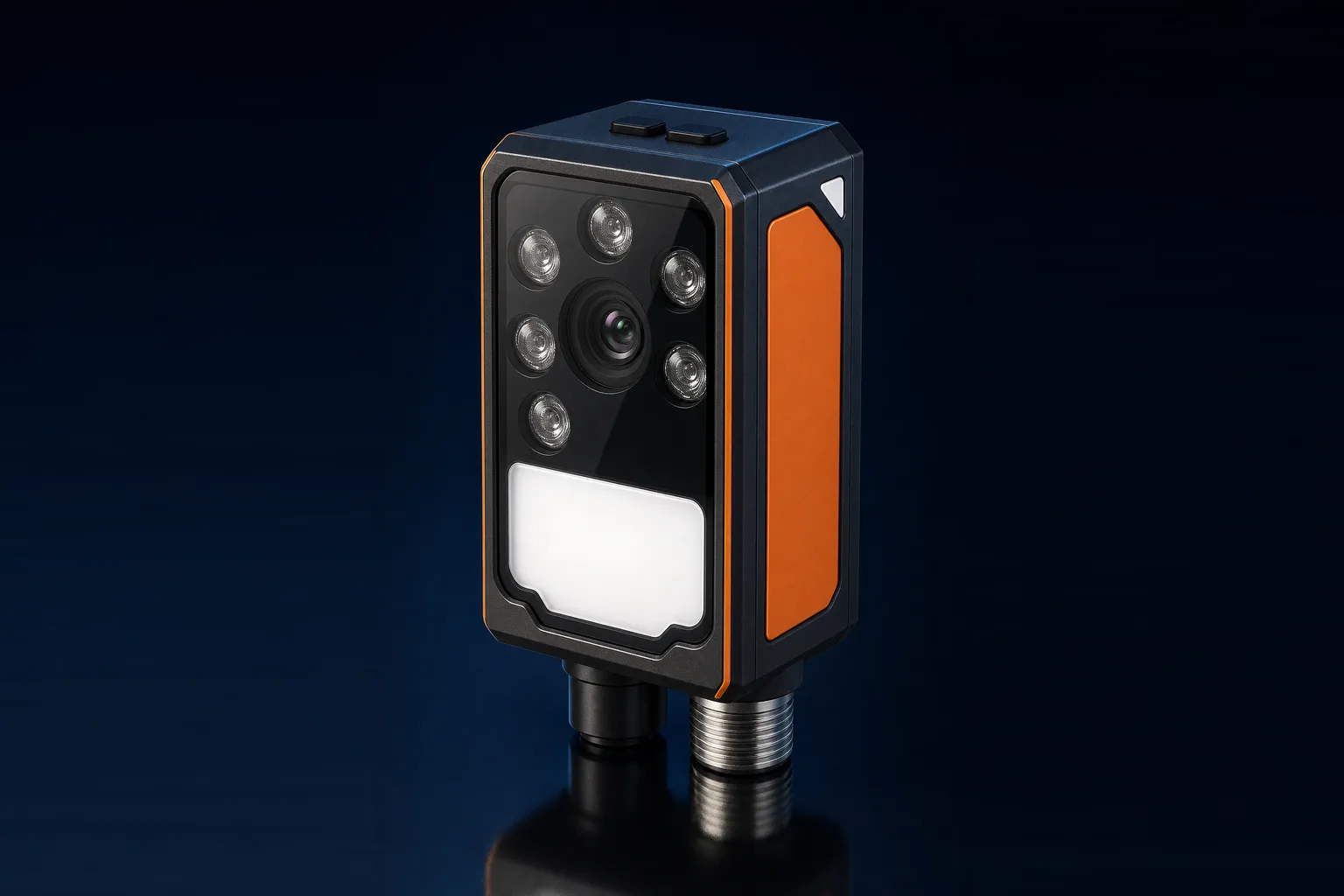
Maximum color grid for controlled scenes
The largest color pixel grid in this sensor batch belongs to MV-SC3060XC: 3200 × 1920 at up to 20 fps. Its 1/2.4-inch CMOS imager has 2 µm pixels and a rolling shutter, with exposure from 540 µs to 200 ms. This combination favours detailed scenes with controlled or stationary presentation. The M12 mount supports mechanical focus, and focused white light is standard with red, blue, IR or UV alternatives.
Color tools, OCR, code recognition, object detection, classification, anomaly detection, measurement and coordinate conversion support detailed presence, surface and identification work. The 12-pin M12 connection carries three isolated inputs, three isolated outputs and RS-232 alongside 12–24 V DC power. Fast Ethernet provides the network path. Straight and right-angle body layouts allow the same sensor to be fitted around different cable directions.
MV-SC3060XM keeps 3200 × 1920, 20 fps and rolling-shutter acquisition but changes to mono. MV-SC3050XC is the global-shutter color alternative at 2432 × 2048 and 40 fps. MV-SC3030XC reduces color resolution to 2048 × 1536 while also reaching 40 fps. Select MV-SC3060XC when the 6.1 MP-class color grid is the main requirement and scene motion suits rolling exposure; choose MV-SC3050XC for faster global capture.
Available versions
Same device, different configuration. We match the part number to your working distance and field of view.
| Part number | PN | Lens | |
|---|---|---|---|
| MV-SC3060XC-08M-WBN | 308601286 | 8 mm | |
| MV-SC3060XC-12M-WBN | 308601288 | 12 mm | |
| MV-SC3060XC-16M-WBN | 308601290 | 16 mm |
Specifications
| Sensor type | CMOS, rolling shutter |
| Sensor format | 1/2.4″ |
| Resolution | 3200 × 1920 |
| Pixel size | 2 µm × 2 µm |
| Maximum frame rate | 20 fps |
| Mono color | Color |
| Exposure time | 540 μs to 200 ms |
| Gain | 0 dB to 33 dB |
| Data interface | Fast Ethernet (100 Mbit/s) |
| Digital I/O | 12-pin M12 connector provides power and I/O, including isolated input (Line 0/1/2) × 3, isolated output (Line 3/4/5) × 3, RS-232 × 1. Supports device triggering via pressing top trigger button |
| Lens mount | M12-mount, mechanical focus supported |
| Light source | Focused white light by default. Red, blue, IR, or UV light is optional. |
| Storage | Supports importing and exporting solutions, up to 32 solutions can be stored. |
| Power supply | 12 VDC to 24 VDC |
| Power consumption | Avg.: 6.6 W @ 24 VDC (light source enabled); Max.: 22 W @ 24 VDC (light source enabled) |
| Ingress protection | IP67 (under proper installation of lens and wiring) |
| Operating temperature | 0 °C to 50 °C (32 °F to 122 °F) |
| Storage temperature | –30 °C to 70 °C (–22 °F to 158 °F) |
| Humidity | 20% RH to 95% RH (no condensation) |
| Dimensions | Straight angle: 80.1 mm × 43 mm × 43.5 mm (3.2″ × 1.7″ × 1.7″); Right angle: 58.5 mm × 43 mm × 64.6 mm (2.3″ × 1.7″ × 2.5″) |
| Weight | Approx. 190 g (0.4 lb.) |
| Certification | CE-EMC,KC |
| Algorithms | Measurement: P2P measurement, P2L measurement, contrast measurement, grayscale size, edge width measurement, width measurement, brightness average value, L2L angle, color measurement, color size, diameter measurement, line angle; Existence: Spot existence, edge existence, contour existence, pattern existence, circle existence, line existence, anomaly judge, presence detection; Count: Spot count, edge count, contour count, pattern count, learning-based count, color count; Recognition: Multi-object count, code recognition, color contrast, color recognition, category recognition, classification registration, object detection, OCR; Logic: Calculator, if module, logic judge, format output, condition judge, character comparison, combination judge; Location: Calibration convert, single point alignment, point rectify, point grasp, scale transformation, fixture; Deep learning: Classification, object detection; Defect detection: Exception detection |
| Software | SCMVS |
| Communication protocol | RS-232, TCP, UDP, FTP, PROFINET, Modbus, EtherNet/IP, MELSEC/SLMP, FINS, Keyence KV |
| Aiming system | 2 LEDs |
| Indicator | 360° visual indicator |
Selection and applications
High-resolution color surface checks. Controlled-motion OCR inspection. UV-assisted feature evaluation.
Minimum kit: To commission MV-SC3060XC, use a mechanically focused M12 lens and selected built-in light, a Fast Ethernet connection, a 12-pin M12 I/O cable and a 12–24 V DC supply.
Nearby in the range: MV-SC3060XM — Choose it for mono 3200 × 1920 rolling-shutter capture at the same 20 fps.; MV-SC3050XC — Prefer it for color global-shutter acquisition at 2432 × 2048 and 40 fps.; MV-SC3030XC — Use it when 2048 × 1536 color detail is sufficient and 40 fps is needed..
Cables and accessories for this model
Compatibility per manufacturer data.
- Data cables
- ID data cablesID Ethernet, M12 8-pinGigE
- I/O & power cables
- ID power, M12 12-pin
- Power
- Power
- Optics
- M12 lenses
- Lighting
- SC lightingID/SC lighting
- Mounting
- Camera mounts
- Protection
- Covers & filters
FAQ
What resolution and shutter type distinguish MV-SC3060XC?
The color CMOS sensor records 3200 × 1920 pixels at up to 20 fps. It uses a rolling shutter, a 1/2.4-inch optical format and 2 µm pixels, with exposure adjustable from 540 µs to 200 ms.
Which target motion is appropriate for the MV-SC3060XC shutter?
MV-SC3060XC uses a rolling shutter rather than the global shutters of the lower-resolution SC3000X neighbours. Its detailed 3200 × 1920 inspections should therefore use controlled target motion and be verified at the actual 540 µs to 200 ms exposure.
What color and defect functions can MV-SC3060XC execute?
The processing set includes color measurement, color size, color count, color contrast and color recognition, plus OCR, code recognition, object detection, classification and exception detection. Geometry and location tools are also listed.
How are focus, light and aiming handled on MV-SC3060XC?
An M12 mount supports mechanical focus. Focused white illumination is standard, while red, blue, IR or UV light is optional. Two LEDs provide aiming, and a 360° visual indicator presents sensor status.
What supply and sealing rules apply to MV-SC3060XC?
The supply range is 12–24 V DC. At 24 V DC with the light enabled, consumption averages 6.6 W and reaches 22 W. IP67 protection applies when the lens and wiring are installed correctly, across a 0 °C to 50 °C working range.