Area camera · CT series
Hikrobot MV-CT2MG0020/G
- Warranty
- 36 months
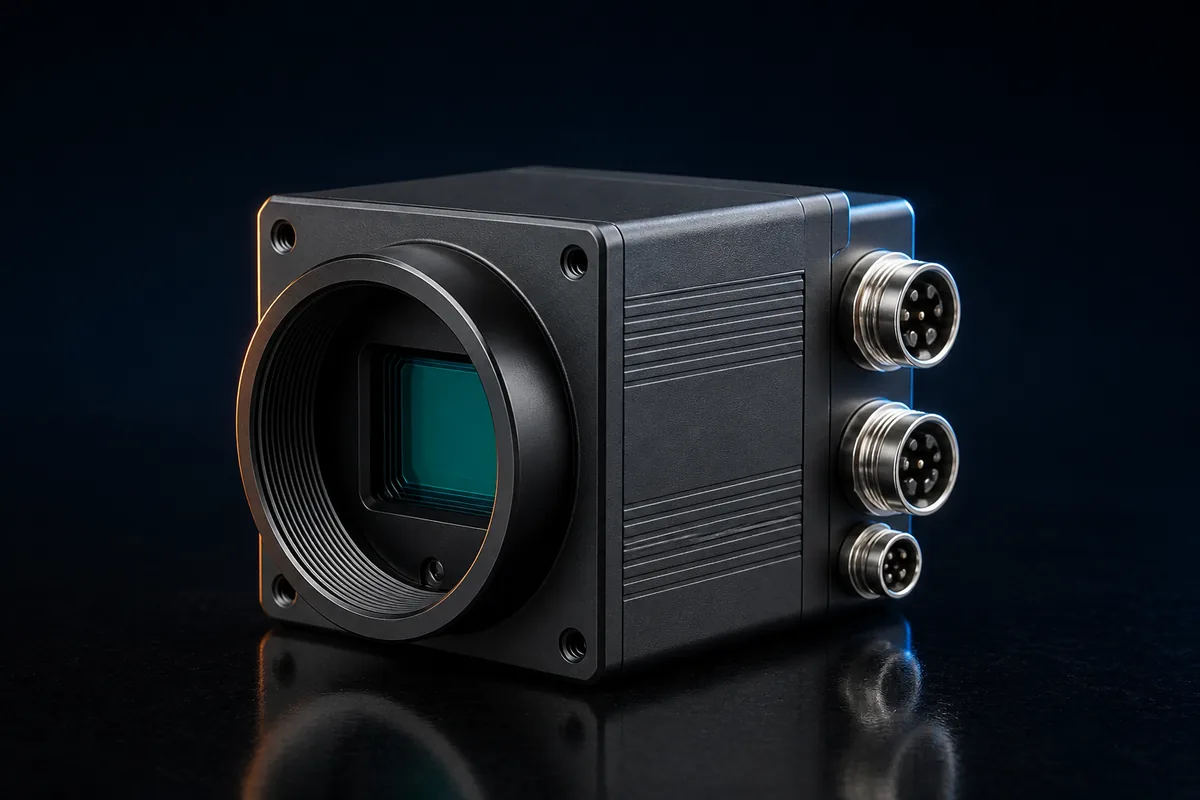
MAX version: what you get
This camera comes in three versions on the same sensor — they differ in protection, connectors and integrated optics:
- 8-pin M12 X-Code waterproof aviation connector
- IP67 (under proper lens and lens cap installation and wiring)
- 8-pin M12 A-Code waterproof aviation connector
- Ready for lens and light integration: control is on board, while the lens and the light are ordered separately (/16LC/WN versions ship with them)
Same sensor, other versions:
Same version, other sensor variant:
Where this 2 MP model fits
A 1624 × 1240 frame at 177.3 fps gives MV-CT2MG0020/G a balance of 2 MP sampling and high event density. The monochrome Stacked BSI CMOS sensor has a global shutter, 3.45 × 3.45 µm pixels and a 1/2.53 in optical format. Full-rate operation is stated for Mono 8 with lossless compression enabled over Gigabit Ethernet, and exposure spans 23 µs to 10 sec.
Fast part sorting, label-position checks and edge measurement on moving material follow directly from the global exposure and 177.3 fps ceiling. Trigger Width and Trigger Controlled modes synchronize the acquisition window with external machinery. The 42 mm × 42 mm × 43 mm body takes C-mount optics, supports PoE or 9 V DC to 24 V DC input, and carries an IP67 rating with correct lens, cap and cable installation.
MV-CT2MG0016/G is the speed-led neighbor: it reaches 180 fps but records 1440 × 1080. MV-CT2MG0032/G increases the image to 2048 × 1536 and the sensor to 1/1.8 in, while reducing the rate to 77.5 fps. MV-CT2MG0020/G belongs between them when the process needs more samples than the 1.6 MP model but cannot accept the larger rate reduction of the 3.2 MP camera.
Specifications
| Order code | MV-CT2MG0020/G/NN/NN |
| Product type | 2 MP GigE Area Scan Camera |
| Sensor type | CMOS, global shutter |
| Sensor model | Stacked BSI |
| Sensor format | 1/2.53″ |
| Resolution | 1624 × 1240 px |
| Pixel size | 3.45 × 3.45 μm |
| Maximum frame rate | 177.3 fps @ 1624 × 1240 Mono 8 (lossless compression mode enabled) |
| Mono color | Mono |
| Pixel format | Mono 8/10/10Packed/12/12Packed |
| Binning | Supports 1 × 1, 2 × 2, 4 × 4 |
| Decimation | Supports 1 × 1, 2 × 2, 4 × 4 |
| Reverse image | Supports horizontal and vertical reverse image output |
| Dynamic range | 68.5 dB |
| Exposure time | 23 μs to 10 sec |
| Exposure mode | Off/Once/Continuous exposure mode, supports Trigger Width and Trigger Controlled |
| Gain | 0 dB to 24 dB |
| SNR | 44.1 dB |
| Data interface | Gigabit Ethernet (1000 Mbit/s), compatible with Fast Ethernet (100 Mbit/s) |
| Digital I/O | 8-pin M8 A-Code aviation connector provides power and I/O, including opto-isolated input × 1 (Line 0), opto-isolated output × 1 (Line 1), bi-directional non-isolated I/O × 1 (Line 2). |
| Lens mount | C-mount |
| Operating system | 32/64-bit Windows 7/10, 64-bit Windows 11, 32/64-bit Linux |
| Power supply | 9 VDC to 24 VDC, supports PoE |
| Power consumption typ | Typ. 1.6 W @ 24 VDC (fast heat balance not enabled and external device not be controlled) |
| Ingress protection | IP67 (under proper lens and lens cap installation and wiring) |
| Operating temperature | –30 °C to 60 °C (–22 °F to 140 °F) |
| Storage temperature | –30 °C to 80 °C (–22 °F to 176 °F) |
| Humidity | 20% RH to 95% RH (no condensation) |
| Dimensions | 42 mm × 42 mm × 43 mm (1.7″ × 1.7″ × 1.7″) |
| Weight | Approx. 120 g (0.3 lb.) |
| Certification | CE, RoHS, KC |
| Compatibility | GigE Vision V2.0, GenICam |
| Data interface connector | 8-pin M12 X-Code waterproof aviation connector |
| Control interface | 8-pin M12 A-Code waterproof aviation connector |
| Client software | MVS or third-party software meeting with GigE Vision Protocol |
Selection and applications
Fast moving-part sorting. Triggered label-position verification. Monochrome edge measurement.
| Lenses | MVL-KF1628M-12MP, MVL-KF5024M-25MP |
|---|
Minimum kit: MV-CT2MG0020/G, a C-mount lens, a Gigabit Ethernet cable with an 8-pin M12 X-Code camera connection, and PoE or a 9–24 V DC power source.
Nearby in the range: MV-CT2MG0016/G — Prefer it when 1440 × 1080 is enough and 180 fps is required.; MV-CT2MG0032/G — Prefer it when 2048 × 1536 detail matters more than the 77.5 fps ceiling..
Compatible lens options
- MVL-KF1628M-12MP — C-mount mount; Ø17.6 mm image circle fully covers the 1/2.53 sensor; 12 MP optical class — headroom for this camera
- MVL-KF5024M-25MP — C-mount mount; Ø19.3 mm image circle fully covers the 1/2.53 sensor; 25 MP optical class — headroom for this camera
Cables and accessories for this model
Compatibility per manufacturer data.
- Data cables
- CT: M12 EthernetGigE
- I/O & power cables
- CT: power and I/O
- Power
- Power
- Optics
- Liquid lens
- Mounting
- Camera mounts
- Protection
- CT: IP67 covers
FAQ
Which listed lenses cover the 1/2.53 in sensor on MV-CT2MG0020/G?
The listed choices are MVL-KF1628M-12MP and MVL-KF5024M-25MP. Each has a C-mount and an image circle that covers the 1/2.53 in sensor. Both lens classes exceed the camera's 1624 × 1240 resolution, leaving focal length to be selected from scene width and working distance.
How are network data, camera power and discrete I/O connected?
Image data uses the 8-pin M12 X-Code Gigabit Ethernet connector. The camera may be powered by PoE or from 9 V DC to 24 V DC. An 8-pin M8 A-Code connection provides power and I/O, including one opto-isolated input, one opto-isolated output and one bidirectional non-isolated line.
Under which image format does MV-CT2MG0020/G deliver 177.3 fps?
The stated maximum is 177.3 fps at the full 1624 × 1240 resolution in Mono 8, with lossless compression enabled. Other available pixel formats are Mono 10, Mono 10 Packed, Mono 12 and Mono 12 Packed; their payloads differ, so stream planning should follow the selected format.
Can this camera time exposure from an external trigger pulse?
Yes. Besides Off, Once and Continuous exposure operation, MV-CT2MG0020/G supports Trigger Width and Trigger Controlled modes. The global shutter and 23 µs minimum exposure provide a basis for capturing moving subjects at a defined point in the process cycle.
What image-reduction modes are available before transmission?
The camera supports binning at 1 × 1, 2 × 2 and 4 × 4, with the same factors available for decimation. Horizontal and vertical reverse image output is also supported. These functions permit the delivered image structure to be adapted without changing the 1624 × 1240 native sensor format.