Area camera · CT series
Hikrobot MV-CT2MG0120/G
- Lead time
- from 5 days
- Warranty
- 36 months
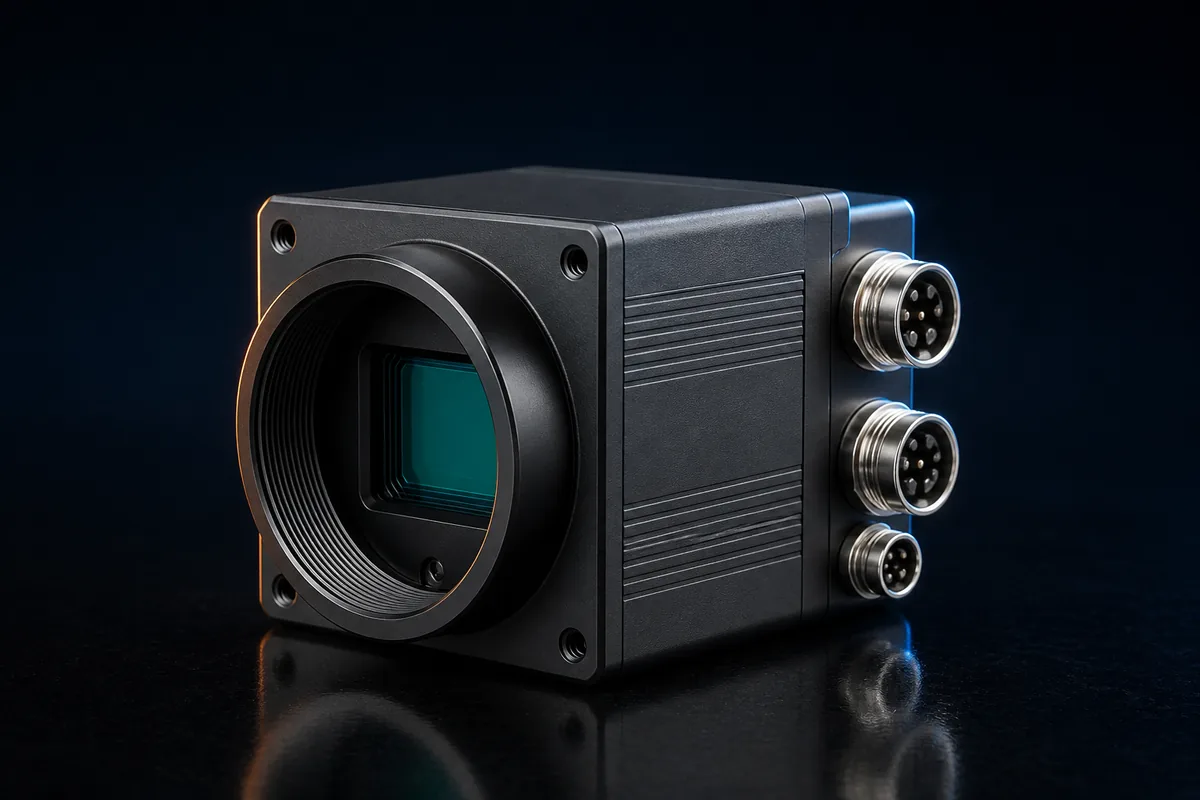
MAX version: what you get
Same sensor, other versions:
Same version, other sensor variant:
12 MP tasks and range choices
Twelve-megapixel capture with a global shutter gives MV-CT2MG0120/G its engineering role. A 1.1 in Stacked BSI CMOS sensor with 3.45 × 3.45 µm pixels produces 4096 × 3000 monochrome frames at up to 23.9 fps in Mono 8 with lossless compression. Gigabit Ethernet carries the output, and UltraShort plus standard exposure modes together cover 10 µs through 10 sec.
The 4096 × 3000 image supports large-field measurement, inspection of several features in one view and defect detection requiring dense spatial samples. Global exposure avoids line-sequential geometry on moving parts, while Trigger Width and Trigger Controlled operation tie acquisition to a machine event. A C-mount lens must cover the 1.1 in sensor; PoE and an IP67 body support production-line installation.
MV-CT2MG0089/G keeps 4096 horizontal samples but uses 2160 vertical pixels and reaches 32.5 fps. MV-CT2MG0120/R records 4096 × 3024 with 2 × 2 µm pixels, but its rolling shutter runs at 18.4 fps. MV-CT2MU0120/G matches the 4096 × 3000 global-shutter format through USB 3.0 at 31 fps. Choose MV-CT2MG0120/G when the network link and PoE are part of the system architecture.
Specifications
| Shutter | global |
| Nominal optical sensor format | 1.1″ |
| Sensor resolution | 4096×3000 px |
| Maximum frame rate | 9.9 fps @ Mono8, resolution 4096×3000 px; 23.9 fps @ lossless compression, Mono8, resolution 4096×3000 px |
| Color mode | mono |
| Lens mount | C-mount |
| Data interface | GigE (Fast Ethernet compatible) |
| Sensor technology | CMOS, stacked BSI |
| Pixel size | 3.45×3.45 µm |
| Dynamic range | 67.2 dB |
| Signal-to-noise ratio | 44.2 dB |
| Exposure time | 10…19 µs @ ultra-short exposure mode; 20…10000000 µs @ standard exposure mode |
| Auto exposure | Off, Once, Continuous, trigger width, trigger controlled |
| Gain | 0…12 dB |
| Pixel format | Mono8, Mono10, Mono10Packed, Mono12, Mono12Packed |
| Binning | 1x1, 2x2, 4x4 |
| Decimation | 1x1, 2x2, 4x4 |
| Protocol compatibility | GigE Vision, GenICam |
| Communication protocol versions | GigE Vision 2.0 |
| Third party software protocol | GigE Vision |
| Client software | MVS |
| Operating systems | Windows 7 (32/64-bit), Windows 10 (32/64-bit), Windows 11 (64-bit), Linux (32/64-bit) |
| Digital I/O lines | 1 input, opto-isolated, line 0; 1 output, opto-isolated, line 1; 1 bidirectional line, non-isolated, line 2 |
| Power supply | 9…24 V |
| Power delivery | PoE |
| PoE support | yes |
| Power consumption | 1.9 W (typical) @ DC, not controlling external device, fast heat balance off, supply voltage 24 V |
| Ingress protection | IP67 @ with lens, lens cap and cables properly installed |
| Working temperature | -30…60 °C |
| Storage temperature | -30…80 °C |
| Humidity | 20…95 % @ non-condensing |
| Dimensions | 42×42×43 mm |
| Weight | 120 g (approx.) |
| Certification | CE, RoHS, KC |
| Reverse image | horizontal, vertical |
Documents
Selection and applications
Large-field dimensional measurement. Global-shutter defect inspection. Multi-feature monochrome capture.
| Lenses | MVL-KF3524M-25MP, MVL-KF5024M-25MP |
|---|
Minimum kit: MV-CT2MG0120/G, a C-mount lens covering the 1.1 in sensor, an 8-pin M12 X-Code Gigabit Ethernet cable, and PoE or 9–24 V DC power.
Nearby in the range: MV-CT2MG0089/G — Choose 4096 × 2160 capture for a higher 32.5 fps ceiling; MV-CT2MG0120/R — Choose 4096 × 3024 and 2 × 2 µm pixels for stationary, stopped-index or strobe-controlled scenes; MV-CT2MU0120/G — Choose USB 3.0 for 4096 × 3000 output at 31 fps.
Compatible lens options
- MVL-KF3524M-25MP — C-mount mount; Ø19.3 mm image circle fully covers the 1.1″ sensor; 25 MP optical class — headroom for this camera
- MVL-KF5024M-25MP — C-mount mount; Ø19.3 mm image circle fully covers the 1.1″ sensor; 25 MP optical class — headroom for this camera
Cables and accessories for this model
Compatibility per manufacturer data.
- Data cables
- CT: M12 EthernetGigE
- I/O & power cables
- CT: power and I/O
- Power
- Power
- Optics
- Liquid lens
- Mounting
- Camera mounts
- Protection
- CT: IP67 covers
FAQ
Which optics are suggested for the 1.1 in MV-CT2MG0120/G sensor?
MVL-KF3524M-25MP and MVL-KF5024M-25MP are suggested. Both are C-mount, 25 MP-class lenses with Ø19.3 mm image circles that cover the 1.1 in sensor. Their different focal lengths allow field of view to be selected while retaining coverage for the 4096 × 3000 format.
How do UltraShort and standard exposure ranges divide?
UltraShort operation covers 10 µs to 19 µs. Standard exposure begins at 20 µs and continues to 10 sec. The camera uses a global shutter in both ranges and supports Trigger Width and Trigger Controlled operation for synchronized 4096 × 3000 acquisition.
What data rate and connector does the 12 MP GigE version use?
The data path is 1 Gbit/s Gigabit Ethernet through an 8-pin M12 X-Code connector, with Fast Ethernet compatibility. Its 23.9 fps maximum applies at 4096 × 3000 in Mono 8 with lossless compression enabled, so pixel format and link load should be planned together.
What are the power requirements for MV-CT2MG0120/G?
The camera supports PoE and an external supply from 9 V DC to 24 V DC. Typical consumption is 1.9 W at 24 V DC under the stated condition. An 8-pin M8 A-Code connection carries power and I/O, including one isolated input, one isolated output and one bidirectional line.
How does the rolling-shutter 12 MP variant differ?
MV-CT2MG0120/R uses a 4096 × 3024 rolling-shutter sensor with 2 × 2 µm pixels and reaches 18.4 fps. MV-CT2MG0120/G uses a 4096 × 3000 global-shutter sensor with 3.45 × 3.45 µm pixels and reaches 23.9 fps. The distinction affects both motion rendering and optical sampling.